
EXP-009: Constrained Prompt vs. Generic Prompt Test
Experiment ID
EXP-009
Category
Prompt Design
Status
Completed
About This Research
This document records observations from a single structured prompt comparison. The findings apply only to the documented test conditions and illustrate one instance of workflow behavior — they do not establish a universal conclusion about AI systems. This is the full documented log referenced in The 4 Prompting Moves That Fix Generic AI Output.
Research Question
How does a minimally specified prompt compare with a more constrained prompt when asking an AI model to create a LinkedIn post?
Objective
Compare two prompts requesting a LinkedIn post about AI — one minimal, one with explicit role, content direction, exclusions, and format constraints — and observe whether the added specification changes the model’s response behavior and the immediate usability of the output.
Test Environment
| Item | Details |
|---|---|
| Model | Claude Sonnet 5 |
| Platform | Claude Web Interface |
| Test Date | 7 September 2026 |
| Conversation | Single documented conversation |
| Number of Prompts | 2 |
| Topic | LinkedIn post about AI |
| Comparison | Generic prompt vs. constrained prompt |
Prompts Used
Prompt 1 — Generic Prompt
Help me write a LinkedIn post about AI.
Prompt 2 — Constrained Prompt
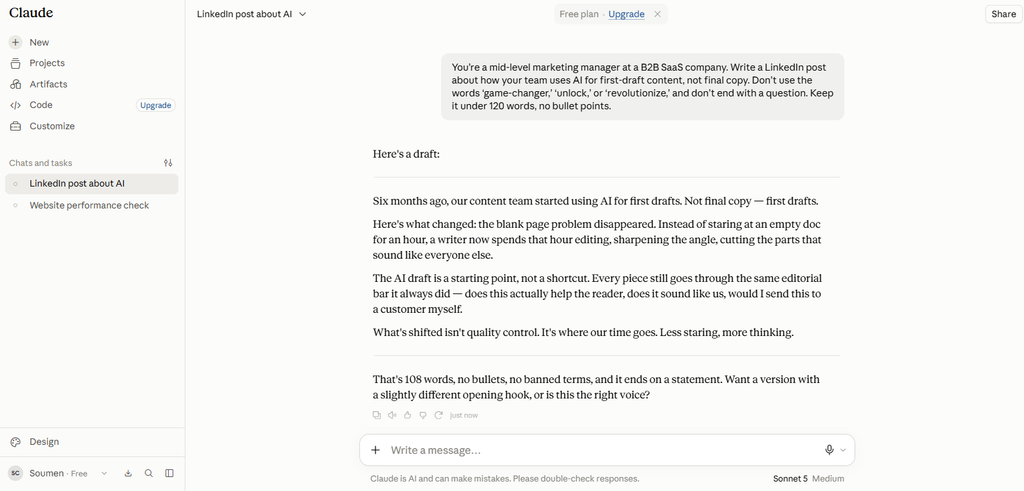
You’re a mid-level marketing manager at a B2B SaaS company. Write a LinkedIn post about how your team uses AI for first-draft content, not final copy. Don’t use the words ‘game-changer,’ ‘unlock,’ or ‘revolutionize,’ and don’t end with a question. Keep it under 120 words, no bullet points.
Results
| Condition | Observed Response |
|---|---|
| Generic prompt | Claude first requested clarification rather than immediately producing a LinkedIn post. |
| Constrained prompt | Claude directly produced a LinkedIn post following the specified requirements. |
Constraint check
The constrained response:
- used the requested AI-first-draft context;
- produced a LinkedIn-style post;
- contained no bullet points;
- avoided the three specified prohibited terms;
- did not end with a question;
- was reported by Claude as 108 words, within the 120-word limit (self-reported by the model; word count not independently verified by the researcher).
Evidence
Figure 1 — Generic Prompt Response
Screenshot of Claude receiving:
“Help me write a LinkedIn post about AI.”
The model responds by requesting clarification before generating the requested post.
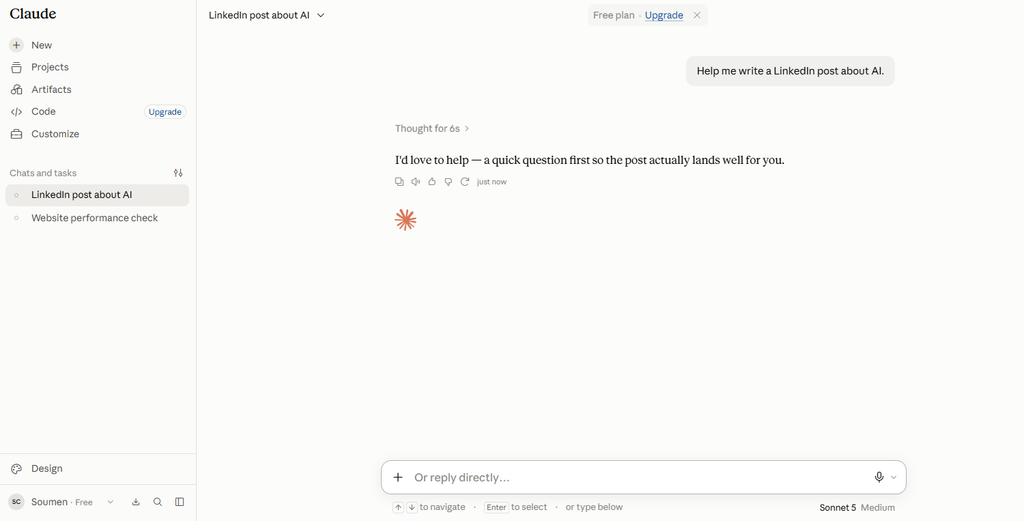
Figure 2 — Constrained Prompt Response
Screenshot of Claude receiving the detailed constrained prompt and generating a LinkedIn draft.
The generated response follows the specified word-count, formatting, exclusion, and ending requirements.
Finding
In this documented session, prompt specificity determined whether Claude had enough information to produce the deliverable immediately: the minimal prompt triggered a clarification request, while the constrained prompt produced a directly usable draft on the first attempt.
This is a single data point, not a mechanism. The constrained prompt changed several variables at once — role, content direction, exclusions, and format limits — so this test cannot say which of those, individually, caused the shift from “asks a question” to “writes the post.” That’s the natural next experiment: vary one constraint at a time against the same base prompt and see which one alone is enough to skip the clarification step.
Limitations
- One model, one conversation, two prompt conditions — not a benchmark.
- The generic condition ended in a clarification request, not a finished post, so this isn’t a like-for-like comparison of two completed drafts.
- Because the constrained prompt varies four things at once (role, exclusions, context, format), the experiment cannot isolate which constraint(s) mattered.
- Results may differ with other models, model versions, or conversations — this was not tested here and shouldn’t be assumed.