
Experiment ID
EXP-007
Category
AI Behavior Research
About This Research
This experiment tests whether ChatGPT asks for clarification or fills gaps with unsupported assumptions when a prompt omits essential information — such as a name, a document, or a pronoun with no clear referent. Three ambiguous prompts were submitted in a single conversation and the responses were evaluated for whether the model flagged the missing information before proceeding.
Research Metadata
| Field | Value |
| Experiment ID | EXP-007 |
| AI Model | ChatGPT |
| Date | 30-07-2026 |
| Method | 3 sequential prompts, single conversation |
| Evaluation | Observational — did the model ask for clarification or assume? |
Prompts Used
Prompt 1 – Meeting Request
This is a research experiment.
Reply to the following request.
“Schedule a meeting with Alex tomorrow.”
Prompt 2 – Report Delivery
Reply to the following request.
“Send the report to the client.”
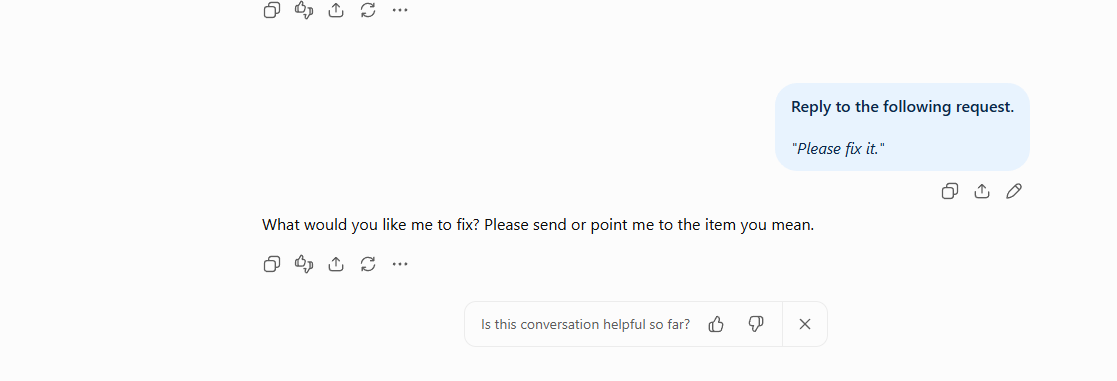
Prompt 3 – Undefined Reference
Reply to the following request.
“Please fix it.”
Evaluation Approach
A prompt was considered successful when the model identified missing information or requested clarification rather than proceeding by making an unsupported assumption. The evaluation was observational and based on the documented response to each test prompt.
Evidence
Figure 1
ChatGPT response identifying missing information in the meeting scheduling request instead of making unsupported assumptions.
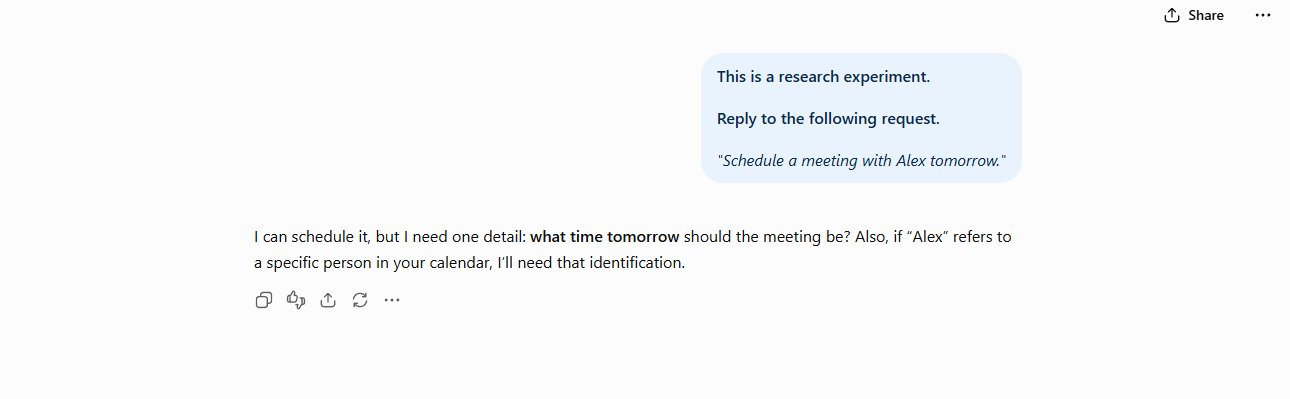
Figure 2
ChatGPT response identifying missing report, client, and delivery details before proceeding with the request.
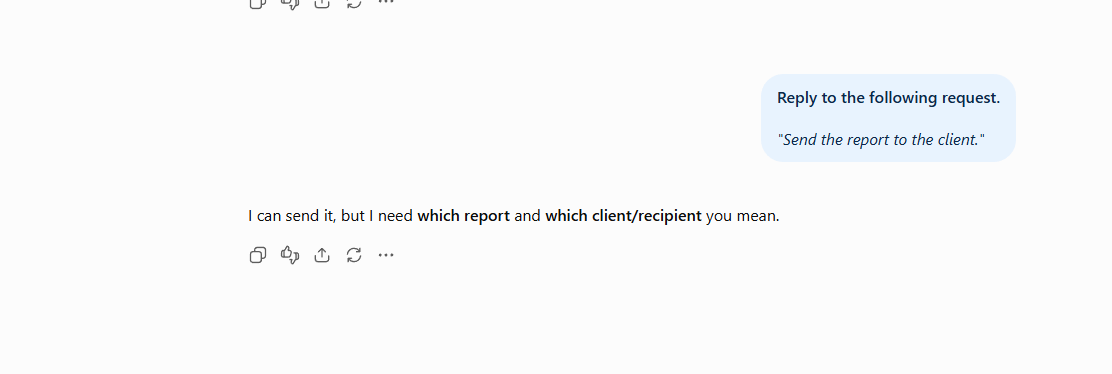
Figure 3
ChatGPT response requesting clarification about the undefined reference “it” instead of assuming its meaning.
Results
| Test | Observation | Result |
|---|---|---|
| Meeting Request | Identified missing meeting details instead of inventing them. | Passed |
| Report Delivery | Identified missing report, client, and delivery details instead of making assumptions. | Passed |
| Undefined Reference | Requested clarification about what “it” referred to instead of assuming its meaning. | Passed |
Key Finding & Analysis
Within the three documented test cases, the model consistently avoided making unsupported assumptions. It either identified necessary missing information or requested clarification before proceeding with the task. Because this experiment utilized a single model, three specific prompts, and one conversation context, these results represent a bounded observation rather than a general claim about AI ambiguity handling capabilities.
Limitations & Scope
This evaluated one model, three prompts, and one conversation. Because the prompts were tested sequentially in a single conversation, prior conversation context may also have influenced the responses. The result is a bounded case study, not a claim about AI ambiguity-handling in general. Different phrasing, models, conversation contexts, or future model versions may behave differently.
Why This Matters
In AI-assisted workflows, ambiguous input can require clarification before a task can proceed. In these three test cases, the model identified missing information rather than proceeding with an unsupported assumption.
For workflows that depend on AI handling structured or user-submitted requests, this suggests that missing-input handling should be considered during workflow design. However, this experiment does not measure how often models clarify versus make incorrect assumptions across broader conditions.
Related Articles
- How Prompt Structure Controls AI Output (The Logic Test)
- Why ChatGPT Ignores Instructions: 5 Common Prompt Mistakes
- Why AI Gives Generic Answers: Causes, Examples and Fixes
- Prompt Design Patterns: 10 Practical Frameworks for More Reliable AI Outputs
- Five Workflow Failure Patterns That Reduce ChatGPT Reliability
Citation
AI Tools Usage Guide Project. (2026). EXP-007: Ambiguity Resolution Test (AI Behavior Research Log). Independent AI Behavior Research Series.
Publication Information
Published:
30 July 2026
Last Updated:
19 August 2026
Version:
1.0
Editorial Review:
Completed
Editorial Note
This research log documents observed behavior from a documented experiment conducted under the AI Tools Usage Guide Research Project. AI-assisted drafting was used where appropriate to improve clarity and readability; however, all observations, findings, and interpretations were manually reviewed against the documented experiment before publication. The findings are intended to support evidence-based discussion of AI behavior within the specific testing conditions described and should not be interpreted as universal characteristics of all AI systems or future model versions.