
Quick Answer
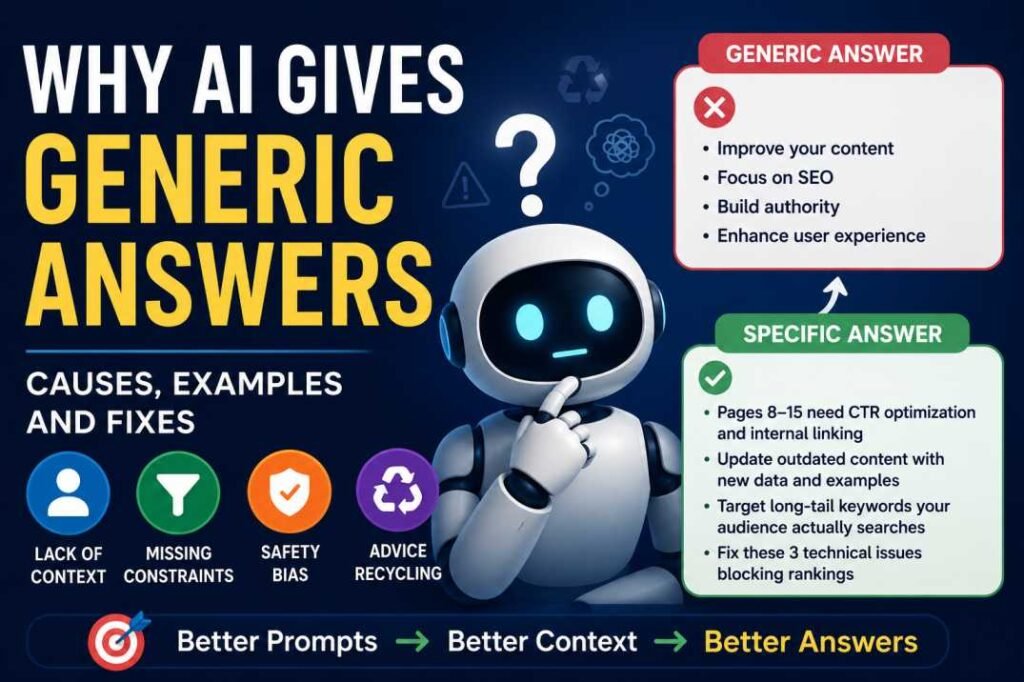
A generic AI response is a broad, non-specific answer that could apply to many users or situations instead of addressing the specific context, constraints, or objective in the prompt.
AI commonly produces generic answers when a prompt provides too little context, few constraints, or no clear objective. The result may be technically correct but still provide little decision-making value because it does not tell the user what matters most for their specific situation.
Key Insight
Generic output does not necessarily mean the AI cannot produce a more useful answer. Often, the prompt leaves too much room for interpretation. When important context, constraints, or objectives are missing, the model can produce broadly applicable guidance instead of situation-specific recommendations.
The Problem of Generic AI Responses
Many users experience the same frustration when working with ChatGPT, Claude, Gemini, or other AI tools.
You ask:
How can I improve my website?
The AI responds:
- Create high-quality content
- Improve user experience
- Optimize for SEO
- Build authority
Nothing here is technically incorrect — but the advice could apply to almost any website on the internet, which makes it disappointing in practice.
The example above illustrates how a broad website-improvement prompt can invite general recommendations. To examine how added context and audience information affect response specificity, we conducted EXP-001 using three prompts about AI slop. The experiment and its observed results are described below.
EXP-001: How Added Context Changes AI Output
Experiment scope
This exploratory test examined how adding examples and audience context affected the specificity and practical usefulness of AI responses. It used one AI model, one testing session, and three prompts about AI slop.
Prompts tested
- “Explain AI Slop”
- “Explain AI Slop with real examples”
- “Explain AI Slop for SEO writers who publish AI-assisted content”
Observed result
In this test, the first prompt produced a broad explanation. Adding a request for real examples made the response more concrete, while specifying SEO writers as the audience produced a more targeted explanation with workflow-relevant guidance.
Limitations
This was a single-session exploratory test using one model and three prompts. It was not a controlled benchmark, a multi-model comparison, or a statistically representative study. The observation illustrates how added context and audience information can affect response specificity under the tested conditions; it does not establish that all AI models will respond in the same way.
What Is a Generic AI Response?
A generic answer is a broad, non-specific response that remains widely applicable rather than context-specific. In AI systems, these responses are usually caused by vague prompts, missing context, or insufficient constraints.
While these responses are often technically correct, they provide limited decision-making value.
Characteristics include:
- Repetitive recommendations
- Common internet advice
- Lack of prioritization
- Minimal adaptation to the user’s actual situation
For example:
Generic: “Improve your content quality and focus on user experience.”
Specific: “If your pages receive search impressions but few clicks, review the pages with the highest impressions and lowest CTR first, then improve their titles and search-intent alignment.”
The first answer could apply to almost any website. The second uses a specific situation to identify a concrete next step.
Why AI Produces Generic Responses
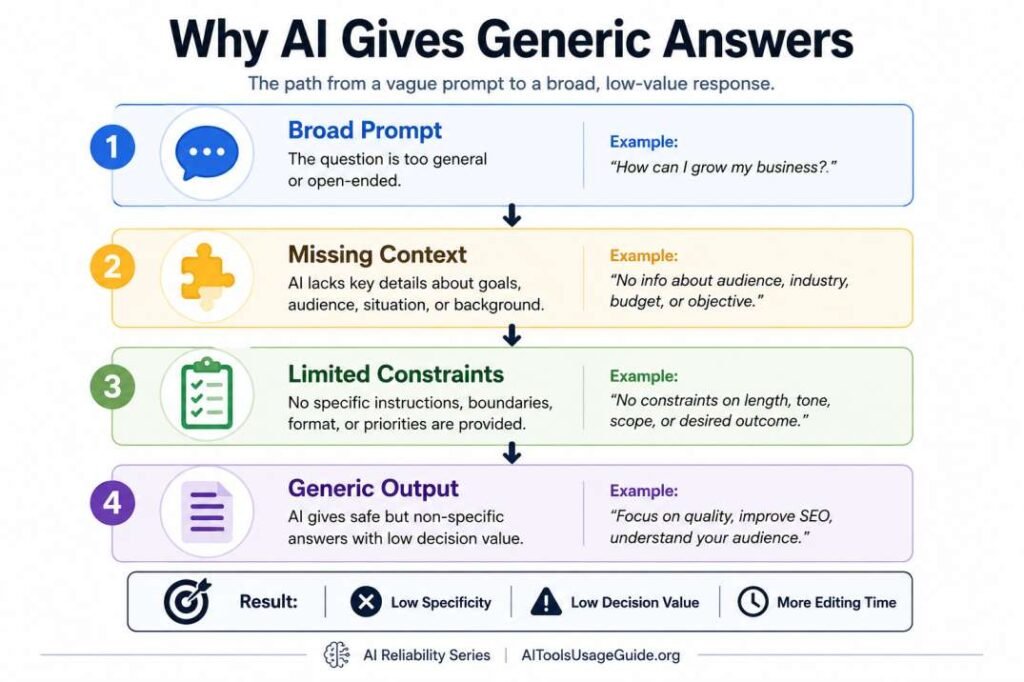
Generic AI responses can arise for several reasons. A prompt may be too broad, omit relevant context, or lack constraints that help narrow the answer. In other cases, the model may provide familiar, broadly applicable advice instead of recommendations tailored to the specific task.
The four patterns below are a practical framework for understanding why responses may lack specificity. They are not four causes independently established by our experiments.
1. The Prompt Is Too Broad
Broad questions leave room for many possible answers. Without a clearly defined topic, audience, or purpose, the model may produce a general explanation rather than a focused response.
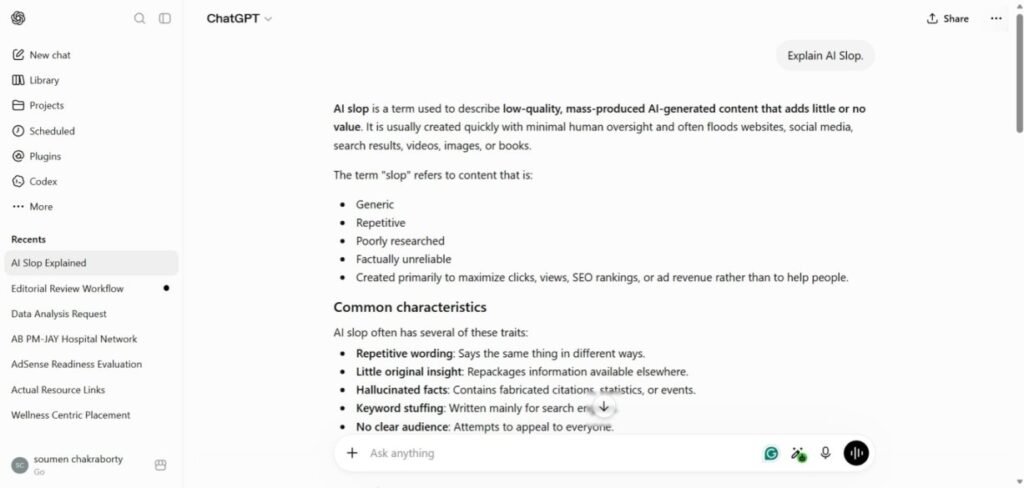
Research Evidence: EXP-001: Generic Prompt Test
Example from our test logs:
Generic Prompt:
“Explain AI Slop.”
Observed Result: The model produced a broad explanation with limited practical context.
More Specific Prompt:
“Explain AI Slop for SEO writers who publish AI-assisted content.”
Observed Result: In this test, adding a defined audience and workflow context produced a response more targeted to SEO writers.
A broad prompt may leave out details such as:
- Industry or subject area
- Intended audience
- Purpose of the request
- Desired level of detail
- Specific problem to solve
When these details are not provided, the model has less information to focus its answer on the user’s particular needs.
Experiment limitation: EXP-001 was a small exploratory test using one AI model, one documented session, and three prompts about AI Slop. It illustrates how added examples and audience context affected the responses under those test conditions. It was not a controlled benchmark or a test of every type of broad prompt.
2. Important Context Is Missing
A prompt can state a clear task but still omit background information needed to make the answer relevant to the user’s situation. Context may include the user’s circumstances, audience, goals, or the details of the problem.
Research Evidence: EXP-007: Ambiguity Resolution Test
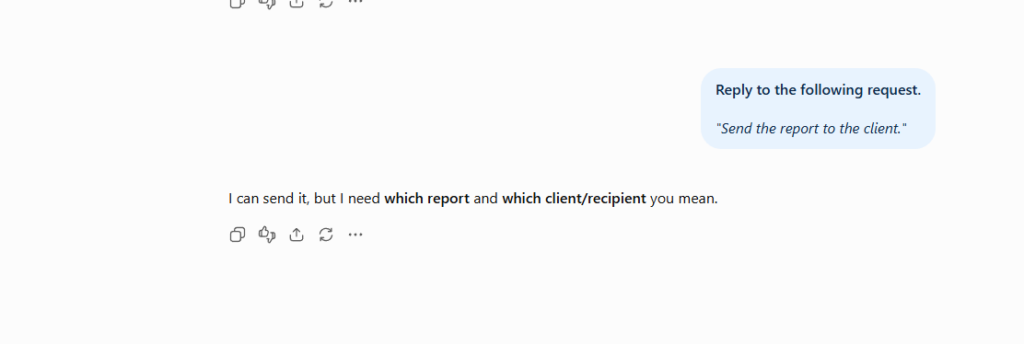
EXP-007 tested three ambiguous or incomplete prompts to observe whether the model identified missing information or guessed. One of the documented examples is shown below.
Example from our test logs:
- Ambiguous Prompt: “Send the report to the client.”
- Observed Result: The model asked which report and which client or recipient the user meant, rather than proceeding without those details.
Missing context and ambiguity are related, but they are not identical. A prompt may be answerable while still lacking useful background information. An ambiguous prompt, by contrast, may omit a detail necessary to determine what the user means.
Broad Prompt vs. Ambiguous Prompt
A broad prompt may be answerable but produce general advice because many answers could reasonably fit.
An ambiguous prompt may lack a key detail that prevents the model from identifying the intended meaning or action.
Compare these prompts:
Prompt A: “How can I improve SEO?”
Prompt B: “How can I improve SEO for an air pollution education website targeting Indian readers?”
Prompt B provides additional information about the website’s topic and audience. That context gives the model a clearer basis for tailoring its recommendations.
For tasks that depend on details from earlier messages, context management also matters. See Why AI Loses Context in Long Conversations.
Evidence limitation: EXP-007 supports the specific observation that the model requested clarification in a tested ambiguous task. It does not establish that all missing-context prompts will cause a model to ask questions, or that adding context always improves response quality.
3. The Prompt Lacks Constraints
Context describes the situation; constraints define the boundaries of a useful answer. Without constraints, the model may suggest options that are too broad, impractical, costly, or unsuitable for the user’s needs.
Useful constraints can include:
- Audience or experience level
- Available budget and resources
- Industry or geographic scope
- Timeframe
- Number of recommendations
- Required format or exclusions
Example:
Unconstrained Prompt:
“Give SEO advice.”
Constrained Prompt:
“Give three low-cost SEO actions for a small educational website with fewer than 20 articles. Prioritize tasks that can be completed within 30 days.”
The second prompt defines the website’s scale, resource limits, timeframe, and expected number of recommendations. These constraints narrow the range of suitable answers and make the output easier to apply.
Practical note: This example illustrates how constraints can make a request more specific. It is a prompting example, not a result from EXP-001 or EXP-007.
4. The Model May Default to Common, Broadly Applicable Advice
Even when a prompt is understandable, the model may respond with familiar recommendations that fit many situations. Such advice can sound reasonable while offering little guidance about what to do first or how to adapt the recommendation to a particular case.
Examples of broadly applicable advice include:
- Focus on quality
- Improve communication
- Understand your audience
- Follow best practices
These suggestions may be relevant, but without task-specific detail they may not help the user prioritize actions or make a decision.
This pattern is distinct from a missing prompt detail: it describes the kind of answer a model may produce when a request allows many possible responses. The examples above illustrate generic advice; they do not establish the model’s internal reasoning or prove why it selected a particular recommendation.
Practical takeaway: When an answer sounds plausible but is too general to act on, provide relevant background, define practical constraints, and state the outcome you want. Ask the model to give specific, prioritized steps and explain how each step relates to your situation. Verify important recommendations against reliable sources and the requirements of your task before applying them.
Why AI Gives Similar Advice Across Different Runs
To explore whether repeated AI responses provide different recommendations, we compared the recommendation categories in multiple fresh-session responses to the same SEO prompt:
How can I improve my SEO?
The examples below show partial overlap in content-related and link-building recommendations, alongside differences in other suggested actions. This is an exploratory observation from the documented responses, not a controlled benchmark of repeated-run consistency across AI systems.
Response 1
- Create quality content
- Build backlinks
- Improve user experience
Response 2
- Publish valuable content
- Increase authority
- Improve site performance
Response 3
- Produce useful articles
- Earn links
- Optimize technical SEO
What We Actually Compared
We compared the recommendation categories rather than the exact wording of the responses.
In the three examples shown, content-related advice and link-building or authority recommendations overlap. Other recommendations differ: one response mentions user experience, another refers to site performance, and a third recommends technical SEO.
These examples illustrate partial similarity alongside variation in AI-generated SEO advice. They do not show that every recommendation remained the same or that wording was the only difference.
The examples are illustrative. The available article text does not specify the exact number of runs, model version, or a formal category-scoring method. Therefore, this observation should not be treated as a controlled benchmark or a general finding about all AI systems.
This behavior is closely related to the tendency of AI systems to repeat similar recommendations across different conversations, which we explain in Why AI Repeats Itself.
Practical Takeaway
When repeated AI responses contain overlapping broad recommendations, adding relevant context, constraints, and a clear objective may help make the advice more specific to the task. However, the examples in this section do not establish that insufficient prompt specificity is the sole cause of repeated advice or that changing the prompt will always produce substantially different recommendations.
Generic Consensus: Similar Advice Is Not Independent Confirmation
When multiple AI responses provide similar recommendations, the overlap may create an impression that the advice has been independently confirmed. However, repeated or similar outputs from AI systems do not, by themselves, establish independent agreement or verify that the recommendations are accurate.
In our illustrative SEO prompt examples, some recommendation categories overlap while others vary. This shows partial similarity in the responses, not an independently verified consensus.
Practical implication: Treat recurring AI recommendations as suggestions to investigate, not as proof. Check important claims against reliable sources, relevant data, and the requirements of the specific task before acting on them.
Generic Answers vs Wrong Answers
Many users confuse generic answers with incorrect answers.
They are not the same thing.
| Generic Answer | Wrong Answer |
| Broad | Factually incorrect |
| Broadly applicable | Misleading |
| Often accurate | Often inaccurate |
| Low usefulness | High risk |
A generic answer may still be correct.
A wrong answer may sound highly specific.
Understanding this distinction is important when evaluating AI outputs.
If you want to understand how factual errors differ from broad but technically correct responses, see our guide on Why AI Gives Wrong Answers.
When Generic Answers Become a Workflow Problem
Generic outputs create several operational bottlenecks:
Lower Decision Value: Broad recommendations rarely help you prioritize. Knowing you need to “improve user experience” doesn’t tell you what to fix first.
Hidden Cost: Because generic answers often sound authoritative, users can mistake them for a data-driven strategy — leading to extra review cycles and rewriting time that erodes the productivity gain AI was supposed to deliver.
If generic or low-specificity AI outputs are recurring across a production workflow, improving individual prompts may not explain the full problem. An AI reliability investigation can examine the available evidence, identify observable failure patterns, and determine whether recurring output problems are linked to prompts, context, instructions, or other workflow factors.
Discuss an AI Reliability Investigation →
How to Make AI Responses Less Generic
Generic answers often occur when a prompt does not provide enough information to distinguish the user’s situation from a broad, familiar request. Before switching to another AI tool or model, improve the prompt by adding relevant context, meaningful constraints, and a clear objective.
One reason prompts may produce less specific answers is that important instructions become diluted among multiple competing requests. Learn more in Prompt Dilution Explained.
Practical Recommendation
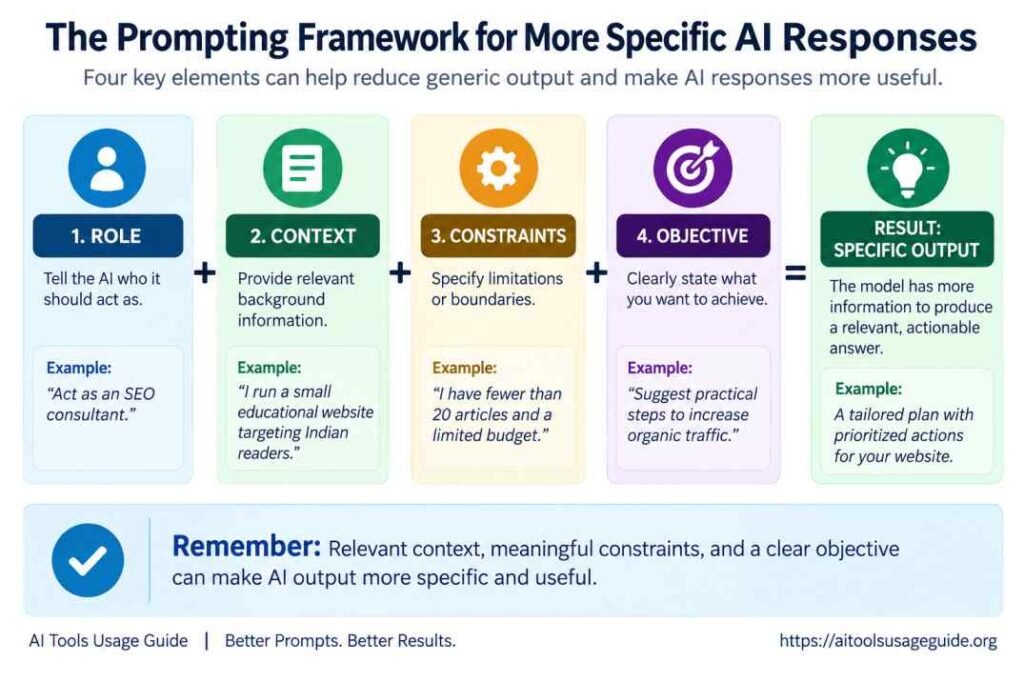
Use four elements to make your request more specific:
Role
Tell the AI what perspective or professional role to adopt.
Example:
Act as an SEO consultant for a small educational website.
Context
Provide relevant background about your website, audience, and current situation.
Example:
The site focuses on air quality education for Indian readers. It publishes educational articles and aims to improve relevant organic search traffic.
Constraints
Define the boundaries of the response so the recommendations fit your resources and priorities.
Examples:
- Avoid generic SEO advice; relate each recommendation to the site’s topic and audience.
- Focus on actions that can be completed within 30 days.
- Prioritize low-cost improvements that do not require a developer.
Objective
State the specific outcome you want the AI to deliver.
Example:
Recommend three practical actions to improve organic traffic to the site’s air quality articles. Prioritize them by expected impact and explain the reasoning behind each recommendation.
Specify the Output Format
When presentation affects how you will use the answer, state the format you want.
Example:
Return the recommendations as a three-step action plan. For each step, include the priority, the action, and one reason it matters.
The goal is not to make prompts longer. It is to provide enough relevant information for the model to distinguish your situation from a broad, generic request and produce recommendations that are specific and actionable. Review the response for relevance and factual accuracy before applying its suggestions.
Research Evidence
This article draws on documented prompt-testing observations conducted for AI Tools Usage Guide. The experiments provide limited, task-specific evidence about how prompt wording and ambiguity can affect AI responses. They are practical tests, not a universal benchmark of AI systems.
Related Experiments:
- EXP-001: Generic Prompt Test examines how adding examples and audience context changes response relevance and practical usefulness across the tested prompts.
- EXP-007: Ambiguity Resolution Test examines whether an AI system identifies missing information or makes assumptions when given ambiguous instructions.
These experiments support the specific observations discussed in this article. They do not establish that the same results will occur across all models, prompts, or use cases.
For additional information about the research process, test design, and evidence limitations, see our Research Methodology page.
This summary is intended to make the evidence behind the article more transparent. The methodology page provides further details about the documented experiments and the scope of their findings.
Further Reading: Editing AI-Generated Content
Disclosure: We may earn a commission if you purchase through this link.
Improving a prompt can help make AI responses more relevant, but editing the resulting draft remains a separate step. Joshua Lisec’s masterclass, The Best Way to Edit AI & Re-Human Your Writing, presents techniques for revising AI-generated writing, including repetitive phrasing and robotic tone.
We have not independently verified the specific time claims in the course’s marketing. Treat “under 90 minutes” as the vendor’s claim, not as an independently established result or a finding from our experiments.
Frequently Asked Questions
Why does ChatGPT repeat the same advice?
AI can repeat similar advice even without retaining the previous conversation because the same or similar prompt can lead to similar high-probability recommendations. Changing the wording alone may not substantially change the underlying advice if the constraints and context remain similar.
Are generic answers a form of hallucination?
Not typically. Generic answers are usually broad but factually accurate, whereas hallucinations involve fabricated or incorrect information. However, they share the trait of being unhelpful for specific problem-solving.
Why do different AI tools give similar advice?
Different AI systems can give similar high-level advice because many prompts have a relatively small set of conventional recommendations that fit the request. Similar prompting patterns can therefore produce overlapping recommendations even when the wording differs.
Do paid AI models give fewer generic responses?
Model capabilities vary, but even capable AI systems can generate generic answers when prompts provide insufficient context, constraints, or a clear objective.
How can I make AI responses more specific?
Provide context, define the audience, specify the objective, add constraints, and describe the desired format or outcome.
Why do AI-generated articles often sound similar?
Similar prompting templates can also contribute to similar outputs: two writers using different AI tools may still receive similar outlines when they provide similarly broad instructions.
What is the difference between a generic answer and a vague answer?
A generic answer is broadly applicable and may be technically correct, but it often lacks situation-specific recommendations. A vague answer is unclear or insufficiently precise. The two can overlap, but they are not identical: a generic answer can be clear while still being too broad to help with a specific decision.
References
The following documentation and research papers provide background on prompt engineering, language models, and context handling. They are supporting resources, not direct evidence for the experiments conducted for this article.
- OpenAI. Prompt Engineering. OpenAI API documentation.
https://developers.openai.com/api/docs/guides/prompt-engineering - Anthropic. Prompt Engineering Overview. Claude documentation.
https://docs.anthropic.com/en/docs/build-with-claude/prompt-engineering/overview - Google. Prompt Design Strategies. Google AI for Developers.
https://ai.google.dev/gemini-api/docs/prompting-strategies - OpenAI. GPT-4 Technical Report.
https://arxiv.org/abs/2303.08774 - DAIR.AI. Prompt Engineering Guide.
https://www.promptingguide.ai/ - Brown, T. B., et al. (2020). Language Models are Few-Shot Learners.
https://arxiv.org/abs/2005.14165 - Anthropic. Context Windows. Claude documentation.
https://docs.anthropic.com/en/docs/build-with-claude/context-windows
Related Articles
Explore related articles on AI response quality, instruction following, repetition, and context retention:
- Why AI Loses Context in Long Conversations
- Why AI Gives Wrong Answers
- ChatGPT Ignores Instructions
- Why AI Repeats Itself
- Prompt Dilution Explained
- The 4 Prompting Moves That Fix Generic AI Output - September 12, 2026
- How to Evaluate AI Answer Reliability: A 7-Step Verification Framework - August 9, 2026
- AI Memory vs. Context Window: Why Most People Confuse Them (And Why It Matters) - July 23, 2026