
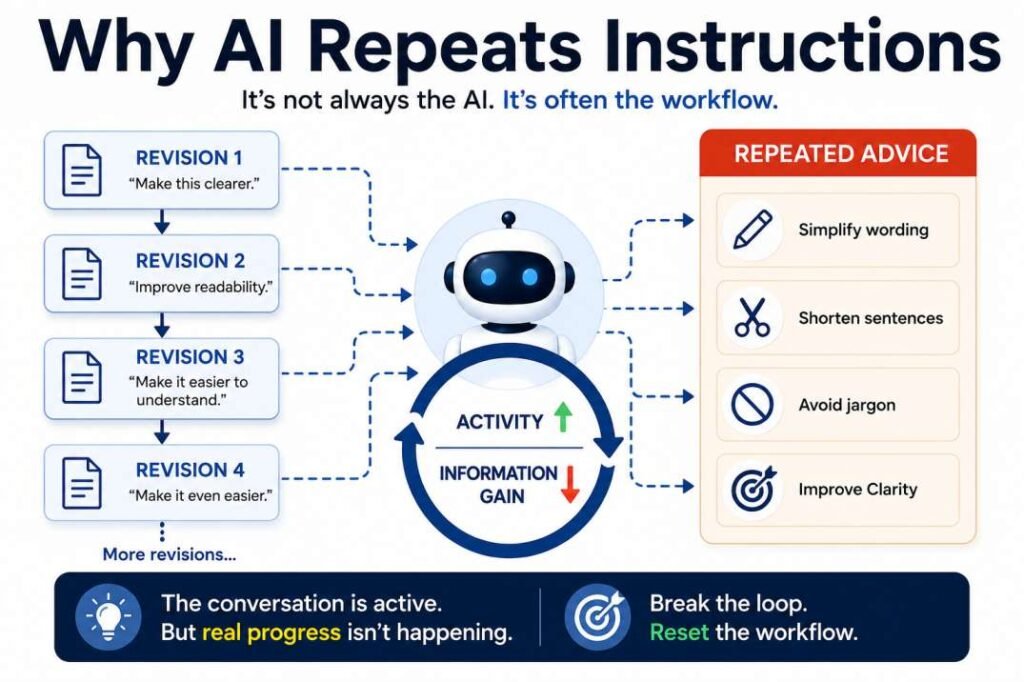
AI repetition is often treated as a model limitation.
In many cases, it is actually a workflow signal.
When revision requests become increasingly similar, AI systems often begin recycling earlier recommendations instead of generating genuinely new improvements.
Quick Answer
AI does not always repeat instructions because it is confused.
In many workflows, repetition occurs when the conversation stops introducing new information, new objectives, or new evidence.
As a result, the model begins returning to the same solution space and recycling earlier advice.
The biggest risk is not repeated wording.
The bigger risk is the illusion of progress.
Why AI Repetition Is Often a Workflow Signal
AI repetition is often treated as a model limitation.
In practice, it is frequently a workflow signal.
When conversations stop generating new information, new objectives, or new evidence, AI systems often begin recycling earlier recommendations while creating the appearance of continued progress.
In these situations, repetition may reveal more about the workflow than about the model itself.
The Strange Pattern Many Users Notice
Imagine you’re editing an article with AI.
Your first request is:
“Make this clearer.”
The AI rewrites the content.
Then you ask:
“Improve readability.”
The AI revises it again.
Then:
“Make it even easier to understand.”
The AI responds once more.
At first, the workflow appears productive.
However, after several rounds, the AI starts repeating familiar advice:
- simplify wording
- shorten sentences
- avoid jargon
- improve clarity
The wording may change, but the recommendations remain largely the same.
The conversation is active.
The information gain is not.
Why AI Starts Repeating Instructions
Most explanations stop at:
“AI predicts patterns.”
While technically true, that explanation does not help users understand what is happening operationally.
A more useful explanation is that repetition often appears when the workflow stops creating new objectives.
The model is still responding.
But it is responding to increasingly similar requests.
As a result, it repeatedly returns to the same solution space.
Research Evidence: EXP-007: Ambiguity Resolution Test
Why Similar Revision Requests Create Repetition
One reason repetition becomes common is that many revision requests target the same underlying objective without realizing it.
For example:
- improve clarity
- improve readability
- make it easier to understand
- simplify the wording
These appear to be different requests.
Operationally, however, they often push the model toward the same optimization goal.
As more revisions focus on the same objective, the range of possible improvements becomes smaller.
The model may continue generating responses, but those responses increasingly draw from the same set of recommendations.
This is why later revisions often feel different on the surface while providing little genuinely new value underneath.
Related: Similar instructions can also weaken prompt signals over time. See our guide on What Is Prompt Dilution? Why ChatGPT Ignores Your Instructions.
Research Evidence: EXP-001: Generic Prompt Test
Repetition Often Signals Information Exhaustion
When repetition becomes noticeable, many users assume the model has become confused or less capable.
In reality, the workflow may simply have exhausted its available information.
The model cannot generate genuinely new observations if the conversation contains no new evidence, no new constraints, and no new objectives.
As a result, it begins recombining existing ideas in slightly different forms.
This is often a stronger explanation than assuming the AI has stopped working correctly.
Hidden Failure Pattern: Advice Recycling
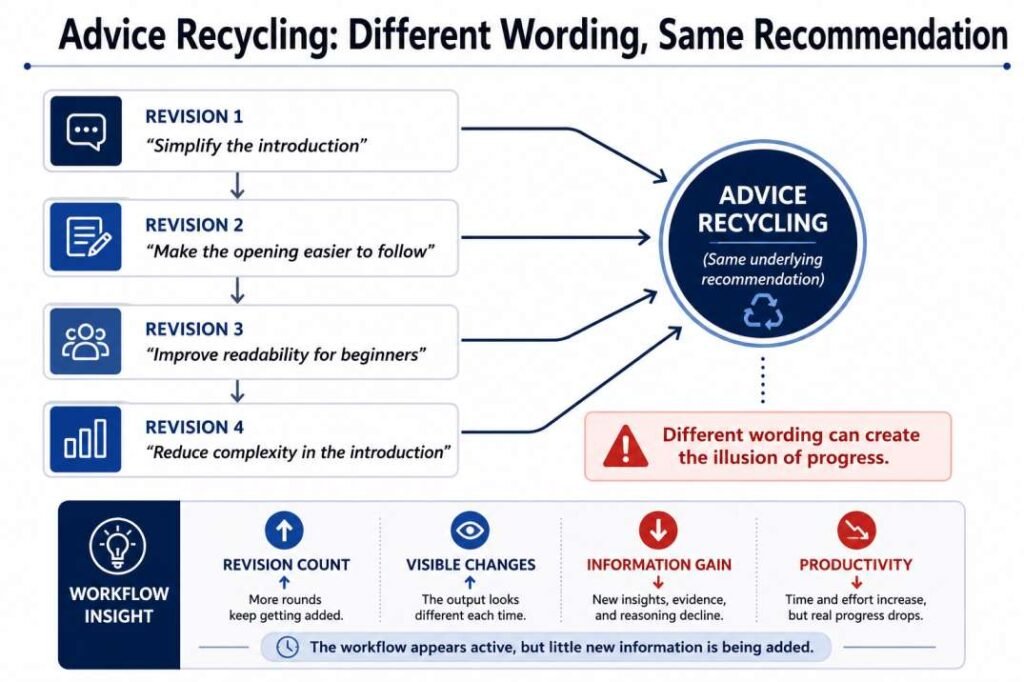
One of the most overlooked AI workflow failures is advice recycling.
This occurs when the model keeps generating different versions of the same recommendation.
For example:
Revision 1:
- simplify the introduction
Revision 2:
- make the opening easier to follow
Revision 3:
- improve readability for beginners
Revision 4:
- reduce complexity in the introduction
Although the wording changes, the underlying recommendation remains almost identical.
The AI appears productive.
In reality, it is recycling earlier advice.
This creates a false sense of improvement.
Why Repetition Is More Dangerous Than It Looks
Many users view repetition as a minor annoyance.
In longer workflows, it can become a serious productivity problem.
The issue is not that the AI repeats words.
The issue is that the workflow begins consuming time without generating meaningful new information.
Teams may spend:
- additional review cycles
- additional revisions
- additional approval steps
while the output quality barely changes.
This is one reason some AI-assisted projects become unexpectedly inefficient.
The workflow creates activity without creating progress.
The Hidden Risk: Repetition Can Hide Unresolved Problems
One reason instruction repetition becomes dangerous is that it can distract attention from issues that still require investigation.
For example, a model may repeatedly suggest clarity improvements while failing to identify:
- missing evidence
- factual uncertainty
- unsupported assumptions
- incomplete requirements
As repetitive recommendations accumulate, genuinely unresolved problems can become less visible.
This creates a risk that teams optimize what is easy to revise instead of what actually needs attention.
Repetition Is Not Just About Wording
Many people assume repetition only happens when the same sentences appear repeatedly.
In practice, the problem is often more subtle.
AI systems may repeatedly recycle:
Decision Criteria
The same reasoning framework appears across multiple outputs.
Structural Recommendations
The model keeps suggesting similar organization changes.
Safety Framing
The same warnings appear in different wording.
Caveats
The same limitations are repeated throughout the workflow.
Editorial Advice
The same improvement suggestions appear under different labels.
This is why repetition can be difficult to detect.
The language changes.
The underlying idea does not.
Diagnostic Checklist: What Type of Repetition Are You Seeing?
Before fixing the problem, identify its source.
Type 1: Constraint Anchoring
The same instruction dominates every output.
Example:
“Use simple language.”
The model keeps returning to simplicity-related advice.
Type 2: Weak Revision Requests
Multiple revision prompts ask for essentially the same improvement.
Example:
- improve clarity
- improve readability
- make it easier to understand
These requests often generate overlapping outputs.
Type 3: Information Exhaustion
The content has already reached a reasonable quality threshold.
There is little left to improve.
The AI continues generating revisions anyway.
Type 4: Workflow Stagnation
The conversation keeps revisiting existing ideas instead of introducing new goals.
This is often where advice recycling becomes most visible.
Early Warning Signs of Advice Recycling
Advice recycling usually does not appear suddenly.
In many workflows, there are warning signs before repetition becomes obvious.
Common signals include:
- revisions become increasingly similar
- recommendations focus on wording rather than substance
- the same weaknesses appear in multiple reviews
- outputs look different but solve the same problem
- new revisions add fewer insights than earlier revisions
These signals often appear before users consciously notice repetition.
Recognizing them early can prevent unnecessary revision cycles.
Real Workflow Example
Consider a content team reviewing an AI-generated article.
The first review asks the AI to improve clarity.
The second review asks for better readability.
The third review requests a more beginner-friendly tone.
The fourth review asks for stronger engagement.
At first, the revisions appear useful.
However, by the fifth or sixth revision, the AI often begins repeating familiar recommendations:
- simplify wording
- shorten sentences
- avoid jargon
- improve flow
The suggestions are not necessarily wrong.
The problem is that they no longer address the article’s biggest remaining weaknesses.
For example:
- missing evidence
- missing examples
- weak argument structure
- unsupported claims
The workflow continues generating revisions, but the recommendations increasingly focus on issues that were already addressed earlier.
As a result, the team spends more time reviewing outputs without making proportionally meaningful improvements.
Why Users Often Miss the Problem
People often judge revisions by visible change rather than meaningful improvement.
A rewritten paragraph looks different, which creates the impression that progress is still occurring.
However, visible edits do not necessarily make content more accurate, complete, or useful.
As a result, users may continue revising long after the most valuable improvements have already been made.
What Actually Stops Improving?
A common misunderstanding is that repeated revisions mean the content is still improving.
In many AI workflows, wording continues improving long after insights, evidence, and reasoning have stopped improving. Different parts of the output reach diminishing returns at different stages.
| Content Element | Often Improves Early | Commonly Stagnates Later |
|---|---|---|
| Structure | Yes | Rarely changes after a few revisions |
| Clarity | Yes | Reaches diminishing returns |
| Examples | Sometimes | Often unchanged |
| New Insights | Rarely | Frequently missing |
| Evidence | Rarely | Frequently missing |
This creates a misleading situation. The output continues changing, but the changes increasingly affect presentation rather than substance. As a result, users may mistake visible edits for meaningful improvement even when new insights, evidence, or reasoning are no longer being added.
The Information Gain Test
A useful way to detect repetition is to compare the latest revision against the previous one and ask:
- What information is genuinely new?
- What recommendation is being repeated?
- What problem was solved in this revision?
- What unresolved issue still remains?
If the revision only rephrases existing advice, the workflow may be trapped in a reinforcement loop.
This test is more useful than simply asking for another rewrite because it checks whether the output actually improved or only changed on the surface.
Research Evidence: EXP-003: Multi-Instruction Compliance Test
How to Break the Repetition Cycle
1. Change the Objective
Instead of:
“Improve this again.”
Try:
“Identify three missing assumptions in this argument.”
A new objective creates a new reasoning path.
2. Introduce New Information
Add:
- new audience requirements
- new constraints
- new examples
- new context
Fresh information reduces recycling.
3. Use a Revision Reset Prompt
Example:
“Summarize the existing recommendations. Do not repeat previous advice. Identify only unresolved issues that have not yet been addressed.”
This forces the model to move beyond earlier suggestions.
4. Stop Measuring Activity as Progress
More revisions do not automatically create better outputs.
In many cases, five meaningful revisions outperform twenty repetitive ones.
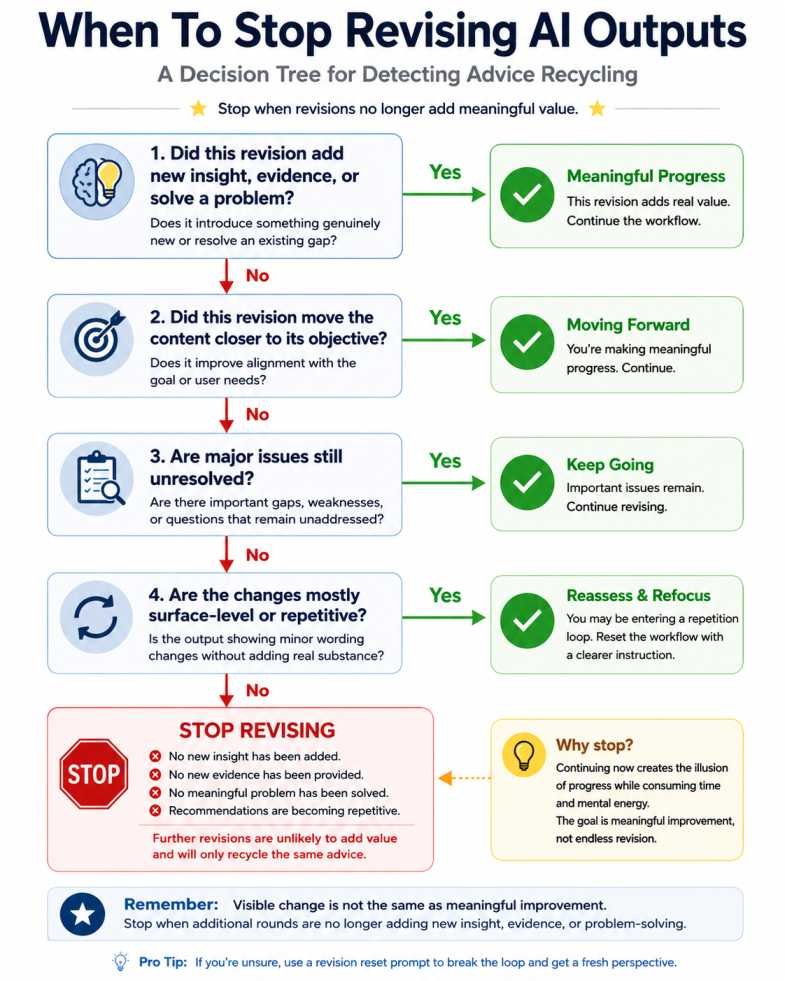
When To Stop Revising
A practical rule is to stop requesting additional revisions when:
- no new insight is being added
- no new evidence is being introduced
- no major problem is being solved
- recommendations are becoming increasingly repetitive
At this stage, another rewrite is often less valuable than introducing new information or redefining the objective.
Many AI workflows become inefficient because users continue optimizing wording after the underlying content has stopped meaningfully improving.
When Repetition Becomes a Workflow Reliability Problem
If recurring AI repetition is creating unnecessary review cycles, inconsistent recommendations, or unresolved problems in a production workflow, another prompt revision may not be enough. An AI reliability investigation can examine the available evidence, identify observable failure patterns, and determine what the evidence actually supports. Discuss an AI Reliability Investigation →
AI Repetition vs Context Loss
These problems are related but different.
Repetition
The model continues returning to earlier advice and recommendations.
Context Loss
The model stops consistently using earlier information.
One creates recycling.
The other creates inconsistency.
A workflow may experience both problems simultaneously.
If the model starts forgetting earlier information instead of repeating it, the issue may be context loss rather than advice recycling. Read: Why AI Loses Context in Long Conversations.
Revision Reset Prompt
When repetition becomes noticeable, restart the workflow with a clearer instruction:
Review all previous recommendations.
Do not repeat advice that has already been given.
Identify only unresolved issues.
Explain why each issue matters.
Prioritize the single change most likely to improve the final output.
This approach helps reveal whether the workflow still contains meaningful improvement opportunities or has simply entered a repetition cycle.
Author Observation
In my own testing, repetition appears most often when users keep requesting generic improvements such as “make it better,” “improve readability,” or “refine this further.” The model continues producing revisions, but the amount of genuinely new information often declines after only a few rounds. In many cases, introducing a new objective produces better results than requesting another rewrite of the same content.
Final Verdict
AI often repeats instructions because the workflow stops generating new informational signals.
When revision requests become increasingly similar, the model begins recycling earlier advice rather than producing genuinely new improvements.
The biggest risk is not repeated wording.
The bigger risk is the illusion of progress.
A workflow can appear productive while generating very little new information.
The most effective solution is not endless revision.
It is creating new objectives, introducing new context, and measuring information gain instead of revision volume.
In my own testing, repetition often appears after multiple revision rounds that pursue the same objective. The model continues generating changes, but the amount of genuinely new information declines significantly. This is one reason repeated rewriting can create the illusion of progress while adding little practical value.
Frequently Asked Questions
Why does AI keep repeating the same advice?
AI often repeats advice when revision requests target the same objective repeatedly and no new information is introduced.
Does repetition mean the AI is confused?
Not necessarily. In many cases, repetition is a workflow signal rather than a model failure.
What is advice recycling?
Advice recycling occurs when AI presents the same recommendation in different wording while adding little new value.
How can I stop AI from repeating itself?
Introduce new objectives, new evidence, new constraints, or ask the model to identify unresolved issues instead of requesting another generic revision.
What is the difference between repetition and context loss?
Repetition means the model keeps returning to earlier ideas. Context loss means the model stops consistently using information that appeared earlier in the conversation.
Can advanced AI models also repeat advice?
Yes. More capable models can often delay repetition, but they are not immune to it. When workflows stop introducing new information, even advanced models may begin recycling earlier recommendations. The limiting factor is often the available information rather than the model itself.
Does repetition happen in ChatGPT, Claude, and Gemini?
Yes. Although different models may delay repetition differently, all AI systems can begin recycling advice when conversations stop introducing new information, constraints, or objectives.
- The 4 Prompting Moves That Fix Generic AI Output - September 12, 2026
- How to Evaluate AI Answer Reliability: A 7-Step Verification Framework - August 9, 2026
- AI Memory vs. Context Window: Why Most People Confuse Them (And Why It Matters) - July 23, 2026