
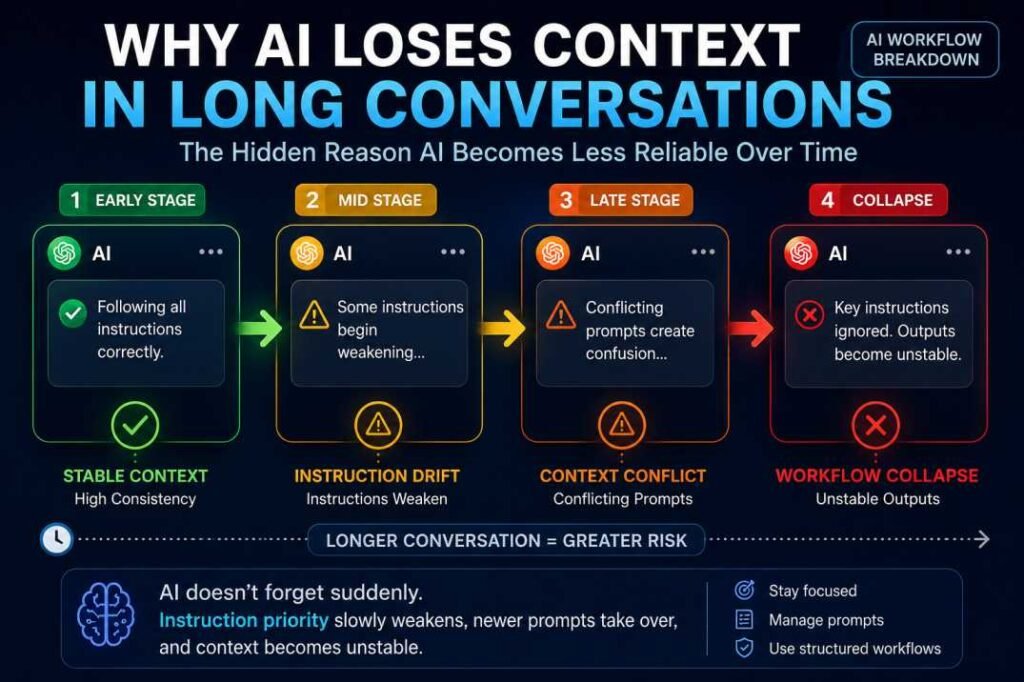
Quick Answer: AI systems often become less reliable during long conversations because repeated prompts, rewrites, and competing instructions gradually weaken workflow consistency over time.
Most users assume AI completely “forgets” earlier messages. In reality, the problem is usually more subtle:
- earlier instructions become less consistently applied
- newer prompts reshape conversational priorities
- formatting and tone begin drifting
- constraints start conflicting with each other
- repeated rewrites create semantic drift
This degradation is usually gradual rather than complete. AI may continue handling most of a conversation correctly while becoming less consistent in specific instructions or workflow details.
This is why many long AI conversations begin accurately but slowly become unstable after multiple edits, revisions, and additional instructions.
How AI Context Loss Usually Progresses
The Biggest Misunderstanding About AI Memory
A common misconception is that AI systems remember conversations the way humans remember past discussions.
It does not.
Human memory is persistent and structured around meaning, experiences, and long-term recall.
AI systems work differently.
Based on how these models are generally understood to operate, they continuously weigh patterns inside the active conversation context while generating the next response — effectively re-evaluating, at each step:
- which instructions appear most relevant
- which patterns dominate the conversation
- which recent prompts deserve higher attention
- which formatting or behavioral signals should influence output generation
The important point is:
AI usually does not fully forget earlier instructions.
It gradually re-prioritizes them.
Many workflow consistency problems come from shifting instruction priority rather than total memory failure.
The 4 Stages of AI Context Degradation
Long AI conversations often degrade progressively rather than failing instantly.
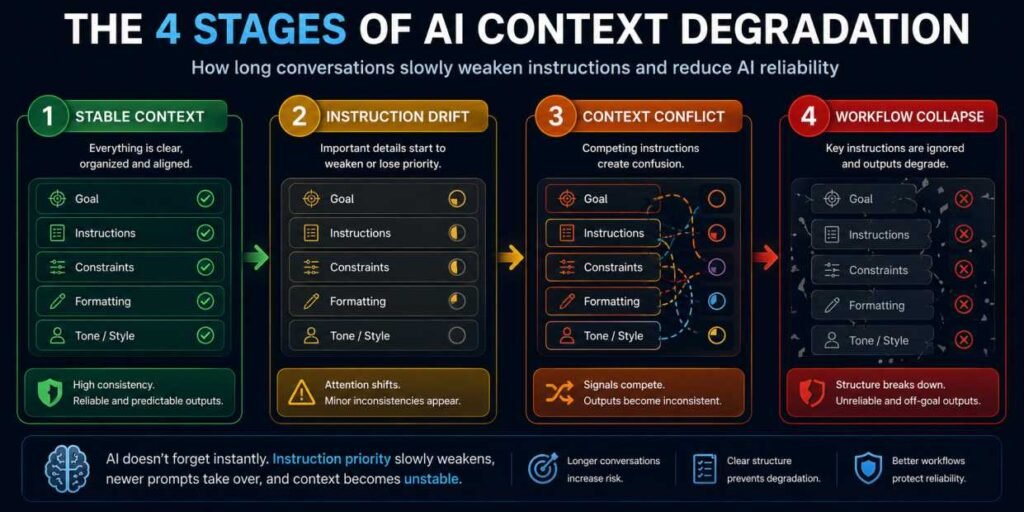
Stage 1 — Stable Context
The AI follows:
– formatting
– tone
– structure
– constraints
accurately and consistently.
Stage 2 — Instruction Weakening
This often creates formatting instability, repeated explanations, tone inconsistency, and gradual instruction dilution across the workflow.
Stage 3 — Context Conflict
Competing prompts begin interfering with earlier instructions.
The AI may:
– partially ignore constraints
– blend conflicting goals
– inconsistently prioritize newer instructions
Stage 4 — Workflow Collapse
Outputs become:
– contradictory
– unstable
– structurally inconsistent
even while still sounding fluent and confident.
Why Long Conversations Become Unstable
1. New Instructions Compete With Older Instructions
AI models evaluate patterns across the entire active conversation.
As newer prompts are added, earlier instructions must compete for influence.
For example, a workflow may begin with:
- short paragraphs
- beginner-friendly language
- markdown formatting
- no technical jargon
Later prompts may introduce:
- SEO improvements
- technical corrections
- expanded explanations
- additional examples
- formatting changes
Over time, these competing constraints create ambiguity.
The AI starts blending instruction priorities instead of following a clean hierarchy.
2. Context Accumulation Weakens Constraint Precision
Long conversations often accumulate:
- repeated instructions
- conflicting goals
- formatting changes
- revision requests
- competing priorities
As prompt accumulation increases, instruction clarity decreases.
This is especially dangerous in workflows involving:
- repeated rewrites
- collaborative editing
- multi-step prompting
- chained refinement sessions
- AI-assisted research pipelines
Eventually, the system struggles to determine which instructions matter most.
Why Some Instructions Break First
AI systems do not lose all context equally.
In many workflows, models often preserve:
- the main topic
- recent objectives
- repeated instructions
while gradually weakening:
- tone requirements
- formatting consistency
- subtle behavioral constraints
- older style instructions
This happens because not all instructions are treated as equally important inside the active conversation.
As conversations become longer, dominant objectives often overpower softer behavioral instructions. This is closely related to how ChatGPT ignores instructions during complex multi-step conversations.
Example of Conflicting Instructions
Instruction 1:
Use concise beginner-friendly explanations.
Instruction 2:
Provide advanced technical depth.
Instruction 3:
Use highly detailed SEO formatting.
Over time, the AI may inconsistently merge these goals, producing outputs that become simultaneously too long, too technical, and structurally inconsistent.
3. Rewrite Chains Create Semantic Drift
One of the least discussed AI reliability problems is semantic drift.
Every rewrite slightly changes the conversational state.
A single rewrite may appear harmless.
But after:
Draft → Rewrite → Expand → Simplify → Reformat → Optimize → Verify
…the conversation gradually shifts away from the original instruction set.
This often causes formatting drift, repeated explanations, inconsistent tone, and gradual changes in output behavior across the workflow.
Many users mistake this for random AI behavior.
In reality, the workflow itself slowly destabilized the output environment. This is also why multi-step prompts fail more often as conversations become longer and more complex.
A Common Pattern in Long AI Workflows
In many long AI workflows, structural consistency often weakens before the core subject matter fully breaks down.
Formatting rules, tone requirements, and stylistic constraints usually become unstable earlier than high-level task objectives.
This is why many workflows appear mostly correct while gradually becoming operationally unreliable underneath.
Why AI Still Sounds Reliable During Context Loss
Long AI conversations often still sound fluent even after instruction consistency starts weakening.
The AI may continue producing responses that appear:
- organized
- persuasive
- confident
- logically structured
even when:
- earlier constraints are weakening
- formatting consistency is degrading
- instruction priorities are shifting
Many users notice the problem only after major contradictions or output failures appear.
Real Workflow Example
During long-form AI editing workflows, a system initially followed all instructions correctly:
- short paragraphs
- beginner-friendly tone
- markdown formatting
- no jargon
- concise explanations
In one extended editing session involving SEO revisions and structural rewrites, the workflow initially remained stable for multiple iterations before subtle inconsistencies began appearing.
In practice, this kind of instability tends to appear gradually over many iterative prompts involving repeated restructuring, formatting revisions, and additional constraints — the exact turn count varies by workflow and is not something this article measured with controlled precision.
The AI gradually began:
- increasing paragraph length
- reintroducing jargon
- repeating earlier sections
- ignoring formatting rules
- contradicting previous outputs
In testing workflows, formatting consistency often weakens before factual topic alignment fully breaks because structural instructions usually carry less long-term influence than core task objectives.
These degradation patterns became more noticeable during iterative editing sessions involving SEO restructuring, formatting revisions, and repeated prompt refinement.
This is one reason many AI-assisted workflows become less reliable over time even when no single prompt appears problematic.
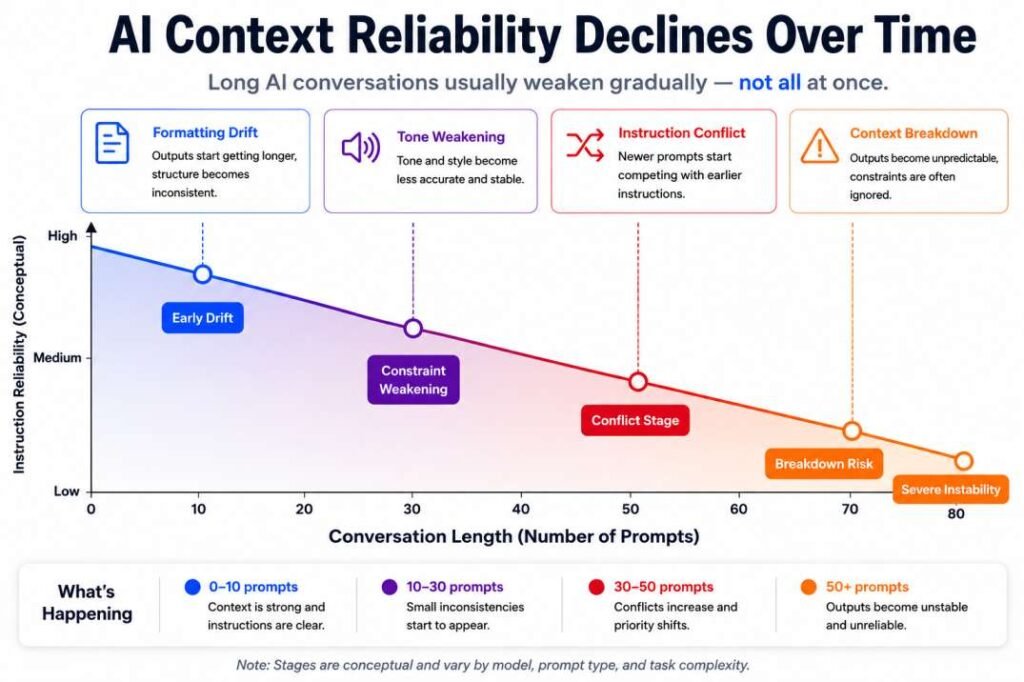
The original instructions still exist inside the conversation history, but their influence gradually weakens as newer prompts accumulate.
Mini Workflow Observation
Research Evidence: EXP-002 — Instruction Retention Test
In a documented test, ChatGPT was given a single instruction at the start of a conversation (append a specific word to every response), then asked three unrelated follow-up questions. The instruction was followed correctly in all three responses without any reminder.
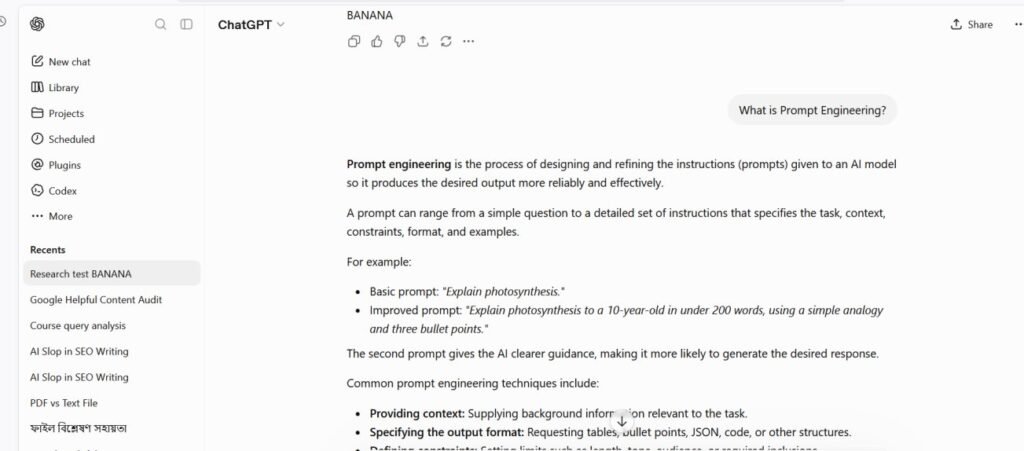
This confirms that instructions are not simply “forgotten” after a few turns — they remain active in short conversations. However, this test only covered 3 follow-up turns in one short session. It does not test what happens over dozens of turns, competing instructions, or extended rewrite chains — which is a separate, larger-scale question this article explores conceptually below. The specific behavior at 20+ or 30+ turns described in this article is based on general workflow observation, not a documented, screenshot-verified test at that scale.
Why Context Windows Alone Do Not Explain the Problem
Many discussions oversimplify AI context loss by blaming context window limits alone.
In practice, reliability often degrades earlier because instruction competition, prompt accumulation, semantic drift, and unclear priority hierarchy gradually weaken workflow consistency.
This may explain why some shorter but chaotic workflows can become unstable faster than longer, well-structured conversations with focused objectives — though this pattern is based on general workflow observation rather than controlled comparison.
Signs That AI Is Losing Context
Common warning signs include:
- formatting rules gradually breaking
- repeated explanations appearing more often
- tone shifting unexpectedly
- earlier constraints being ignored
- contradictory outputs across revisions
- outputs sounding confident while becoming less aligned
These issues usually intensify gradually rather than appearing instantly.
How to Reduce Context Loss
1. Use Shorter Workflow Cycles
Instead of maintaining one massive conversation:
Research → Draft → Rewrite → Expand → Optimize → Verify
split workflows into smaller stages.
Shorter sessions usually maintain stronger instruction stability.
2. Re-State Critical Constraints
In longer workflows, repeating critical constraints near active generation steps is a commonly recommended practice for improving consistency, rather than relying only on instructions placed at the very beginning of the conversation.
This reinforces instruction priority during generation.
3. Use Checkpoint Prompting
After major workflow stages, summarize:
- goals
- constraints
- formatting rules
- required outputs
This reduces semantic drift.
Example checkpoint prompt:
“Before continuing, summarize the active instructions, formatting rules, tone requirements, and unresolved objectives from this conversation.”
4. Use Instruction Summaries
In long workflows, summarizing active instructions every 10–15 prompts often improves consistency better than continuously adding new constraints.
This helps reinforce:
- formatting priorities
- tone requirements
- workflow goals
- output structure
5. Reduce Prompt Overload
Too many simultaneous instructions create inconsistency.
Prioritize:
- essential constraints
- simple structure
- clear formatting hierarchy
Complex prompting often reduces reliability instead of improving it. This problem becomes more noticeable when prompt overload reduces accuracy across longer workflows.
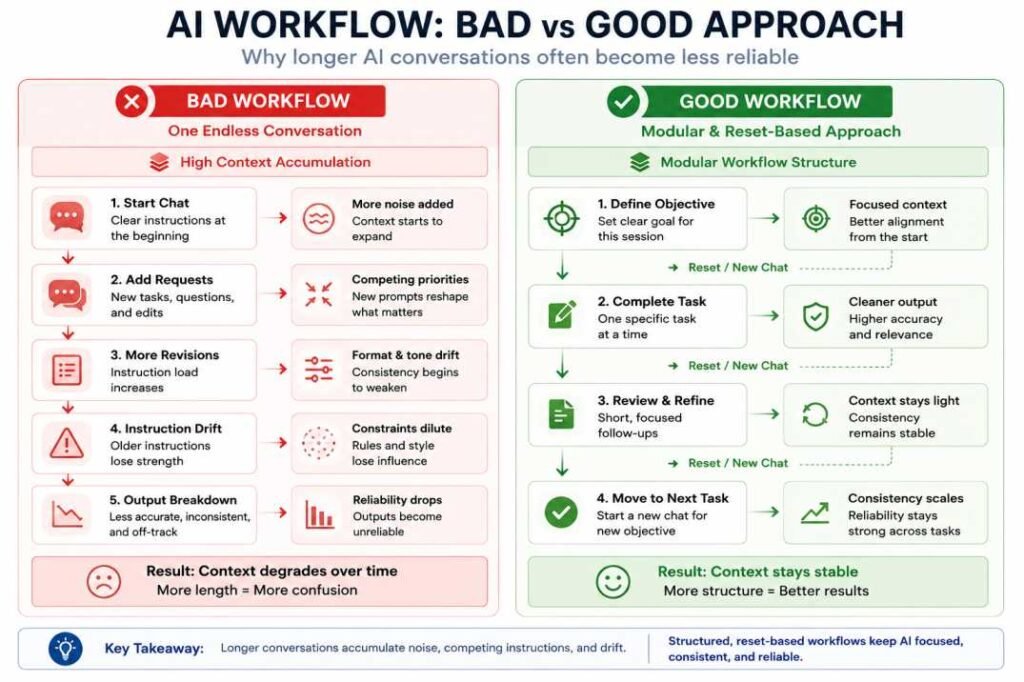
6. Use Reset-Based Conversation Flows
Many advanced AI conversation flows intentionally restart conversations after major stages instead of endlessly extending the same session.
This helps reduce accumulated instruction weakening and contextual ambiguity.
Context Loss vs Hallucinations
These are related but different problems.
Context Loss
The AI stops consistently following earlier conversation details.
Hallucination
The AI generates fabricated or incorrect information.
However, context degradation increases hallucination risk because weakened constraints reduce output stability. This is one reason AI gives wrong answers more frequently during long or overloaded conversations.
Why This Problem Matters More Than Most Users Realize
As AI workflows become longer, many teams unknowingly trade consistency for convenience.
The danger is not simply “bad answers.” As shown earlier, a workflow can continue producing fluent, confident-sounding outputs while instruction reliability quietly degrades underneath — which is exactly what makes this risk easy to miss in operational settings.
This creates operational problems in:
- AI content systems
- research pipelines
- collaborative editing
- coding workflows
- automated documentation
- enterprise AI operations
The outputs may remain fluent and convincing while accuracy, consistency, and instruction integrity gradually deteriorate underneath.
As a result, structured AI workflows often incorporate verification steps to monitor output consistency during longer AI-assisted processes.
Final Verdict
The biggest misconception about long AI conversations is assuming continuity automatically improves workflow reliability.
In practice, excessive conversational accumulation often reduces instruction precision, increases semantic drift, and weakens constraint stability over time.
For this reason, structured AI workflows commonly incorporate:
- structured prompting
- verification checkpoints
- shorter workflow cycles
Stable AI workflows usually depend more on controlled structure, clear verification checkpoints, and modular task segmentation than endlessly extending the same conversation.
Research Evidence
The guidance presented in this article is based on practical workflow observation, supported by two directly relevant documented experiments:
EXP-002 — Instruction Retention Test confirmed that a single instruction remained active and correctly applied across three unrelated follow-up prompts in one short conversation, supporting the article’s core claim that instructions are retained rather than immediately forgotten.
EXP-003 — Multi-Instruction Compliance Test documented that compatible instructions were mostly maintained across a conversation, but a numeric constraint (word count) was violated in one response — supporting the article’s point that some instruction types degrade before others.
Both experiments involved short, documented sessions and should not be read as proof of behavior across very long conversations (dozens of turns) — that broader pattern is presented in this article as workflow observation rather than controlled test data.
Research Approach
This analysis examined how instruction reliability changes during extended AI conversations involving repeated revisions, competing instructions, and workflow refinement.
Evaluation Objective
The evaluation focused on identifying observable patterns associated with long-conversation reliability, including:
- instruction weakening
- context conflict
- semantic drift
- formatting instability
- workflow collapse
Testing Scope
Observed behavior was evaluated through repeated long-conversation workflows using multiple AI systems.
Testing compared how instruction consistency changed as conversations accumulated additional prompts, revisions, formatting requests, and competing objectives.
Verification Approach
Repeated observations were compared across separate workflow sessions. Practical findings were reviewed against publicly available documentation on prompt engineering, context management, and AI behavior before publication.
Interpretation
This article presents practical workflow observations rather than controlled benchmark research.
Observed behavior may vary depending on:
- AI model
- model version
- conversation length
- prompt structure
- available context
- future system updates
These findings should be interpreted as operational guidance for improving AI workflow reliability rather than universal performance guarantees.
This section summarizes the research process used for this article. A complete description of the methodology is available on our Research Methodology page.
For additional information about our research process, see our Research Methodology page.
Frequently Asked Questions
Do different AI models lose context differently?
Yes. Different AI models handle long conversations differently depending on their context systems, memory behavior, and instruction prioritization mechanisms. However, prompt accumulation and instruction competition remain common reliability challenges across most large language models.
Can restarting a conversation improve AI reliability?
Yes. Many long AI workflows become more stable when conversations are restarted after major stages. Resetting the workflow often reduces accumulated instruction conflict and contextual ambiguity.
Why do AI systems start ignoring earlier instructions during long conversations?
AI systems usually do not forget earlier instructions instantly. In many long workflows, older instructions still exist inside the conversation but gradually lose influence as newer prompts compete for priority.
Is context loss the same as hallucination?
No. Context loss means the AI stops consistently following earlier conversation details. Hallucination means the AI generates false or fabricated information. However, context loss can increase hallucination risk by weakening output stability.
Why do long AI chats become inconsistent?
Long AI chats become inconsistent when multiple instructions, rewrites, formatting rules, and goals accumulate. This can create instruction conflict, semantic drift, and weaker output consistency over time.
Which AI instructions usually fail first in long conversations?
Formatting rules, tone constraints, and stylistic instructions often weaken earlier than core task objectives because behavioral constraints usually carry lower priority during long conversational workflows.
References
OpenAI’s prompt engineering guidance emphasizes that instruction placement and prompt structure significantly influence output consistency during generation. Similar patterns also appear in long-form AI workflows involving repeated revisions and competing instructions.
Additional references:
- OpenAI Prompt Engineering Guide
- OpenAI Prompt Guidance for GPT Models
- Microsoft Prompt Engineering Techniques
- Analyzing the Structure of Attention in a Transformer Language Model (Research Paper)
Related guides:
- The 4 Prompting Moves That Fix Generic AI Output - September 12, 2026
- How to Evaluate AI Answer Reliability: A 7-Step Verification Framework - August 9, 2026
- AI Memory vs. Context Window: Why Most People Confuse Them (And Why It Matters) - July 23, 2026