AI Memory vs. Context Window: Why Most People Confuse Them (And Why It Matters)

Quick Answer

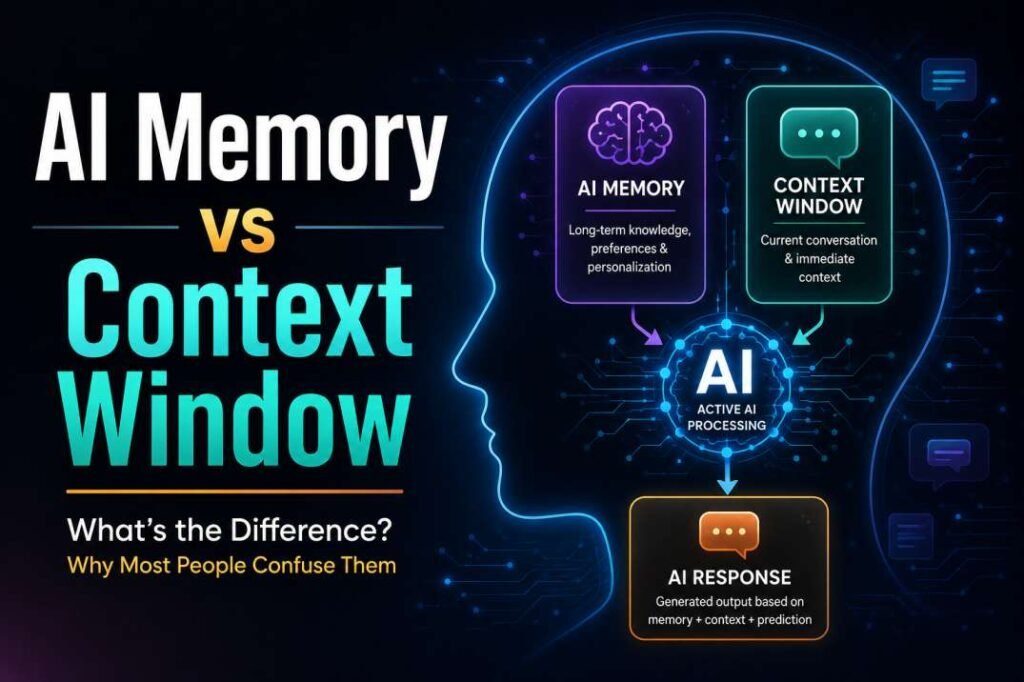
AI memory and the context window are two different concepts that work together in modern AI systems.

The context window represents the information currently available to the AI while generating a response.

AI memory, when available, stores selected information that may be reused across future conversations, such as user preferences or personalization settings. Unlike the context window, memory is not automatically active in every response.

Understanding this distinction explains why AI may appear to forget earlier instructions during long conversations, even when memory features are available.

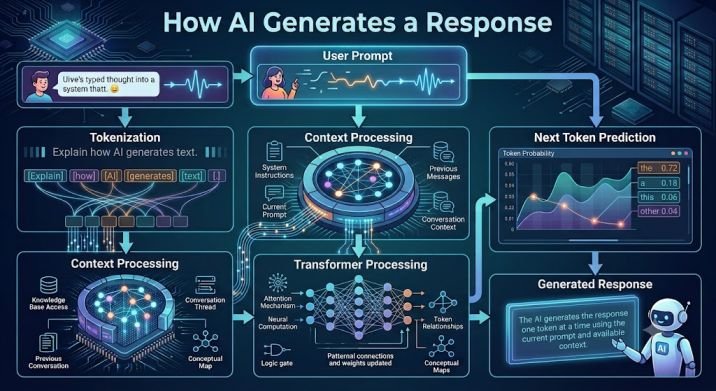
Infographic showing how AI generates a response through user prompt, tokenization, context processing, transformer processing, next token prediction, and generated response.
Figure 1. Simplified AI text generation pipeline showing how a user prompt is converted into a generated response through tokenization, context processing, transformer processing, and next-token prediction.

Why This Confusion Happens

AI conversations often feel natural and continuous, making it easy to assume AI remembers information like a person. In reality, most AI systems generate responses using the information available in the current context rather than recalling everything from previous interactions. Because both memory and the context window can influence responses, the two concepts are often mistaken for the same thing, even though they serve different purposes.

Human Memory vs AI Context

Although AI conversations may feel similar to human conversations, the underlying processes are fundamentally different. Human memory stores, recalls, and connects experiences over time. AI, however, generates each response using only the information available in its active context. As the conversation grows, earlier information may become less influential if it is no longer part of that active context.

The comparison below highlights these key differences.

Human MemoryAI Context Window
Long-term recallTemporary working information
Stores experiencesProcesses active conversation
Persists over timeLimited to available context
Meaning-basedToken-based processing
Can recall old eventsUses current conversation state

What Is a Context Window?

A context window is the information an AI model can actively process while generating a response. It typically includes the current prompt, recent conversation history, system instructions, uploaded files, and other relevant inputs. Instead of reviewing everything it has ever seen, the model relies only on the information available within this active context. As new information enters the conversation, older content may become less influential or eventually fall outside the available context.

This may include:

  • earlier user messages
  • previous AI responses
  • uploaded text
  • system instructions
  • developer instructions
  • current prompt

The size of a context window is measured in tokens, making tokens an important concept for understanding how AI processes information.

What Are Tokens?

Tokens are the small units of text that AI models process instead of counting words or characters. A token may represent a whole word, part of a word, punctuation, or even a space, depending on the tokenizer used.

Every prompt, response, system instruction, and uploaded document is converted into tokens before processing. The total number of tokens that can be handled at one time determines how much information fits within the available context window.

Every message added to a conversation consumes part of the available context. This includes user prompts, AI responses, uploaded documents, formatting instructions, and system guidance. As more tokens accumulate, the model must process increasing amounts of information, which can reduce instruction-following consistency during long conversations.

Running out of available context does not necessarily mean the AI suddenly “forgets.” In many cases, instruction competition, prompt accumulation, and changing conversational priorities begin affecting output quality before the context window reaches its maximum capacity.

Infographic illustrating how AI converts a sentence into words, subwords, and tokens before processing them to generate a response.
Figure 2. AI models do not read complete sentences like humans. Instead, they break text into smaller units called tokens before processing and generating a response.

What Is AI Memory? (And What It Doesn’t Do)

AI memory is a feature that allows some AI systems to retain selected information beyond a single conversation. Depending on the platform, this may include user preferences, recurring instructions, or other details that improve personalization over time.

In many modern AI systems, persistent memory is implemented as a platform feature rather than as an intrinsic property of the language model itself.

This general approach is consistent with publicly available documentation from major AI providers, although implementation details differ between platforms.

Depending on the AI system, memory may include:

  • saved user preferences
  • persistent profile information
  • remembered conversation details (when supported)
  • custom instructions
  • stored personalization

Unlike the context window, memory is designed to remain available across future interactions.

The exact behavior of AI memory varies between AI platforms. Some systems allow users to view, update, or delete stored memories, while others use different approaches or may not offer persistent memory at all.

How AI Memory Works

When memory is enabled, the AI platform identifies selected information that may be useful in future conversations, such as user preferences or recurring instructions. Before generating a response, the platform can make relevant stored information available to the AI model when appropriate.

However, memory is not automatically used in every response. AI platforms determine whether stored information is relevant to the current conversation before making it available to the model. As a result, a response may rely on stored memories, the current context, both, or neither, depending on the platform’s implementation and the task being performed.

The exact decision process for when stored information is used varies by platform and is not fully disclosed publicly.

Different AI Systems Handle Memory Differently

There is no universal AI memory system. Each platform decides how memory is implemented, what information can be stored, and when stored information is used. Some AI assistants support persistent memory across conversations, while others rely primarily on the current conversation unless additional memory features are available.

Because these implementations differ, the same prompt may produce different behavior across AI platforms. Understanding these differences helps set realistic expectations when using AI for personalized or long-term workflows.

Important: Memory features vary between AI platforms and may change over time. Always check the documentation of the specific AI system you are using.

AI PlatformPersistent MemoryUser Control
ChatGPTYesYes
ClaudeLimitedVaries
GeminiYesVaries

Last reviewed: July 2026
AI memory features and user controls may change over time. Always refer to the official documentation of the platform you are using for the latest information.

When This Explanation May Not Apply

This article explains how modern conversational AI systems typically behave. Actual behavior may differ between AI platforms, model versions, enterprise deployments, and future updates.

Why Users Mix Them Up

The confusion usually develops gradually during longer conversations. At first, the AI consistently follows formatting, tone, and writing preferences. As additional prompts introduce new objectives and competing instructions, earlier guidance may become less influential. Many users interpret this change as a memory failure, even though the active context has simply evolved.

Conversation begins.

The AI follows:

  • preferred writing style
  • formatting
  • language
  • constraints

After many prompts:

  • formatting changes
  • tone drifts
  • instructions weaken

Users often assume:

“The AI forgot.”

AI Information Pyramid

Not all information available to an AI system has the same role or priority. During response generation, different types of information are considered at different levels. Thinking of AI information as a pyramid makes it easier to understand why some instructions consistently influence responses while others have only a temporary effect.

The AI Information Pyramid showing the relationship between the current prompt, active context window, and persistent memory during AI response generation.
Figure 3. The AI Information Pyramid. During response generation, the current prompt usually has the strongest immediate influence, followed by the active context window. Persistent memory, when supported by the platform, primarily contributes to personalization across conversations.

The pyramid illustrates influence during response generation rather than technical architecture. A lower layer is not less important—it simply has less immediate influence on the next generated token.

This framework is the author’s conceptual model created to explain how different types of information can influence AI responses. It is intended as an explanatory framework rather than a representation of any specific AI architecture or internal implementation.

Layer 1 —Current Prompt

The instruction you just entered.

Example:

Explain this in simple English.

Highest immediate influence.

Layer 2 —Active Context Window

Everything still available inside the current conversation.

Examples:

  • previous questions
  • earlier answers
  • uploaded content
  • recent workflow

Medium influence.

Layer 3 —Persistent Memory (If Available)

Information intentionally saved for future conversations.

Examples:

  • preferred language
  • writing preferences
  • recurring user settings

Long-term influence, but usually much smaller than the active conversation during response generation.

Why Context Window Matters More During Long Conversations

Long conversations introduce:

  • additional instructions
  • rewrites
  • new objectives
  • formatting requests
  • competing priorities

As the conversation grows, the AI must balance increasing amounts of information.

This can make instruction-following less consistent even though earlier messages still exist in the conversation.

This explains why context management is an important part of reliable AI workflows.

Continue Learning

Explore these related guides:

Practical Example

Imagine you’re writing a research article with an AI assistant. Early in the conversation, you specify that the content should follow APA style and target beginners. As the discussion grows and new instructions, revisions, and examples are added, those early instructions may receive less attention if they are no longer part of the model’s active context.

Now imagine the AI platform has a memory feature that stores your writing preference, such as always using APA style. In a future conversation, that preference may be available again without you repeating it. However, it still does not replace the need for clear instructions in the current conversation.

This example shows that the context window supports the current task, while memory supports long-term personalization.

Author Observation

During repeated workflow testing across multiple AI platforms, I observed that earlier formatting instructions became less influential as new objectives accumulated. This often occurred before the model reached its maximum context capacity, suggesting that instruction competition—not simply context size—can affect response consistency. While different AI platforms behave differently, this pattern appeared across multiple modern conversational AI systems.

Although this observation is not a controlled benchmark, similar behavior appeared consistently across multiple practical AI workflows.

Memory Does Not Guarantee Reliability

Persistent memory can improve personalization.

It does not automatically guarantee:

  • consistent formatting
  • stable instruction following
  • accurate reasoning
  • reliable workflows

These outcomes depend on multiple factors, including prompt quality, context management, and model capabilities. Memory supports personalization but does not replace effective prompting.

Context Window vs Memory

FeatureContext WindowMemory
Active during current responseYesSometimes
Cross-conversation persistenceNoYes (if supported)
Changes continuouslyYesUsually stable
Main purposeResponse generationPersonalization
Affects every token generatedYesIndirectly

Quick Decision Guide

If your goal is…Focus on…
Improve responses in the current conversationContext Window
Personalize future conversationsAI Memory
Reduce forgotten instructionsClear prompts and active context management
Handle long or complex workflowsBreak tasks into smaller stages and summarize key objectives
Troubleshoot inconsistent AI responsesReview the active context before assuming a memory issue
Maintain consistent writing style across sessionsUse AI Memory (if available) and restate critical instructions when needed

Common Misconceptions

Myth: AI memory and the context window are the same.

Reality: The context window supports the current conversation, while AI memory stores selected information that may be reused in future conversations.

Myth: AI memory means the model remembers everything.

Reality: Memory stores only selected information, not every prompt or response.

Myth: A larger context window gives AI better memory.

Reality: A larger context window allows the model to process more information in a single conversation, but it does not create long-term memory.

Myth: Enabling memory prevents AI from forgetting.

Reality: AI can still miss or ignore earlier instructions if they are no longer part of the active context.

Myth: All AI assistants use memory the same way.

Reality: Memory features vary across AI platforms and implementations.

How to Work More Reliably With AI

You can improve consistency by:

  • keeping workflows modular
  • separating large tasks into stages
  • restating critical constraints
  • reducing conflicting instructions
  • summarizing active objectives before major revisions

These practices often improve workflow reliability regardless of whether memory features are available.

Mini Case Study

While testing a long writing workflow, I instructed an AI assistant to always use APA style and beginner-friendly language. During the early stages, it consistently followed those instructions. After multiple revisions, new objectives, and formatting requests, the responses gradually became less consistent even though the original instructions were still part of the conversation.

This behavior appeared before the conversation reached the model’s maximum context capacity, suggesting that instruction competition—not simply context size—can reduce instruction-following consistency.

Why This Difference Matters

Understanding the distinction between memory and context helps explain many common AI behaviors.

It also helps you use AI more effectively by:

  • writing clearer prompts
  • managing long conversations more efficiently
  • setting realistic expectations for AI memory
  • understanding when to restart or restructure a conversation
  • choosing AI tools based on their memory capabilities

Whether you’re using AI for writing, coding, research, or everyday tasks, knowing how memory and the context window work together leads to more reliable results.

Flowchart showing how the current prompt, context window, token prediction, and AI response generation lead to common AI behaviors such as context loss, prompt dilution, hallucination, and generic answers.
Figure 4. Why AI Behaves This Way. Modern AI systems generate responses by combining the current prompt, active context, and next-token prediction. This processing workflow helps explain why behaviors such as context loss, prompt dilution, hallucination, and generic answers can occur.

Final Thoughts

AI memory and the context window are complementary, not interchangeable. The context window determines what an AI model can actively use while generating a response, whereas AI memory—when available—helps retain selected information across conversations. Understanding this distinction makes it easier to write better prompts, interpret AI behavior, and choose the right expectations when working with modern AI systems.

Research Methodology

Sources

This article is based on publicly available documentation from major AI providers, prompt engineering resources, and practical observations of AI workflows. These sources were used to compare documented platform behavior with real-world AI interactions.

Primary references include:

  • OpenAI documentation
  • Anthropic documentation
  • Google Gemini documentation
  • Prompt Engineering Guide

Platform-specific features described in this article reflect publicly available documentation at the time of publication and may change as AI platforms evolve.

Approach

The analysis combines:

  • practical AI workflow observations
  • comparative review of AI platform documentation
  • prompt engineering principles
  • context management concepts
  • repeated testing across writing, research, and prompt-engineering workflows
  • publicly documented AI memory features

The AI Information Pyramid and other explanatory models presented in this article are the author’s original conceptual frameworks designed to simplify complex AI concepts.

Scope

This article explains the practical differences between AI memory and the context window. It is intended for educational purposes and focuses on how modern AI systems typically process information rather than describing the internal implementation of any specific AI model.

Evaluation Objective

The objective was to clarify:

  • how context windows influence response generation
  • how AI memory differs from active context
  • why users often confuse the two
  • how this misunderstanding affects workflow reliability
  • Interpretation
  • This article explains general concepts rather than platform-specific implementation details.
  • Different AI systems may use different approaches to:
  • persistent memory
  • conversation history
  • personalization
  • context management
  • Readers should interpret the examples as conceptual explanations rather than descriptions of every AI platform.

Limitations

AI platforms evolve rapidly.

Memory features, context capacities, and conversation handling may change as new model versions are released.

For this reason, this article focuses on foundational concepts that remain useful even as individual implementations evolve.

Methodology Note: This article presents an explanatory framework intended to improve understanding of AI behavior. It should not be interpreted as reverse engineering or a description of any single proprietary AI model.

Examples throughout this article are simplified for educational purposes and should not be interpreted as describing the internal implementation of any single AI platform.

Frequently Asked Questions

Is the context window the same as AI memory?

No. The context window contains information actively used during response generation, while memory refers to information that may persist beyond the current interaction.

Can AI lose context without losing memory?

Yes. A long or complex conversation can reduce instruction consistency even if personalization features remain available.

Does memory improve accuracy?

Not necessarily. Memory improves personalization, while accuracy depends on many factors, including prompt quality, available information, and reasoning.

Why do long AI conversations become less reliable?

As conversations accumulate more instructions, revisions, and competing objectives, maintaining consistent priorities becomes more difficult.

Does starting a new chat remove memory?

Starting a new chat resets the active conversation context.

Whether previously saved information is still available depends on the AI platform and whether persistent memory or similar personalization features are enabled.

Related Articles

  1. Why AI Loses Context in Long Conversations
  2. What is Prompt Dilution? Why ChatGPT Ignores Your Instructions
  3. Why AI Gives Wrong Answers: 3 Failure Types Explained
  4. Why AI Sounds Confident Even When It Is Wrong
  5. What Happens After Clicking “Generate”? Inside the AI Text Generation Process
  6. AI Tools vs. AI Models: Why ChatGPT, Gemini, and Claude Give Different Answers

References