
Quick Answer
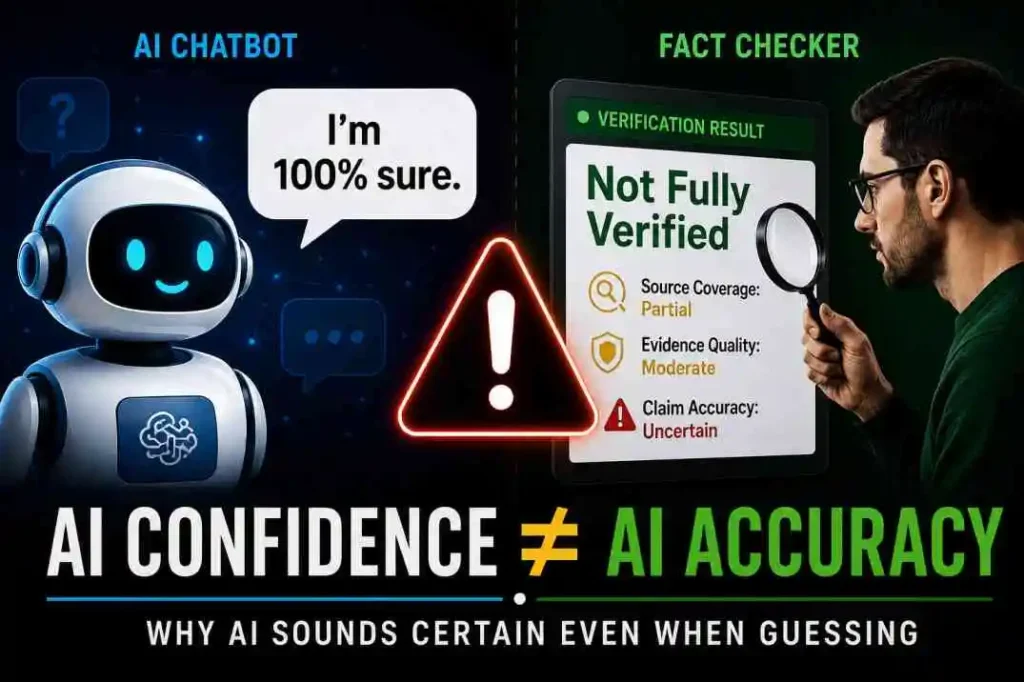
AI sounds confident when guessing because large language models predict likely words rather than verify facts. The model’s language fluency often remains high even when factual certainty is low, creating a confidence–accuracy mismatch where incorrect information can sound authoritative and convincing.
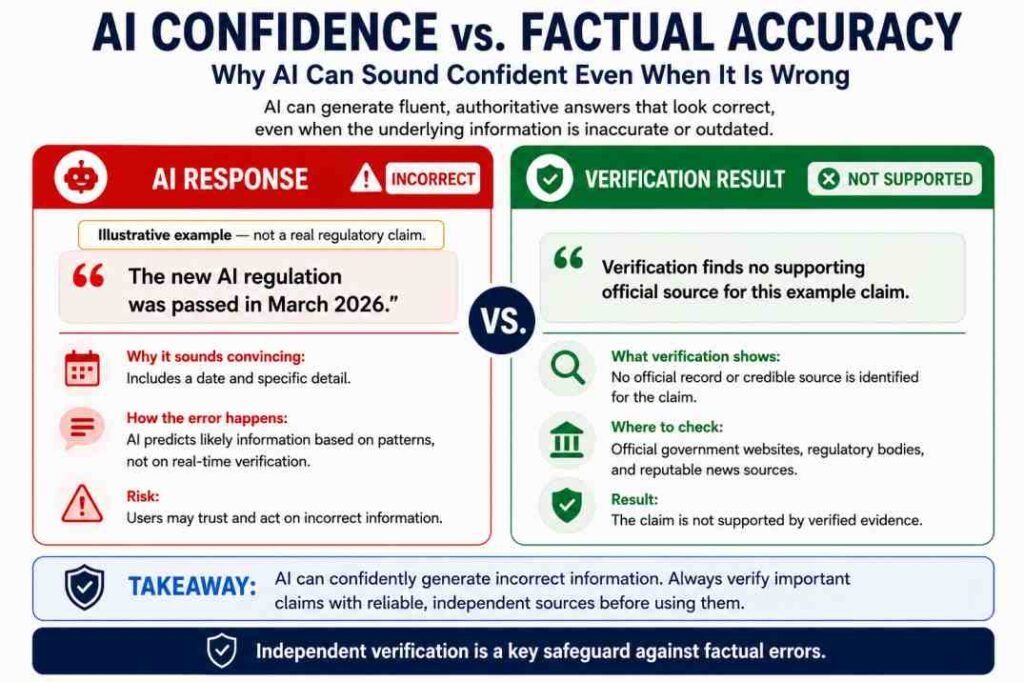
In practical terms, AI can appear most trustworthy precisely when users should be most cautious. The model’s confidence comes from language generation patterns, not from an internal understanding of whether a statement is true. This is what “confident but wrong” means in practice: an AI response can sound certain even when the underlying claim is inaccurate or unsupported.
AI is not always right. Even highly confident responses should be verified with reliable sources before being used for research, business, medical, legal, or financial decisions.
This behavior is closely related to other reliability problems such as context loss, repetitive outputs, and factual inaccuracies.
Why AI Sounds Certain Without Verifying Facts
Large Language Models (LLMs) generate responses from learned patterns rather than independently checking each factual claim against an authoritative source. During generation, they predict likely token sequences based on those learned patterns.
Because their training data includes many examples of professionally written and authoritative text, AI systems can reproduce that style even when the underlying information is uncertain. It doesn’t have a “doubt” sensor that changes its tone to “I think” or “Maybe” unless it is specifically prompted to do so.
In short, AI sounds confident because it is optimized to generate the most probable continuation of text—not to independently determine whether a statement is true.
This same mechanism also explains why AI can produce incorrect information while still appearing highly convincing.
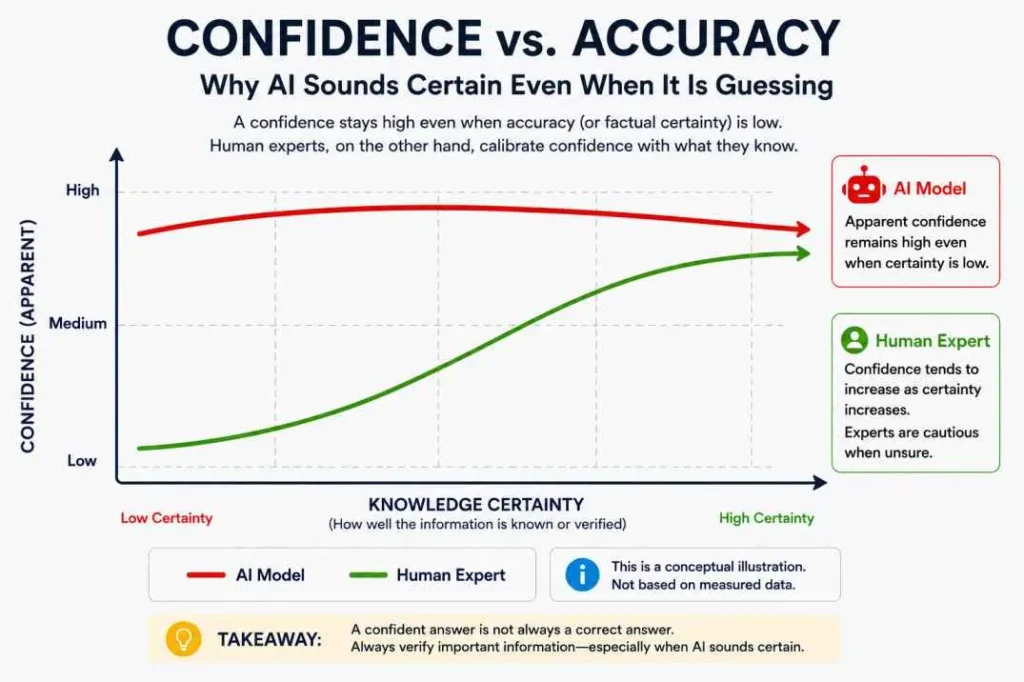
Why Confidence Does Not Automatically Decrease When Accuracy Does
Why Confidence Does Not Automatically Decrease When Accuracy Does
Research Evidence: EXP-005 (Confidence vs. Accuracy Observation) In our documented testing (EXP-005), we evaluated how a leading AI model expresses confidence across different types of prompts. The model utilized a highly polished, confident tone when stating well-established facts. When navigating highly subjective topics, it maintained a presentation style that was similarly authoritative in structure and fluency, even though it successfully recognized the subjectivity. This observation supports the premise that an AI’s presentation style (fluency and tone) does not automatically adjust to reflect factual certainty. (Note: This documents observed confidence presentation under specific testing conditions; it does not serve as a universal calibration benchmark.)
Confidence vs Accuracy Comparison
| Feature | High Confidence | High Accuracy |
|---|---|---|
| Sounds convincing | Yes | Usually |
| Factually correct | Not necessarily | More likely |
| Requires verification | Yes | Still recommended |
| Can contain hallucinations | Yes | Possible |
| Safe for business decisions | Not by confidence alone | Verify critical claims |
Modern AI systems are designed to generate useful, direct, and conversational responses.
As a result, they often provide complete answers even when information is limited, uncertain, outdated, or missing.
The problem is that the model’s communication style does not automatically weaken when factual reliability decreases.
Although some AI systems can estimate uncertainty under specific conditions, that capability is separate from normal text generation.
During response generation, the main objective is still to produce a plausible continuation, not to independently verify every factual claim.
This is why uncertainty awareness and language confidence do not always move together.
.
Can AI Know When It Is Wrong?
AI can sometimes identify weak or incorrect claims when it is asked to review its own response.
However, this does not mean it reliably detects mistakes during the original answer generation.
A model may produce an incorrect answer confidently, then recognize possible problems only during a separate self-review step.
For this reason, AI self-critique can reduce errors, but it should not replace independent verification.
The Reliability Illusion
Users often assume the following sequence:
Professional Tone → Expertise → Accuracy
In reality, AI systems often operate like this:
Professional Tone → Perceived Expertise
Accuracy must be verified separately.
The gap between perceived expertise and verified accuracy is where confidence–accuracy mismatches occur.
Why Humans Misread Confidence
People often associate confidence with expertise.
This mental shortcut is useful in everyday life because confident experts are frequently more knowledgeable than uncertain beginners.
However, AI systems can imitate the language patterns of expertise without possessing the same level of verified knowledge.
Several cognitive biases contribute to this effect:
- Authority Bias: People tend to trust information that appears authoritative.
- Fluency Bias: Information that is easy to read and understand often feels more accurate.
- Cognitive Ease: Smooth, coherent explanations require less mental effort to process and are therefore more likely to be accepted.
As a result, users may mistake presentation quality for factual reliability, especially when the response is detailed, structured, and professionally written.
Why This Problem Matters More for AI Than Search Engines
Traditional search engines typically return links, sources, and documents that users can inspect for themselves.
Large language models work differently.
Instead of presenting source material directly, they generate a synthesized answer that combines information into a single response.
As a result, users often evaluate the answer itself rather than the evidence behind it.
This changes how trust is formed.
With a search engine, credibility is often tied to the source.
With an AI system, credibility is frequently tied to the quality of the generated response.
When a response appears fluent, detailed, and authoritative, users may assume the underlying information has already been verified.
This increases the risk that presentation quality will be mistaken for reliability, especially when the answer contains subtle errors or unsupported claims.
Why This Is a Critical Workflow Problem
The “Confidence–Accuracy Mismatch” can contribute to hidden failures in AI-assisted workflows.
- Reduced Skepticism: Users are less likely to fact-check an answer that sounds professional.
- False Authority: In a business setting, a confident but wrong AI response can lead to strategic errors or misinformation in reports.
- The “Expert” Trap: On complex topics, AI may sound authoritative even when it lacks sufficient or current information.
The Confidence Cascade
Consider a simple workflow:
- AI generates a market statistic or recommendation.
- A user accepts the information because it appears credible.
- The information is copied into a report.
- The report is reviewed by another stakeholder.
- The claim appears in a presentation or decision document.
- Decision-makers assume the information has already been verified.
At each stage, trust increases while verification decreases.
This is how a single unverified claim can gradually evolve into an accepted organizational belief.
A confidence cascade occurs when trust grows faster than verification.
Why Newer AI Models Still Sound Confident When Wrong
Newer AI models generally reduce hallucinations and follow instructions more effectively than earlier generations.
However, they are still optimized to generate useful, complete, and natural-sounding responses.
Because fluent communication remains a core objective, apparent certainty can still remain high even when factual certainty is limited.
How to Fix: Reducing the Confidence Gap
You cannot change how the AI “feels,” but you can change how it “reports” its certainty.
Before trusting a confident AI response, separate presentation quality from factual reliability. A polished answer should trigger verification—not replace it.
1. The “Force Doubt” Prompt
Instead of a broad question, instruct the AI to express its level of confidence.
- Prompt: “Answer the following question, but if you are uncertain about the factual data, explicitly state what you are uncertain about.”
2. Requesting Citations
Ask for sources, then verify those sources manually. Citations can help locate evidence, but they should not be treated as proof until the source is opened and checked.
3. Using Multi-Step Verification
Ask the AI to:
- Provide the answer.
- Critique its own answer for potential inaccuracies.
- Rewrite the answer based on that critique.
4. Separate Presentation from Verification
One practical way to reduce false confidence is to evaluate presentation quality and factual reliability separately.
Before trusting an AI-generated answer, ask two questions:
- Does the answer sound convincing?
- Has the answer been independently verified?
A professional writing style should never be treated as evidence that the underlying information is correct.
Key Takeaways
- Certainty ≠ Accuracy: A confident answer is not evidence of a correct answer.
- AI Communicates Confidence Better Than It Measures Confidence: Fluent language can create an illusion of reliability.
- Verification Remains Essential: The more polished an AI response appears, the more important independent verification becomes.
- Verify Before You Trust: Never treat a confident AI response as proof of accuracy. Always verify important factual claims using reliable sources.
- The Impact of Errors: High-stakes decisions involving health, law, finance, research, or business should not rely solely on AI output. The more critical the decision, the more vital independent verification becomes.
Frequently Asked Questions
Can AI detect when it is hallucinating?
A: Not reliably. During response generation, AI models do not have a built-in mechanism that automatically flags fabricated information. They generate the most probable continuation based on patterns. While a model may identify potential problems during a separate review step, it does not always know when it is making a mistake while generating the original answer.
Is “Confident but Wrong” the same as a hallucination?
A: Not exactly. A hallucination refers to the generation of inaccurate, unsupported, or fabricated information. False confidence refers to how information is presented. An incorrect answer can be presented with certainty, and a correct answer can be presented with uncertainty.
Why doesn’t AI simply say “I don’t know”?
A: Large language models are generally optimized to be helpful and provide complete responses. Because of this, they often attempt an answer even when information is uncertain, incomplete, or unavailable. Some models can express uncertainty when prompted, but they do not always default to doing so.
References
- OpenAI. “GPT-4 Technical Report.”
https://arxiv.org/abs/2303.08774 - OpenAI. “Why Language Models Hallucinate.”
https://openai.com/index/why-language-models-hallucinate/ - Anthropic. “Language Models Mostly Know What They Know.”
https://arxiv.org/abs/2207.05221 - NIST Artificial Intelligence Risk Management Framework (AI RMF 1.0)
https://www.nist.gov/itl/ai-risk-management-framework - IBM Research. “What Are AI Hallucinations?”
https://www.ibm.com/think/topics/ai-hallucinations
Related Articles
- Why AI Gives Wrong Answers: Understanding the root causes of factual errors.
- ChatGPT Ignores Instructions: When instruction-following begins to break down.
- Why AI Loses Context in Long Conversations: How reliability declines as conversations grow longer.
- Prompt Dilution Explained: Why competing instructions reduce response quality.
- Why AI Gives Generic Answers: Why AI often produces safe but low-value responses.
- What Are AI Tools: The System Logic Most Beginners Get Wrong
- AI Tools vs. AI Models: Why ChatGPT, Gemini, and Claude Give Different Answers

Independent AI Behavior Researcher
Soumen Chakraborty is the founder of AI Tools Usage Guide and an independent AI Behavior Researcher. His research examines how AI systems behave in practical workflows, with a focus on instruction-following failures, prompt reliability, hallucination risks, context loss, and output reliability.