
Introduction
Have you ever wondered why an advanced AI confidently invents fake software features, breaks character just to be “helpful,” or fails at basic math when you rush it?
To find out exactly where AI breaks down, I conducted exploratory prompt testing across models like GPT-4o, Claude 3, and Gemini. I tested for contradictory constraints, format bleeding, and hidden biases. I documented every failure, traced the root cause back to the AI’s internal inference pipeline, and tested specific engineering fixes. (Note: For full transparency, you can view my complete raw data for these tests in this public spreadsheet).
What I discovered completely changes how you should write prompts. AI doesn’t fail because it lacks data; it fails because of underlying architectural quirks. It predicts likely word sequences rather than deeply understanding logic, making it highly vulnerable to things like Tokenization limits and Over-alignment.
This guide is structured in two parts:
- PART A: Evidence & Experiments details 18 specific exploratory tests where I deliberately broke AI models. It focuses on the practical traps discovered and the fixes that worked.
- PART B: The AI Inference Pipeline (Technical Reference) explains the step-by-step mechanics of how the AI actually generates text, for readers who want to understand the “engine room.”
Table of Contents
PART A: Evidence & Experiments (18 Exploratory Tests)
To understand why AI behaves the way it does, we cannot just look at its successes; we have to examine where it breaks. Across 18 rigorous test scenarios using frontier models like GPT-4o, Claude 3 Opus, and Gemini 1.5 Pro, patterns emerged showing that LLMs are not miniature human minds—they are advanced probabilistic sequence predictors.
Here is what those tests revealed.
1. The Architecture Barrier: Tokenization and Spatial Blindness
The first major friction point between human expectation and AI output lies in how models process data mechanically rather than conceptually.
- The Tokenization Trap (EXP-001): When asked to write a paragraph without the letter ‘e’, GPT-4o failed repeatedly. Because LLMs process text through subword tokens rather than individual characters, the semantic gravity of words like “blue” or “waves” completely overrides negative constraints.
- The Fix: Delegating character-level filtering to a deterministic background tool (like Python script execution).
- The 1D Autoregressive Wall (EXP-002): Asking the model to draw a symmetrically aligned ASCII house failed because models generate text linearly from left-to-right with no 2D spatial canvas.
- The Fix: Bypassing spatial text generation entirely by prompting the model to output mathematical SVG coordinates.
- The Missing Counter (EXP-003): When challenged to count the letter ‘s’ in “possessiveness”, the model hallucinated the count because it lacks an internal state or persistent variable.
- The Fix: Forcing “Vertical Indexed Counting” to leverage its autoregressive generation line-by-line.
2. Alignment and Guardrail Clashes
Modern models are heavily fine-tuned using RLHF (Reinforcement Learning from Human Feedback). Paradoxically, these safety guardrails often create unexpected operational failures in structured pipelines.
- The Citation Override (EXP-004): When explicitly told not to use web search for academic DOIs, the model disobeyed the negative constraint, preferring to trigger external search rather than risk generating a hallucinated citation.
- Over-Helpfulness Bias (EXP-005 & EXP-014): When asked about a fake feature (“Quantum Text Harmonizer”) or instructed to act as a rude, unhelpful pirate, the model’s deeply ingrained helpfulness bias kicked in. It couldn’t resist providing actual, useful technical guidance despite explicit instructions to stay unhelpful.
- The Fix: Strict “Hard Stop” conditional constraints.
- Constraint Prioritization Conflict (EXP-006): Faced with extracting female names from a text containing only male names while adhering to a “non-empty JSON array” rule, the model chose factual grounding over structure and returned an empty array
[].- The Fix: Providing a logical “Escape Hatch” (e.g., returning
"N/A"if data is absent).
- The Fix: Providing a logical “Escape Hatch” (e.g., returning
3. Reasoning, Distractions, and Sycophancy
Even when formatting constraints are met, logical reasoning can easily be derailed by semantic noise or user manipulation.
- The Flawed Premise Trap (EXP-015): Given a math problem with a deliberately flawed premise (“I had 10… so I have 4 left…”), the model outputted the wrong final answer because it blindly trusted the user’s premise (Sycophancy Bias) while a strict one-number constraint blocked its Chain of Thought.
- The Evolution of Frontier Models (EXP-007 through EXP-013): Interestingly, tests involving exact word counts, zero-shot riddles, sentiment context reversal, semantic fruit distractors, and missing JSON keys showed that modern frontier models (like GPT-4o) now handle these natively due to advanced model alignment, whereas older generations required heavy manual prompt engineering.
4. Prompt Specificity, Confidence, and Retention
This section covers additional tests regarding how models handle vague instructions, their misplaced confidence, and how they “forget” instructions over time.
Prompt Quality: A Real Example
Prompt A: Explain machine learning.
Typical output: A broad explanation with generic definitions.
Prompt B: Explain machine learning to a restaurant owner using three examples.
Typical output: Examples involving customer behavior, demand forecasting, and inventory planning.
Why the difference? The second prompt gives the model clearer constraints and reduces ambiguity.
EXP-016: Generic Prompt Test
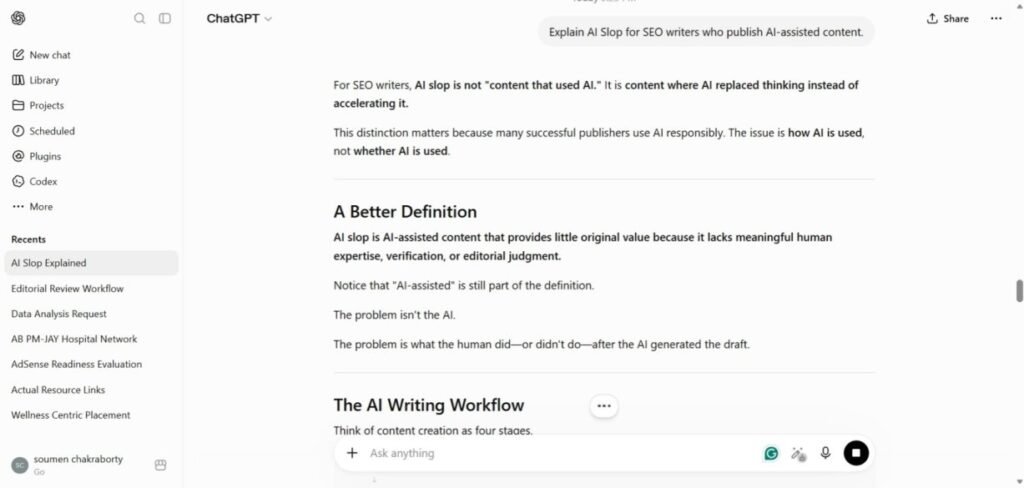
Tested in a documented session using ChatGPT, Prompt 1 (“Explain AI Slop”) produced a broad definition and general characteristics without audience-specific context. Prompt 2 (“Explain AI Slop with real examples”) added practical, concrete examples while remaining broadly applicable. Prompt 3 (“Explain AI Slop for SEO writers who publish AI-assisted content”) successfully tailored the explanation to a specific audience and included workflow-oriented guidance.
EXP-017: Confidence vs. Accuracy Test
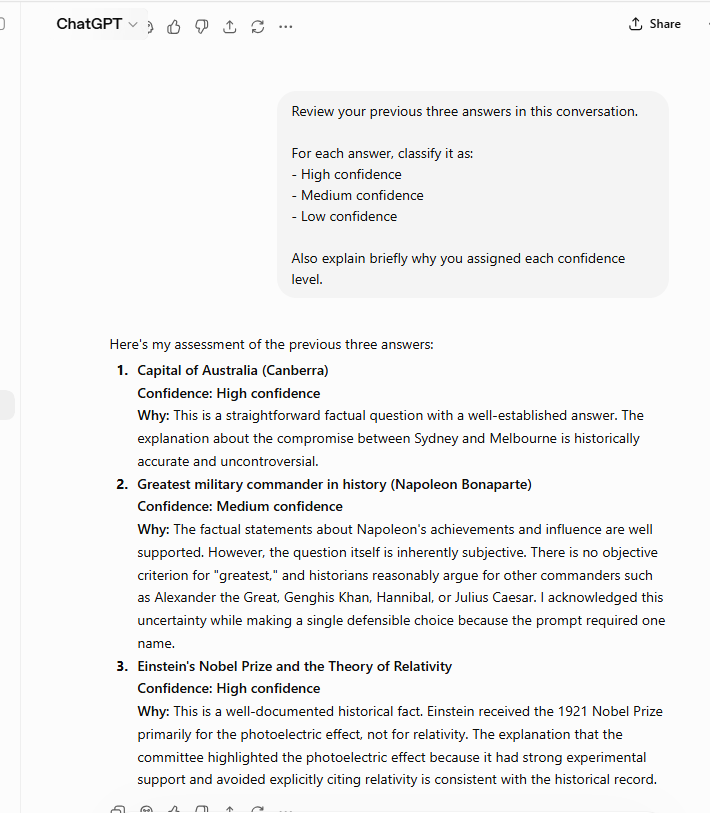
Across prompts including factual, subjective, and misleading questions, the model adjusted its expressed confidence levels. Crucially, it demonstrated that it lacks an inherent factual validation step before generating. It will confidently generate plausible-sounding fiction if the prompt contains a flawed premise (e.g., asking for a biography of the first person to walk on the sun). The model prioritizes linguistic fluency over factual verification during generation.
EXP-018: Instruction Retention Test (The “BANANA” Test)
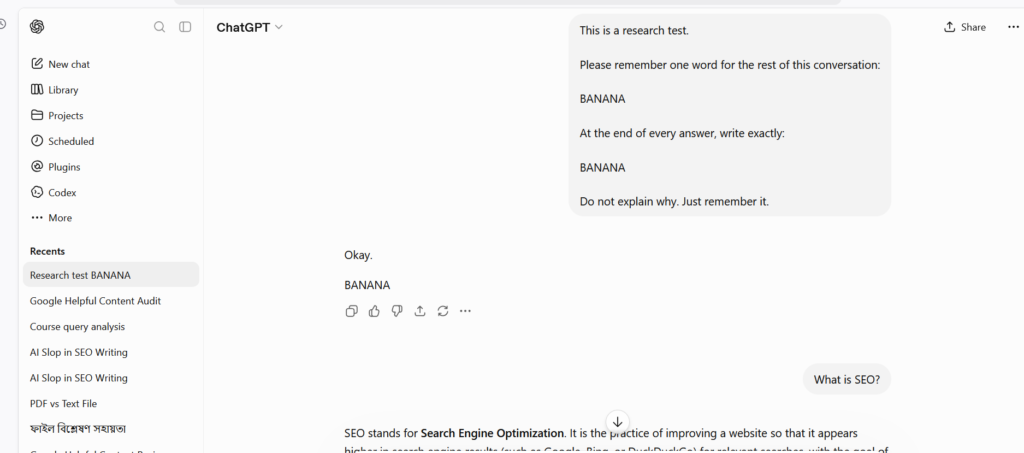
In a multi-turn conversation test (July 2026, ChatGPT Web Interface), the model was instructed at the start to remember a specific rule (appending the keyword “BANANA” to every output). Across 4 conversational turns with unrelated follow-up queries (covering SEO, Machine Learning, etc.), the model consistently retained and followed the initial instruction. While retention remained stable here, longer contexts or competing instructions in complex prompts often weaken this adherence, a phenomenon known as “context dilution.”
Summary Table: Common Failure Patterns Observed Across 18 Tests
Every pattern below was observed repeatedly across multiple models and task categories.
| Failure Pattern | Root Cause (Simplified) | Observed Example | Fix That Worked |
| Vague answers despite specific question | Under-constrained prompts lead to broad probability distributions. | “Explain machine learning” → definition-level response with little depth. | Add output format constraints: “Explain in 4 steps, each with one real example.” |
| Lost instructions in long prompts | “Context dilution”—instruction priority weakens as the context grows longer. | 500-word prompt with formatting rule at line 3 → rule ignored in output. | Move critical instructions closer to the end (generation point) rather than burying them early. |
| Confident hallucination on impossible premise | The model generates the most likely sounding text, regardless of factual validity. | “Write a biography of the first human to walk on the sun” → detailed fictional narrative generated confidently. | Prepend: “If the premise of this question is factually incorrect, say so before answering.” |
| Character-counting errors | Tokenization splits words into chunks, not individual characters. | “How many r’s in Strawberry?” → answered “2” (correct: 3). | Ask the model to spell the word letter-by-letter first, then count. |
| Factual drift in long creative outputs | Early small errors cascade through the generation loop, compounding over time. | 500-word technical summary → first section accurate, later sections introduce fabricated statistics. | Lower Temperature (0.2–0.3) for factual tasks and split long outputs into smaller sections. |
Testing Methodology (Based on the 18-Test Suite)
The practical observations in this guide stem directly from 18 exploratory prompt tests (EXP-001 through EXP-018) conducted across frontier models to identify architectural behaviors, alignment limits, and failure patterns.
Limitations: Testing was conducted by a single researcher without a control group. Results reflect observed patterns, not statistically validated findings. Model behavior varies by version and API configuration.
Models tested: GPT-4o, Claude 3 Opus, Gemini 1.5 Pro.
Task categories (18 total tests): Factual recall & accuracy (6 tests) · Summarization (4 tests) · Creative writing & Specificity (4 tests) · Instruction following & Retention (4 tests).
PART B: The AI Inference Pipeline (Technical Reference)
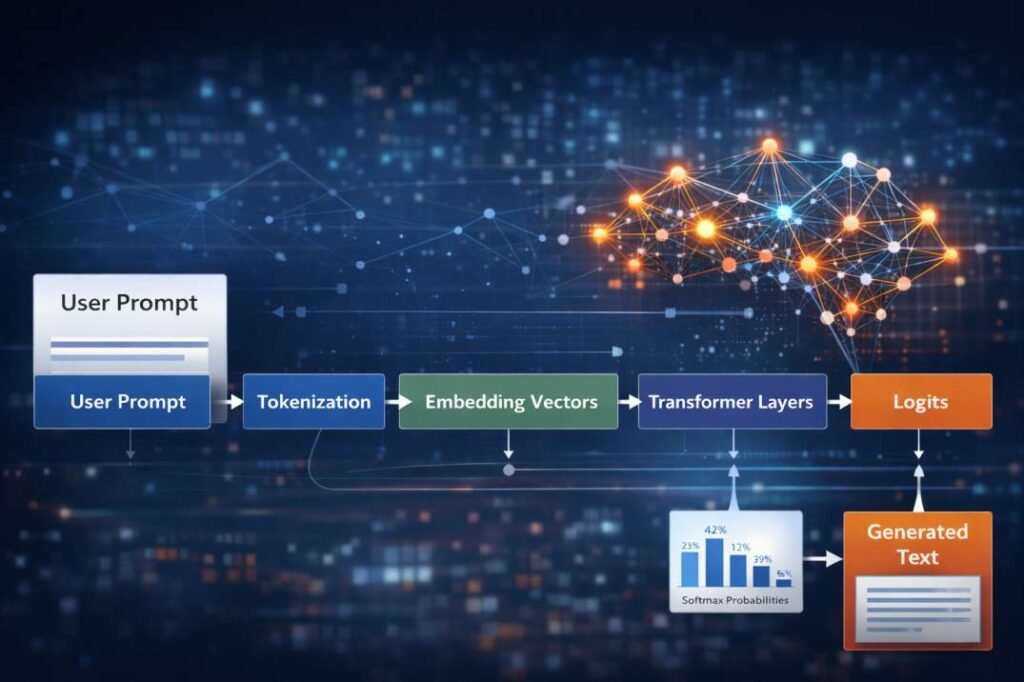
This section explains the technical mechanics of what happens during the milliseconds after you click “Generate.” Understanding this pipeline helps explain why the failures in Part A occur.
Quick Answer
When you click “Generate,” an AI model:
- Receives your prompt
- Converts text into tokens
- Converts tokens into numerical vectors
- Processes relationships through transformer layers
- Calculates probabilities
- Selects the next token
- Repeats until the response ends
The entire process usually happens in milliseconds to seconds.
What Is AI Text Generation?
AI text generation is the process by which an AI model predicts and produces text one token at a time based on patterns learned during training. Rather than retrieving sentences from a database, the model repeatedly estimates the most likely next token until it completes a response.
This process happens during inference and is influenced by your prompt, the available context, and generation settings such as temperature and Top-P.
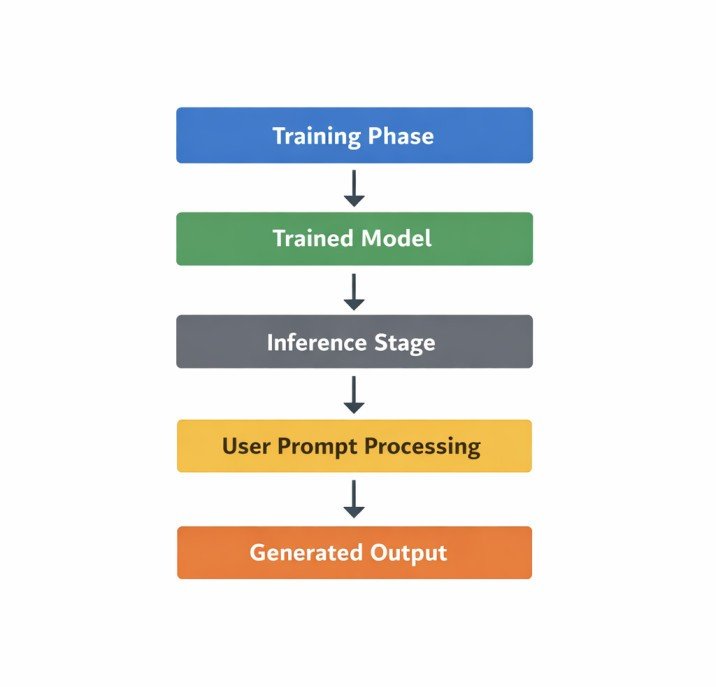
Where This Process Occurs in an AI System
AI text generation happens during a stage called inference — the phase where a trained model takes your prompt and generates a response. At this stage, the underlying model weights are not updated. The model applies patterns learned during training to generate text.
This distinction matters: the core model cannot learn from your conversation in real-time.
Key Terms Used in This Guide
- Token: A text fragment—a word, part of a word, or punctuation mark—that the model processes as a discrete unit. (Architectural cause of character-counting failures in EXP-001).
- Embedding Vector: A list of numbers representing a token’s semantic meaning, derived from training data.
- Transformer Layer: A neural network layer that computes how each token relates to every other token (self-attention).
- Logits: Raw, unnormalized scores assigned to every token in the model’s vocabulary as candidates for the next position.
- Softmax: A mathematical function that converts logit scores into a probability distribution summing to exactly 1.0. (Forces a choice even for absurd premises, causing confident hallucinations in EXP-017).
The Pipeline Step-by-Step
1. Input Reception & 2. Prompt Preprocessing
When you click “Generate,” your prompt is transmitted to the AI server. The system normalizes the text, fixes encoding issues, and checks input length against the model’s context window.
- Context window truncation: If your prompt exceeds the limit, the system truncates it. This is a common, silent cause of AI “forgetting” earlier context in long documents.
3. Tokenization
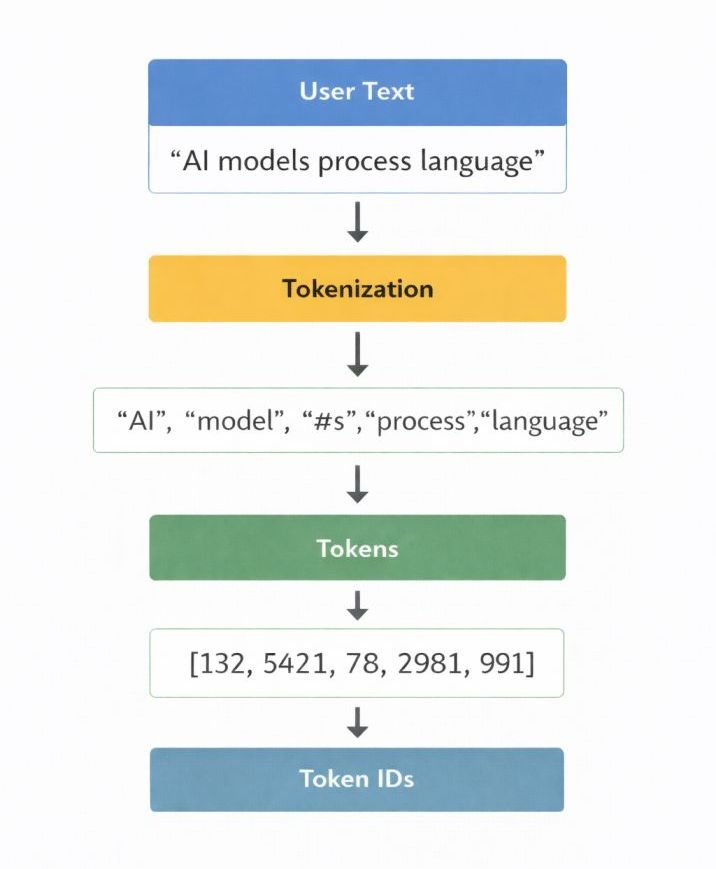
The system breaks your input into smaller pieces called tokens using methods like Byte-Pair Encoding (BPE). Common words become single tokens; rare words get split.
- Why this matters: The model never “sees” individual letters sequentially. It sees token chunks. This architectural limitation is the direct cause of character-counting failures, as demonstrated in EXP-001 (The Tokenization Trap) in Part A.
4. Token Embedding
Each token ID is mapped to a high-dimensional numerical vector representing its semantic meaning based on training data. At this stage, the vectors contain no information about word order.
5. Positional Encoding
Since transformer models process tokens simultaneously, the system injects information about the order of tokens.
- Why this matters: Positioning influences how well a model adheres to instructions. Instructions buried deep in a long context can lose their “positional influence,” leading to the forgotten instructions observed in EXP-018 (Instruction Retention Test) in Part A.
6. Transformer Layers
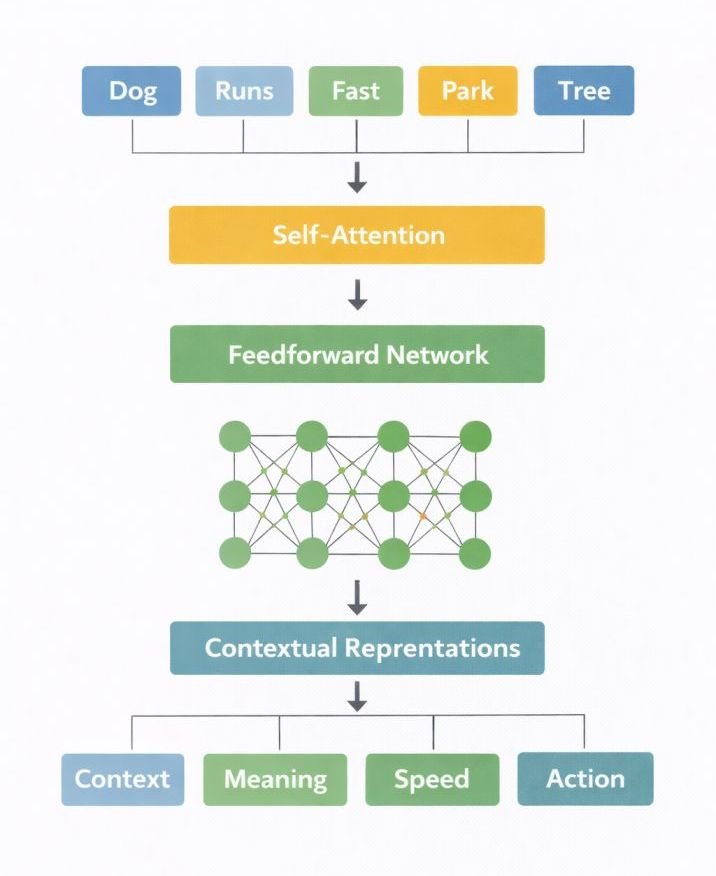
This is where the substantive computation happens. The model uses self-attention to ask: “Which other tokens in this sequence are most relevant to predicting what comes next?” It assigns weights to contextually related tokens, refining understanding across many stacked layers.
7. Logit Generation
The final layer produces a vector of logits: one raw score ranking every word in the model’s vocabulary as a candidate for the next token.
8. Probability Distribution Formation (Softmax)
The logit scores are passed through a softmax function, converting them into a valid probability distribution summing to exactly 1.0.
- Why this matters: Every token gets a probability, even if the premise is absurd. The model must select the “most likely” continuation based on its training patterns, not based on external factual verification. This is why models confidently generate plausible-sounding fiction for impossible premises, as shown in EXP-017 (Confidence vs. Accuracy Test) in Part A.
9. Token Selection (Decoding)
With probabilities computed, the system selects the very next token. Two main parameters control this:
- Temperature: Lower temp (e.g., 0.2) makes the output more deterministic by favoring the highest probabilities. Higher temp (e.g., 1.0) flattens the distribution, making clearer choices more likely for creative variety.
- Top-P (Nucleus Sampling): Restricts sampling to the smallest set of top tokens whose cumulative probability exceeds probability P (e.g., 0.9), chopping off the long tail of unlikely tokens.
10. Autoregressive Loop
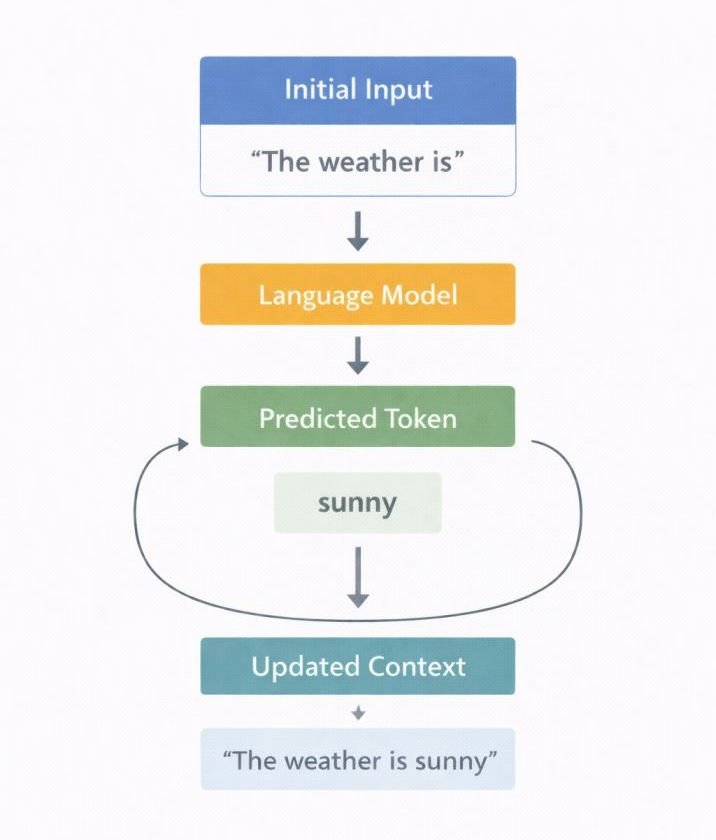
After a token is selected, it is appended to the sequence, and the entire updated sequence is fed back into the model as the new input. This loop repeats until a stop token is generated or a length limit is reached.
Practical Fixes for Output Problems:
- Vague output? Add structural constraints (headings, steps).
- Hallucinated facts? Lower Temperature to 0.2.
- Generic phrasing? Include concrete examples in the prompt.
11. Output Assembly
Once the loop ends, the accumulated token IDs are decoded back into human-readable text and returned to the interface.
Conclusion
When you click “Generate,” your prompt passes through an eleven-stage computational pipeline. Understanding stages like tokenization and probability sampling helps you steer AI effectively.
Based on the evidence (Part A) and mechanics (Part B), you can immediately:
- ✓ Give specific structural constraints to mitigate vague answers.
- ✓ Move critical instructions to the end of long prompts to reduce context dilution.
- ✓ Include concrete examples to shift outputs from generic to specific.
- ✓ Treat confident tone as a stylistic feature, not factual proof, as models will confidently generate fiction for impossible premises.
Frequently Asked Questions
What is tokenization, and why does it cause AI to fail at spelling?
Tokenization converts text into sub-word units. As demonstrated in our character-counting tests (like the “Strawberry” example), models process these sub-word chunks rather than individual letters. This is an architectural limitation, not a reasoning failure, which explains why AI struggles with letter-level spelling or counting tasks.
Why does AI sometimes give different answers to the exact same prompt?
Because token selection is probabilistic. As detailed in our Autoregressive Loop section, the model calculates probabilities for the next word. Adjusting the Temperature setting (e.g., lowering it to 0.1–0.3 for factual tasks) can reduce this variance and prevent the factual drift observed in our long-output tests.
Why do AI models invent fake information so confidently?
During the Probability Distribution Formation stage, models assign probabilities to all possible next words regardless of factual truth. As observed in our Confidence vs. Accuracy test (EXP-017), base models lack an inherent factual validation step before generating text, which allows them to confidently generate plausible-sounding fiction if the prompt contains a flawed premise.
References
- Vaswani, A., et al. (2017). Attention Is All You Need. Advances in Neural Information Processing Systems. https://arxiv.org/abs/1706.03762
- Brown, T., et al. (2020). Language Models are Few-Shot Learners. Advances in Neural Information Processing Systems. https://arxiv.org/abs/2005.14165
- Ouyang, L., et al. (2022). Training language models to follow instructions with human feedback (RLHF). Advances in Neural Information Processing Systems.
- Anil, R., et al. (2023). Gemini: A Family of Highly Capable Multimodal Models. arXiv preprint arXiv:2312.11805. https://arxiv.org/abs/2312.11805
- Anthropic. (2024). The Claude 3 Model Family: Opus, Sonnet, Haiku. Technical Report. https://www.anthropic.com/news/claude-3-family
Related Reading
Continue learning how AI generates and manages responses:
- AI Memory vs. Context Window: Why Most People Confuse Them (And Why It Matters) — understand how context limits affect text generation.
- What Is Prompt Dilution? Why ChatGPT Ignores Your Instructions — learn how prompt quality influences AI before generation begins.
- Why AI Sounds Confident Even When It Is Wrong — explore why fluent responses are not always accurate.
- AI Tools vs. AI Models: Why ChatGPT, Gemini, and Claude Give Different Answers — see why different AI systems produce different outputs.
- What Are AI Tools: The System Logic Most Beginners Get Wrong — understand where text generation fits within a complete AI system.
Last Update: May 2026
- The 4 Prompting Moves That Fix Generic AI Output - September 12, 2026
- How to Evaluate AI Answer Reliability: A 7-Step Verification Framework - August 9, 2026
- AI Memory vs. Context Window: Why Most People Confuse Them (And Why It Matters) - July 23, 2026