

Introduction
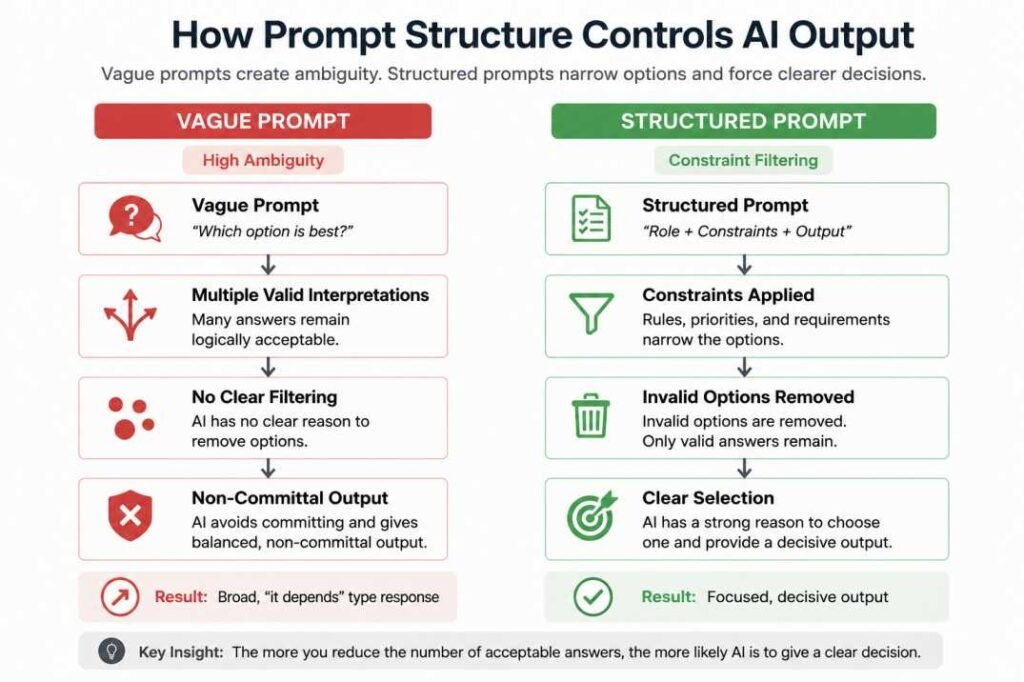
Prompt structure determines how many answers an AI model considers acceptable.
When prompts are vague, multiple responses remain logically valid. The model avoids committing and produces broad, non-committal answers.
Structured prompts change this behavior.
By adding constraints, priorities, and output requirements, you reduce the number of acceptable outcomes the model can generate. As the possible answer range narrows, the AI becomes far more likely to produce a clear and decisive response.
This article explains why that happens, how structured prompts alter AI decision behavior, and how to design prompts that consistently produce stronger outputs.
Quick Answer: AI gives vague answers when multiple responses remain logically acceptable.
Structured prompts improve output quality by reducing ambiguity through constraints, priorities, and output requirements. As the number of acceptable answers decreases, the model becomes more likely to produce a clear and decisive response instead of a broad or non-committal one.
In practice, the most effective prompts usually contain:
- a defined role
- hard constraints
- a forced output format
Table of Contents
Quick Test (Try This Now)
Before reading further, try this experiment:
- Ask any AI: “Which marketing strategy is best for my business?” (Observe the vague, “it depends” answer).
- Now, rewrite it with:
- Role: Senior Growth Strategist
- Constraints: Budget under $500 + Results needed in 15 days
- Output: Single best recommendation
You’ll see the difference instantly—less explanation, more decision. The difference comes from how the prompt restricts the model’s possible outputs.
The Experiment: The Hiring Decision Test
To validate this theory, we conducted a logic test using a standard hiring scenario. The goal was to see if the AI would make a definitive choice or revert to safe, non-committal summaries.
Initially, the model defaulted to “it depends” reasoning, keeping multiple outcomes equally valid because the prompt lacked clear boundaries to eliminate them.
Research Evidence: EXP-001 — Generic Prompt Test
Phase 1: The Raw Prompt (Failure Case)
The Prompt:
“I have three candidates. John has 5 years of experience but wants a high salary. Sarah has 3 years of experience and is a strong team player. Mike has 10 years of experience but refuses to work in the office. Who should I hire?”
AI Output Behavior: The model produced a balanced but non-committal response:
- Neutrality: It highlighted the individual strengths of all three candidates.
- Hedging: It avoided eliminating any option.
- Passivity: It deferred the final decision back to the user.
Verdict: FAIL The issue here isn’t a lack of intelligence; it is decision avoidance. Because all three candidates remained “logically acceptable” within the vague prompt, the AI had no logical incentive to select one over the others.
Phase 2: The Structured Prompt (Constraint Applied)
In the second phase, we applied the Single-Variable Refinement Method by introducing hard constraints that structurally removed the “acceptability” of certain candidates.
The Prompt:
Role: Senior Recruitment Analyst
Task: Select exactly one candidate for a Startup Lead role
Constraints:
- Budget is strictly fixed at $60k (Excludes John)
- Role requires 100% in-office presence for 6 months (Excludes Mike)
- Culture fit is secondary, not a hard requirement
Data: Same candidate info as Phase 1
Output: Provide a decision table and final selection
AI Output Behavior:
- Aggressive Filtering: The model immediately eliminated John (budget violation) and Mike (requirement violation).
- Definitive Selection: It selected Sarah as the only viable candidate.
- Logic-Based Justification: The decision was justified by constraint satisfaction rather than generic praise.
Verdict: SUCCESS
By shrinking the solution space, the model shifted from broad evaluation to aggressive filtering.
Once only one candidate satisfied the constraints, the AI became far more likely to produce a clear selection.
Research Evidence: EXP-003 — Multi-Instruction Compliance Test
Key Insight From Testing
In repeated testing, a clear pattern emerged:
- Open-ended prompts usually produced broad or non-committal answers
- Adding 2–3 hard constraints consistently pushed the model toward clearer decisions
The biggest improvement was not accuracy—it was decisiveness.
Instead of reviewing several vague possibilities, structured prompts produced one clearer direction to evaluate.
Cross-Model Consistency: Does This Behavior Hold Across Models?
We ran the same hiring logic test across multiple leading models:
- ChatGPT (GPT-4o)
- Claude 3.5 Sonnet
- Gemini 1.5 Pro
Observed Pattern:
| Model | Raw Prompt Behavior | Structured Prompt Behavior |
|---|---|---|
| GPT-4o | Balanced, cautious, non-committal | Clear elimination and final selection |
| Claude 3.5 Sonnet | Faster logical framing but still hedged | Strong constraint adherence, decisive |
| Gemini 1.5 Pro | More verbose explanation, less filtering initially | Improved selection after constraints, but more explanatory |
Research Evidence: EXP-006 — Model Comparison Test
Key Insight:
Unstructured prompts → multiple acceptable answers
Structured prompts → constrained decision outcome
Output Comparison (Before vs After)
Raw Prompt Output:
“It depends on your needs. Each candidate has strengths…”
Structured Prompt Output:
“Hire: Sarah
Reason: Only candidate within budget and meeting in-office requirement.”
Difference:
- Raw prompt → explanation
- Structured prompt → decision
How Prompt Structure Forces AI Decisions
AI gives vague answers when multiple responses remain logically acceptable.
In unstructured prompts:
- priorities are unclear
- trade-offs remain unresolved
- several interpretations remain valid
As a result, the model defaults to balanced or non-committal responses.
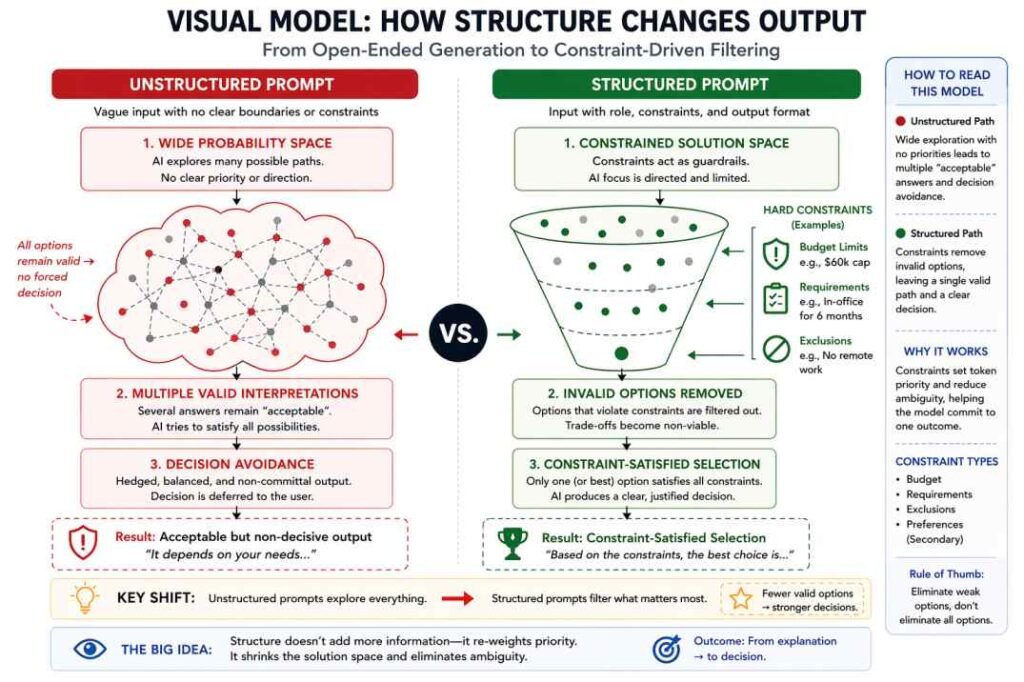
Structured prompts reduce the number of acceptable outcomes by introducing hard constraints, exclusions, and priorities.
Instead of evaluating every option equally, the AI begins filtering based on the rules you provide.
Vague prompt → many valid answers → hedging
Structured prompt → fewer valid answers → clearer decisions
The Science Behind the Failure
AI models do not treat every part of a prompt equally.
When prompts lack structure, multiple instructions compete for attention simultaneously. This often creates attention drift: the model keeps several possible interpretations active instead of following one clear decision path.
As a result:
- important constraints lose priority
- trade-offs remain unresolved
- outputs become cautious or generic
Structured prompts reduce this ambiguity by making certain conditions more important than others.
Instead of treating every option equally, the model begins filtering based on the constraints you provide.
According to transformer-based model research, attention mechanisms determine how input tokens are weighted during generation.
Expert Insight: Constraint Ordering Matters
Not all constraints should carry equal weight.
If priorities are unclear, the model may try to balance conflicting conditions instead of enforcing the most important rule.
Example:
Critical Constraint:
- Budget under $500
Secondary Preference:
- Faster delivery
Without priority labels, the AI may produce unrealistic compromises.
By defining which constraint matters most, you guide the model toward more consistent decisions.
Warning: The “Empty Set” Trap
If you apply multiple hard constraints that cannot coexist (e.g., “Immediate results” + “Zero budget” + “High quality”), the model may generate unrealistic compromises.
To prevent this, include a fallback clause:
“If no option meets all constraints, identify the closest match and explicitly state which constraint was violated.”
Quick Examples Across Use Cases
Marketing:
Unstructured → “You can try SEO, ads, or content marketing”
Structured → “Use SEO due to budget constraint and long-term ROI”
Product:
Unstructured → “Feature A improves UX, Feature B improves speed”
Structured → “Prioritize Feature B due to performance requirement”
Finance:
Unstructured → “Stocks and bonds both have advantages”
Structured → “Choose bonds due to low-risk constraint”
Analyst Decision Rule: The 3-Part Prompt Check
Before submitting any prompt, apply this filter:
1. Role — Who is making the decision?
(e.g., Analyst, Editor, Auditor)
2. Constraints — What conditions cannot be violated?
(e.g., budget limits, requirements, exclusions)
3. Output — What form must the answer take?
(e.g., table, score, ranked list)
If any of these are missing, the model will default to a safe, non-committal response.
When Structured Prompts Fail (Important Limitation)
Structured prompting is powerful—but it is not universally optimal.
It performs poorly when the goal is:
– idea generation
– creative writing
– open-ended exploration
In these cases, constraints reduce variation and limit useful outcomes.
Use structure when:
– a decision is required
– options must be filtered
– consistency matters
Avoid structure when:
– you want unexpected ideas
– ambiguity is useful
In these scenarios, removing constraints often produces better results because it expands the solution space instead of restricting it.
Advanced Solution for Complex Tasks
While adding constraints helps the AI decide, there is a limit to how much logic a single prompt can hold. When a task requires too many steps, the model’s attention budget becomes exhausted, leading to errors.
For complex workflows, separating reasoning into multiple stages usually produces more reliable outputs than forcing every task into one prompt. This allows each stage of reasoning to be handled more reliably before moving to the next step.
The Exception: When Constraints Over-Restrict
Constraints improve decisions—but excessive constraints can break the system.
Example:
Role: Analyst
Task: Recommend a business strategy
Constraints:
- Budget under $100
- Must generate results in 24 hours
- No digital channels
- No offline channels
In this case, the model may:
- Fail to produce a meaningful answer
- Generate forced or unrealistic suggestions
- Default to generic fallback responses
This happens because the solution space is reduced to near zero.
This can be understood as over-restricting the prompt—the constraints are so tight that no valid solution remains.
Practical Rule:
Constraints should eliminate weak options, not eliminate all options.
If the model struggles to respond, your constraints are likely over-restrictive.
Copy-Paste Prompt Framework
Use this template to force consistent output:
Role: [Define the decision-maker]
Task: [State the objective clearly]
Constraints:
1. [Hard limitation]
2. [Hard limitation]
3. [Optional preference]
Data:
[Insert your input]
Output:
[Define exact format]
This converts an open-ended prompt into a controlled evaluation system.
Real-World Use Case: Fixing a Vague Business Decision
A user asks:
“What is the best pricing strategy for my product?”
Unstructured output:
“You can consider competitive pricing, value-based pricing, or cost-plus pricing.”
Structured version:
Role: Pricing Analyst
Task: Select the best pricing strategy
Constraints:
- Product is new to market
- Budget is limited
- Goal is fast customer acquisition
Output:
“Use competitive pricing to reduce entry friction and gain initial users.”
The improvement comes from reducing ambiguity, not from giving the AI more information.
Summary: How to Control AI Output
AI output quality is strongly influenced by how many responses remain logically acceptable.
Vague prompts leave multiple interpretations open, so the model avoids committing and produces broad or cautious answers.
Structured prompts narrow the range of acceptable answers by adding constraints, priorities, and output rules.
As ambiguity decreases, the model becomes far more likely to produce consistent and decisive outputs.
Better prompting is not mainly about giving the AI more information.
It is about reducing ambiguity until only strong decisions remain.
Research Evidence: EXP-007 — Ambiguity Resolution Test
Analyst Checklist: Is Your Prompt Structured for a Decision?
Before submitting your prompt, validate it using this quick check:
[ ] Identity Check: Have you defined a clear role? (e.g., Analyst vs. Advisor)
[ ] Boundary Check: Are there at least 2 hard constraints? (e.g., budget, time, requirement)
[ ] Outcome Check: Is the output format forced? (e.g., table, rank, yes/no)
[ ] Conflict Check: If constraints clash, is priority clearly defined?
If any of these are missing, the model will likely default to a safe, non-committal response.
Frequently Asked Questions
Q1. Why does AI give vague or “it depends” answers?
AI gives vague answers when prompts allow multiple valid interpretations. Without constraints, the model avoids committing to one outcome and produces balanced or non-committal responses.
Q2. Does adding more details improve AI output?
Not necessarily. Adding more details without constraints can increase ambiguity. Better results usually come from reducing acceptable options rather than adding more information.
Q3. What is the most important element in prompt structure?
Constraints are the most important element because they determine which answers remain valid and which are eliminated.
Q4. Can too many constraints make AI output worse?
Yes. Over-restricting prompts can reduce the solution space too much, leading to unrealistic, rigid, or low-quality outputs.
Q5. How do I know if my prompt structure is incomplete?
If the AI continues producing multiple acceptable answers instead of a clear decision, the prompt likely lacks strong enough constraints or output requirements.
References
Vaswani, A. et al. (2017). Attention Is All You Need.
https://arxiv.org/abs/1706.03762
IBM. What is an Attention Mechanism?
https://www.ibm.com/think/topics/attention-mechanism
Wikipedia. Transformer (Deep Learning)
https://en.wikipedia.org/wiki/Transformer_(deep_learning)
- The 4 Prompting Moves That Fix Generic AI Output - September 12, 2026
- How to Evaluate AI Answer Reliability: A 7-Step Verification Framework - August 9, 2026
- AI Memory vs. Context Window: Why Most People Confuse Them (And Why It Matters) - July 23, 2026