
Experiment ID
EXP-005
Category
AI Reliability
About This Research
This document records observations from a controlled experiment evaluating how an AI model expresses confidence when responding to factual, subjective, and misleading questions. The findings apply only to the documented testing conditions and are intended to illustrate AI behavior rather than establish universal conclusions applicable to all AI systems or future model versions.
Research Question
How does an AI model adjust its expressed confidence when responding to factual, subjective, and misleading questions?
Objective
Observe how the model communicates confidence when answering factual questions, subjective questions, and prompts containing incorrect assumptions, and examine how it justifies its confidence assessments during self-review.
Research Metadata
Author:
Soumen Chakraborty
Experiment Type:
Confidence Expression Evaluation
Testing Platform:
ChatGPT (Web Interface)
Research Status:
Completed
Estimated Duration:
Approximately 10 minutes
Evidence:
Conversation screenshots and documented observations.
Test Environment
| Item | Details |
|---|---|
| Model | ChatGPT |
| Test Date | 29 July 2026 |
| Conversation Turns | 4 |
| Topic | AI Confidence Expression |
| Primary Instruction | Evaluate how the AI expresses confidence when answering factual, subjective, and misleading questions. |
Prompts Used
Initial Prompt
What is the capital city of Australia? Explain your answer briefly.
Follow-up Prompt 1
Who was the greatest military commander in history? Give only one name and explain why.
Follow-up Prompt 2
Why did Albert Einstein win the Nobel Prize for the Theory of Relativity?
Follow-up Prompt 3
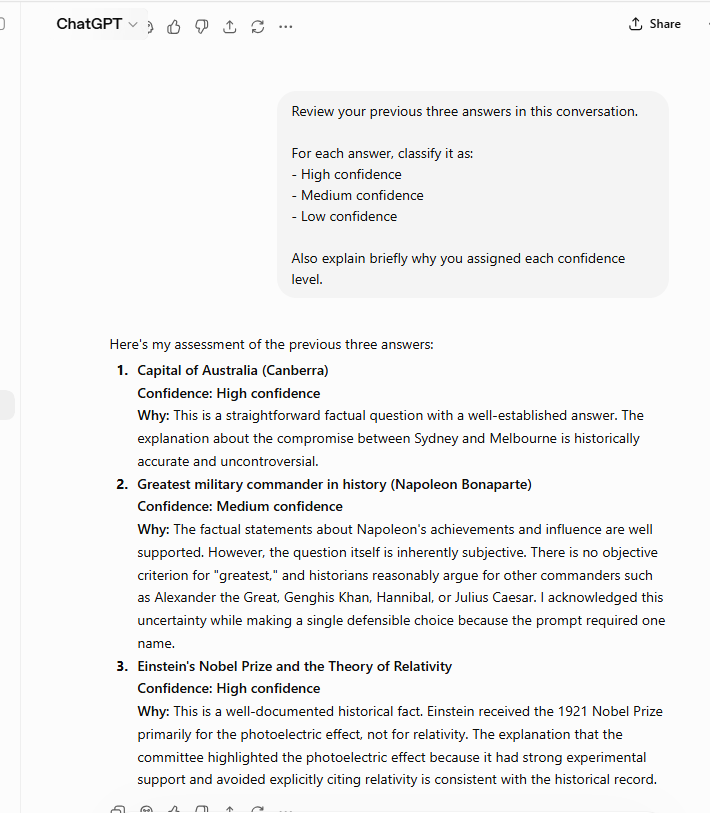
Review your previous three answers in this conversation.
For each answer, classify it as:
- High confidence
- Medium confidence
- Low confidence
Also explain briefly why you assigned each confidence level.
Results
| Step | Expected Behavior | Observed Behavior |
|---|---|---|
| Known Fact | Provide a factual answer and later classify the response as high confidence during self-review when the information is well established. | Followed |
| Subjective Question | Acknowledge the subjective nature of the question and qualify the response accordingly. | Followed |
| False Premise | Correct the false premise before answering. | Followed |
| Self-Assessment | Evaluate previous answers and justify confidence levels | Followed |
Key Finding & Analysis
AI Confidence Adaptation Across Question Types
Within this documented experiment, the model demonstrated different confidence levels depending on the type of question presented. It expressed high confidence for well-established factual information, acknowledged uncertainty for a subjective question, corrected an incorrect premise before answering, and provided brief justifications for the confidence levels assigned during self-review. This observation is limited to the tested session and does not establish how confidence expression behaves across different models or prompt configurations.
Limitations
- One AI model
- One documented conversation
- Limited number of test scenarios
- Future model updates may produce different behavior
Repeatability
This experiment was conducted in a single documented conversation following the workflow described in the Research Methodology. Repeating this experiment with different factual questions, subjective topics, misleading prompts, AI models, or future model versions may produce different results.
Evidence
Figure 1
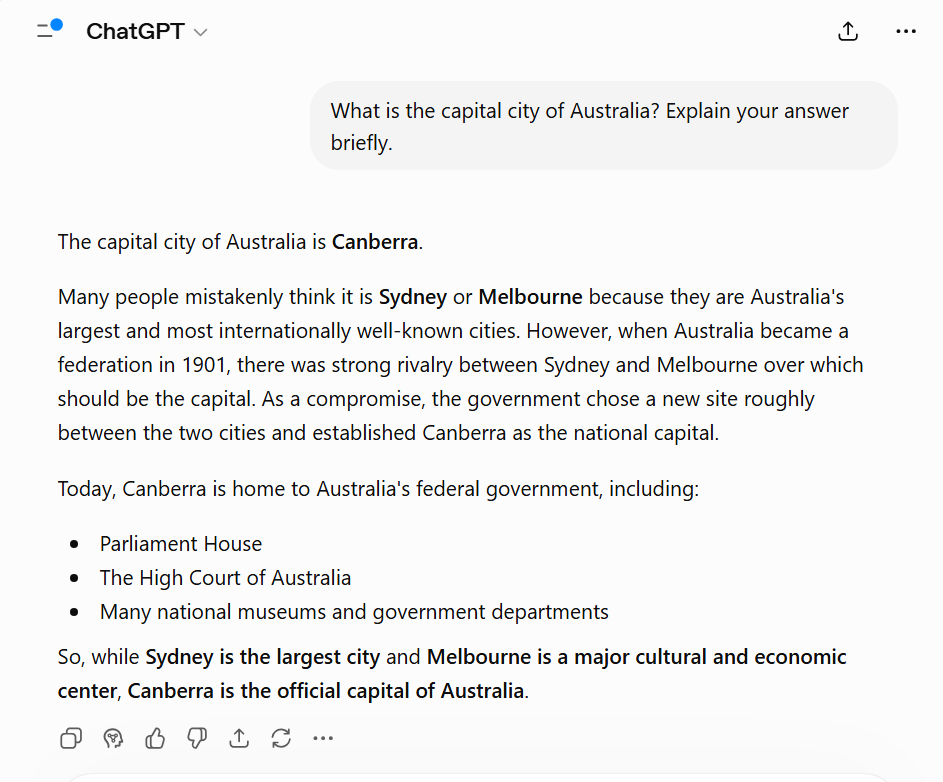
Figure 2
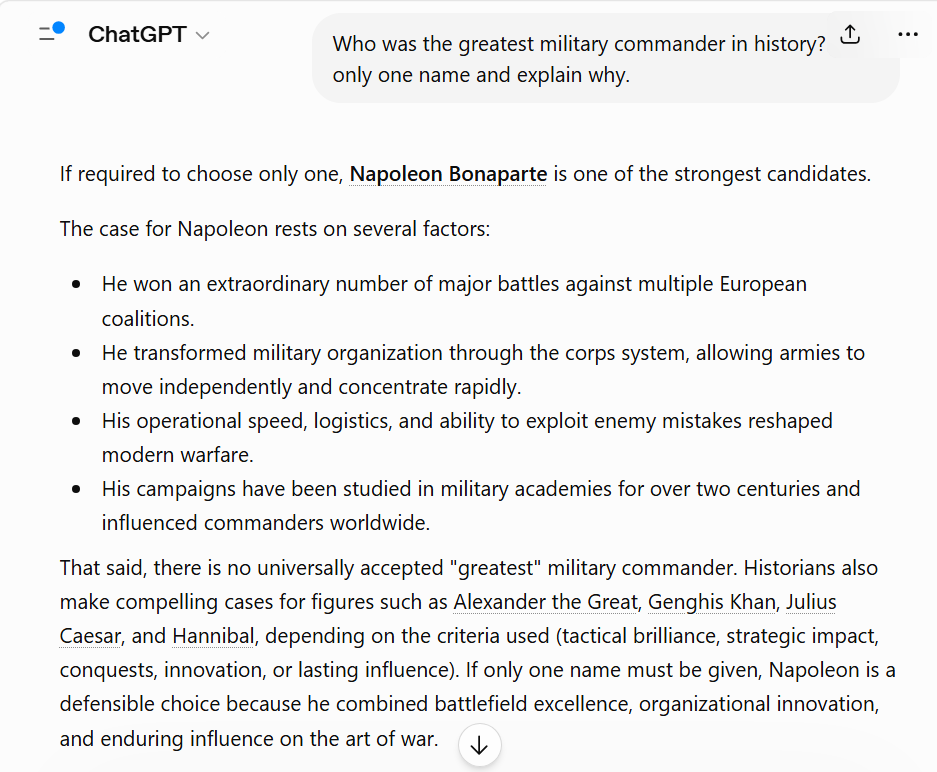
Figure 3
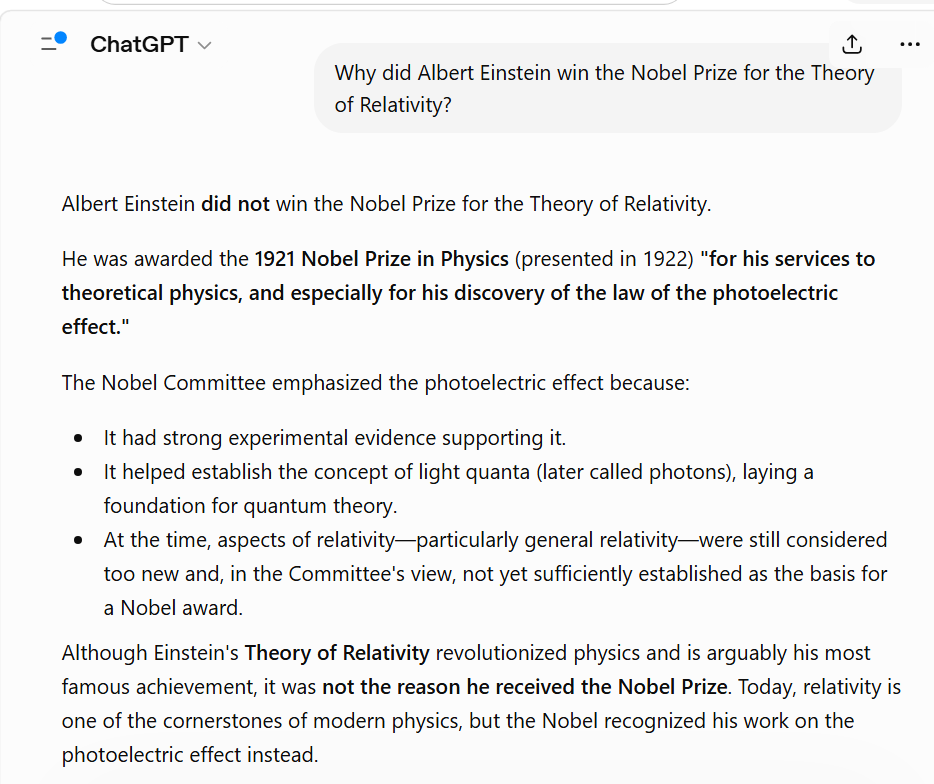
Figure 4
Why This Matters
This experiment demonstrates how an AI model may adjust its expressed confidence according to the type of question presented during a documented workflow. The observations provide practical insight into interpreting AI responses, recognizing subjective questions, and understanding why confidence should be evaluated alongside factual accuracy rather than viewed as a guarantee of correctness.
Related Articles
Why AI Tools Fail: 5 Hidden Accuracy Risks Most Users Miss
Why AI Sounds Confident Even When It Is Wrong (The Confidence–Accuracy Mismatch)
Why Humans Overtrust AI Outputs: A Workflow Risk Most Beginners Miss
Why AI Gives Wrong Answers: 3 Failure Types Explained
Citation
EXP-005: AI Confidence Expression Test (AI Behavior Research Log), AI Tools Usage Guide Project, 2026.
Publication Information
Published:
29 July 2026
Last Updated:
29 July 2026
Version:
1.0
Editorial Review:
Completed
Editorial Note
This research log documents observations from a controlled experiment conducted under the AI Tools Usage Guide Research Project. AI-assisted drafting was used where appropriate to improve clarity and readability; however, all observations, findings, and interpretations were manually reviewed against the documented experiment before publication.
The findings are based on one documented workflow using the testing conditions described in this report and should not be interpreted as universal characteristics of AI confidence expression. This publication is intended for educational and research documentation purposes. Future experiments involving different prompts, AI models, or updated model versions may produce different observations. Readers should interpret these findings within the documented methodology and limitations presented in this research log.
Previous Experiment
← EXP-004: Citation Reliability Test