
Introduction
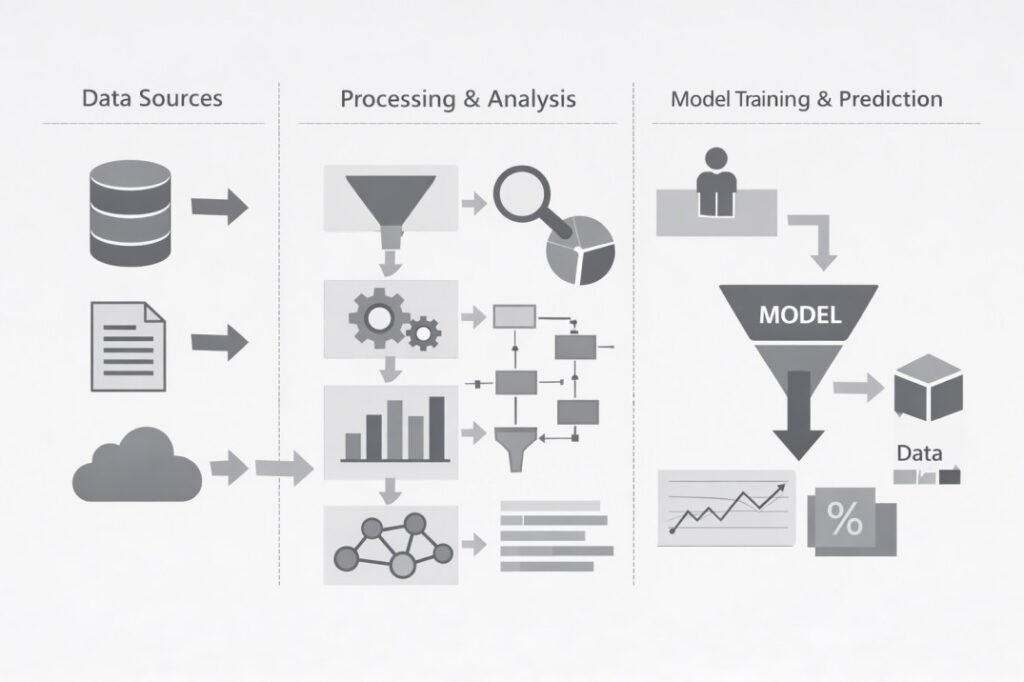
An AI workflow refers to a structured process. In this process, artificial intelligence–related components are arranged, connected, and governed within a defined operational sequence. In academic and institutional contexts, the term is used to explain how AI systems function within broader processes rather than to describe isolated tools, models, or automated actions.
AI workflows are discussed in research, policy, and technical documentation. These discussions clarify how data, models, decision logic, and human oversight interact over time.
This perspective is especially relevant because AI systems rarely operate independently; they are embedded within organizational, analytical, or administrative structures that shape their use and interpretation.
This article presents a descriptive and educational overview of AI workflows as process structures. It explains what an AI workflow is, how it is typically organized, and where it is commonly observed. The focus is on conceptual understanding rather than implementation, evaluation, or optimization.
The discussion intentionally excludes procedural guidance and design recommendations. It also excludes performance claims and domain-specific instructions. It does not assess effectiveness, economic value, or strategic impact. Instead, it situates AI workflows as explanatory models used to document and analyze how AI functions are integrated into structured processes.
Conceptual Foundations of an AI Workflow
This section outlines the foundational concepts used to describe AI workflows as structured process representations. The focus is on how core elements are positioned and related within a workflow, rather than on specific algorithms or implementation details.
AI Workflows as Process Descriptions
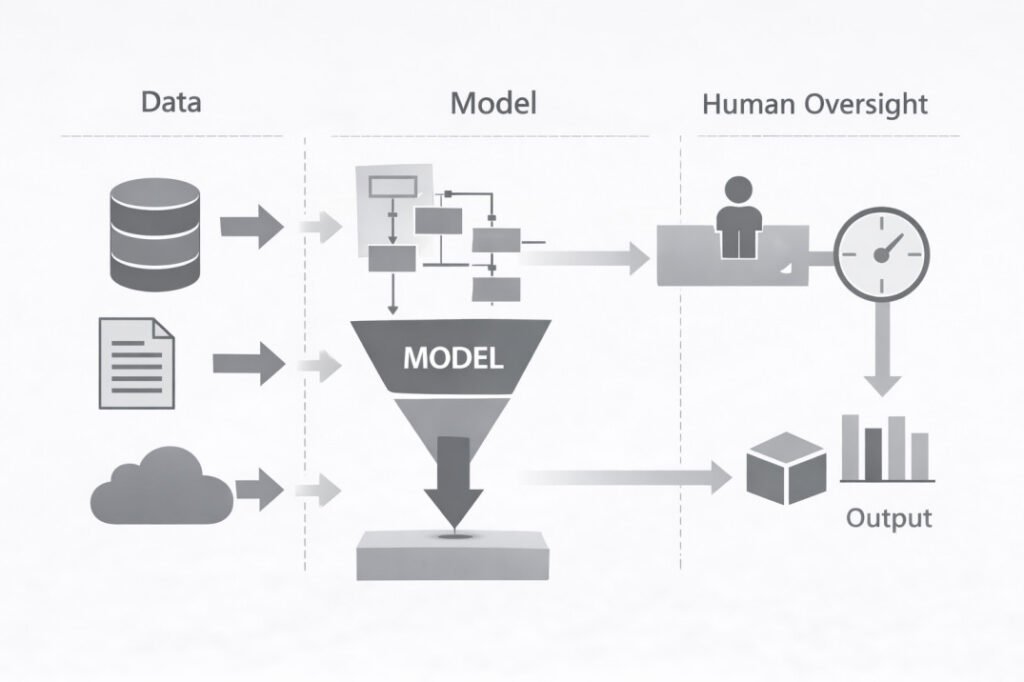
At a foundational level, an AI workflow is designed to describe process relationships rather than algorithmic details. The workflow framework emphasizes sequencing, dependency, and coordination between components that may include AI and non-AI elements.
Unlike standalone AI models, workflows focus on how multiple stages are connected. This includes how information enters the system, how it is transformed, and how outputs are handled or reviewed. The workflow concept exists to make these relationships explicit and traceable.
Distinction Between AI Capability and AI Workflow
An important conceptual distinction exists between an AI capability and an AI workflow.
- An AI capability refers to what a model or system is designed to do.
- An AI workflow refers to how that capability is embedded within a process.
This distinction is commonly emphasized in academic systems literature to avoid conflating technical function with operational structure.
Workflow Orientation in Systems Thinking
This discussion remains descriptive, outlining how AI workflows are referenced in institutional documentation rather than evaluating governance effectiveness or decision authority. AI workflows reflect a systems-oriented perspective. Under this perspective, AI components are treated as parts of a larger socio-technical system. This framing recognizes that technical behavior interacts with organizational rules. It also interacts with human interpretation and contextual constraints.
Institutions such as NIST describe AI systems as combinations of data, models, processes, and oversight mechanisms. This reinforces the idea that workflows are structural representations rather than guarantees of behavior.
Structural Components Within AI Workflows
Within institutional and academic literature, AI workflows are often described using recurring structural components rather than fixed procedural steps. This component-based framing clarifies how different functional elements are positioned within a workflow. It does not imply uniform implementation or standardized behavior across systems.
Core Component Categories
Educational descriptions of AI workflows commonly identify recurring component categories. These categories are analytical tools rather than fixed requirements.
Data Handling Components
Data handling components describe how information is introduced, transformed, and routed within the workflow. This may include ingestion, normalization, or segmentation stages, without making assumptions about data quality or suitability.
AI Model or Inference Components
Within a workflow, the AI model is positioned as a functional element that produces outputs based on inputs. The workflow description focuses on placement and interaction rather than model architecture or training methodology.
Output Routing and Handling
Output components describe how AI-generated results are transferred, stored, flagged, or forwarded. In many workflows, outputs are treated as intermediate signals rather than final determinations.
Human Interaction Points
Human interaction points refer to stages within an AI workflow. At these stages, outputs are reviewed, interpreted, or contextualized by individuals or organizational processes. These points are documented to clarify how human judgment intersects with AI-generated information. This is particularly relevant in situations involving uncertainty or contextual evaluation.
Review and Interpretation Stages
Human interaction points are commonly documented as part of AI workflows. These stages indicate where interpretation, contextual judgment, or validation may occur.
The inclusion of such stages highlights that workflows are designed to accommodate uncertainty rather than eliminate it.
Modularity and Separation of Components
Standards-oriented frameworks, including those developed by ISO and the IEEE, emphasize modularity. Components are described as separable so that changes in one part do not necessarily alter the entire workflow structure.
Contextual Integration of AI Workflows
Institutional research indicates that AI workflows are commonly documented in organizational, research, and governance contexts. In these contexts, system behavior must be traceable across multiple stages. OECD and NIST publications describe workflow representations as a method for clarifying system boundaries, component interactions, and oversight responsibilities across different operational environments.
Organizational and Operational Contexts
AI workflows are commonly used within organizations to document how AI functions integrate with existing systems. These workflows do not replace conventional processes but coexist alongside them.
Examples include analytical pipelines, document processing environments, and monitoring systems. In each case, the workflow provides a structural map rather than operational guidance.
Research and Documentation Contexts
In academic research, AI workflows are used to describe experimental or analytical processes. The workflow functions as a documentation artifact that clarifies sequencing and dependency, supporting transparency and reproducibility.
Policy and Governance Contexts
Public-sector and policy discussions often reference AI workflows when addressing accountability and oversight. Reports from the OECD frequently use workflow representations to illustrate where AI functions occur within regulated processes.
Variability Across Domains
AI workflows vary significantly across domains. A workflow documented for scientific research differs structurally from one used in administrative analysis, even if similar components are named. The workflow concept accommodates this variability by focusing on structure rather than domain outcomes.
Limitations, Uncertainty, and Structural Constraints
This section shifts from definition to structural limitation and governance framing without introducing operational guidance.
Standards bodies and research institutions consistently note that AI workflows are subject to structural limitations. These limitations relate to data quality, model assumptions, and contextual variability. The NIST AI Risk Management Framework (2023) and ISO/IEC guidance on AI systems emphasize that workflow documentation does not eliminate uncertainty, but instead makes sources of variability, dependency, and responsibility more explicit across system stages.
Inherent Uncertainty in AI Workflows
AI workflows do not eliminate uncertainty associated with AI systems. They describe how processes are arranged but do not ensure reliability, consistency, or correctness of outputs.
Dependency Propagation
Because workflows are sequential, dependencies between stages are structurally significant. Issues introduced in early components may propagate through later stages, a limitation that workflows make visible without resolving.
Interpretability Constraints
Workflow documentation can identify where interpretation occurs but does not define how interpretation should be performed. This separation between structural clarity and semantic understanding is a recognized limitation.
Organizational Framing Effects
Workflow representations may reflect institutional priorities or regulatory requirements. As noted in discussions by the WEF, this framing can create a perception of control that should not be conflated with assurance.
Interpretation, Oversight, and Boundary Conditions
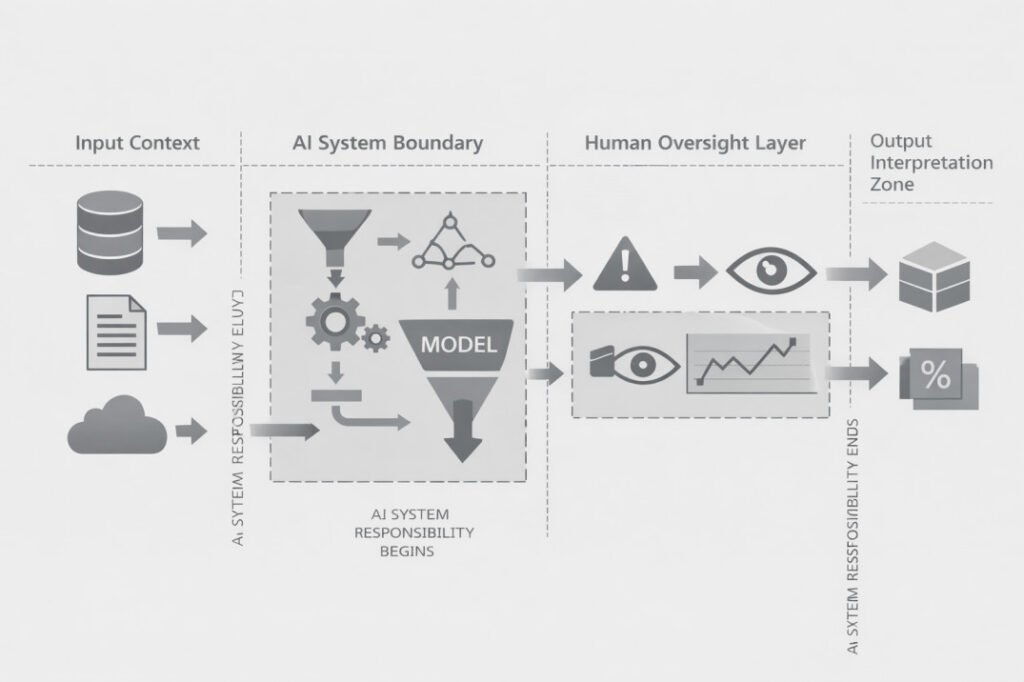
Policy and standards documentation consistently identify interpretation and oversight as necessary boundary conditions in AI system use. Frameworks published by the OECD (2019) and NIST (2023) describe human oversight as a mechanism for contextual evaluation, accountability, and error recognition, particularly where AI outputs are probabilistic or sensitive to environmental variation. These sources emphasize that workflow documentation clarifies where automated processing ends and human responsibility begins, rather than transferring decision authority to the system.
Interpretation as a Structural Role
AI workflows commonly specify points where outputs are interpreted. These points indicate responsibility locations rather than interpretive standards.
Oversight as a Boundary Condition
Human oversight is embedded in workflows as a boundary condition. It defines where AI-generated information intersects with decision-making processes without implying decision authority.
Workflow Scope and Boundaries
Entry and Exit Definitions
Workflows define where processes begin and end. These boundaries are chosen for documentation clarity and may exclude upstream or downstream activities.
Variability in Human Judgment
Even within the same workflow, interpretation may vary across individuals or contexts. Workflow structures highlight where variability occurs but do not standardize judgment.
Conclusion
An AI workflow is a structural representation of how artificial intelligence components are arranged within a defined process. It is intended to clarify sequencing, interaction, and dependency rather than to prescribe actions or evaluate results. The discussion remains confined to structural explanation and does not extend into system design, deployment, or evaluation.
This article has examined AI workflows through conceptual foundations, structural components, contextual integration, limitations, and oversight boundaries. Across these perspectives, AI workflows emerge as descriptive frameworks. They support understanding rather than control.
Importantly, AI workflows do not resolve uncertainty, replace human judgment, or guarantee outcomes. They document how AI functions are situated within broader systems, acknowledging both technical and organizational constraints.
From a university-level educational perspective, AI workflows provide a useful lens for examining AI as part of socio-technical processes. By maintaining a neutral, process-oriented framing, they support informed analysis while respecting the limits of structural descriptions.
References
- NIST (2023).
Artificial Intelligence Risk Management Framework (AI RMF 1.0).
U.S. National Institute of Standards and Technology.
— Provides system-level descriptions of AI components, processes, lifecycle stages, and governance boundaries relevant to workflow framing. - ISO / IEC (2023).
ISO/IEC 22989: Artificial Intelligence — Concepts and Terminology.
— Defines AI systems, components, and process relationships, supporting neutral terminology used in workflow descriptions. - IEEE (2021).
IEEE 7000™-2021: Model Process for Addressing Ethical Concerns During System Design.
— Describes process-based system documentation, including human oversight and lifecycle boundaries applicable to AI workflows. - OECD (2019, updated 2021).
OECD Principles on Artificial Intelligence.
— Uses workflow-style representations to explain AI system integration, accountability points, and contextual usage across sectors. - WEF (2020).
AI Governance: A Holistic Approach to Implementing the OECD AI Principles.
— Discusses AI systems as structured processes, highlighting workflow documentation, oversight layers, and organizational framing. - European Commission – Joint Research Centre (2020).
AI Watch: Defining Artificial Intelligence.
— Provides descriptive models of AI systems and process structures used in policy and research documentation. - Russell, S., & Norvig, P. (2021).
Artificial Intelligence: A Modern Approach (4th ed.). Pearson.
— Academic textbook offering foundational system-level perspectives relevant to understanding AI as part of structured processes. - Mitchell, M. et al. (2019).
Model Cards for Model Reporting.
Proceedings of the ACM Conference on Fairness, Accountability, and Transparency (FAccT).
— Illustrates how AI components are situated within documented processes and workflows for interpretation and oversight.