AI Tools vs Traditional Software: Structural and System-Level Differences

Introduction

AI tools vs traditional software systems represent two distinct approaches to designing digital systems within contemporary technological environments. These systems differ in fundamental ways from traditional software, which has historically operated through fixed rules, predefined logic, and deterministic behavior. Understanding the distinction between AI tools vs traditional software systems supports clearer conceptual interpretation of how contemporary digital systems are structured and governed.

This explainer presents a neutral, educational comparison between AI tools and traditional software systems. Rather than promoting products or offering usage advice, it focuses on conceptual differences in design, behavior, adaptability, decision-making processes, reliability, and governance. The discussion focuses on conceptual differences in design, behavior, and governance across system types, without evaluating performance or practical advantage.

In line with independent educational standards, this article emphasizes system architecture, human oversight, limitations, and accountability, avoiding performance claims or marketing language. It follows the same editorial principles used in independent AI education platforms that prioritize factual accuracy, neutrality, and public-interest learning.

This article outlines commonly cited conceptual distinctions between AI tools and traditional software systems.

This comparison draws on commonly used distinctions in software engineering and AI governance literature rather than proposing a new classification framework.

A broader conceptual framing of AI tools is presented in AI Tools Explained — Conceptual Foundations, System Logic, and Institutional Context

Educational Disclaimer:
This article is intended solely as an educational and conceptual explainer and does not constitute technical, legal, medical, or professional guidance.

Core Design Philosophy: Rule-Based Logic vs Data-Driven Learning

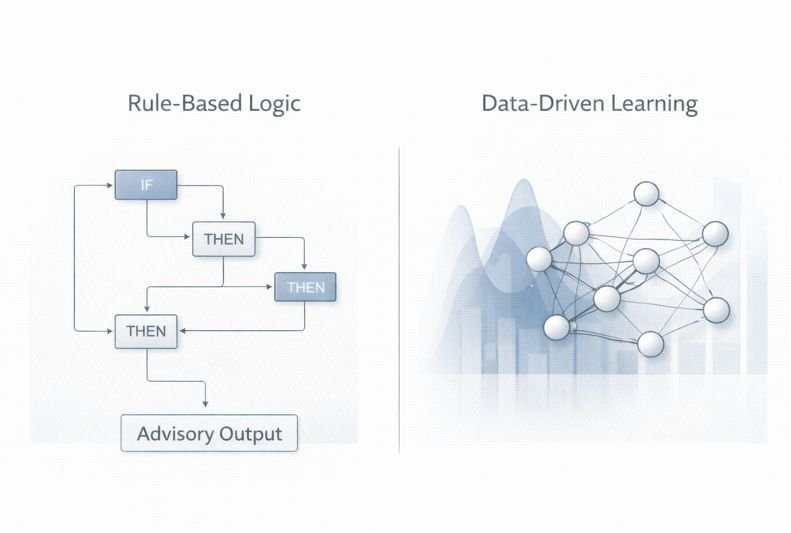
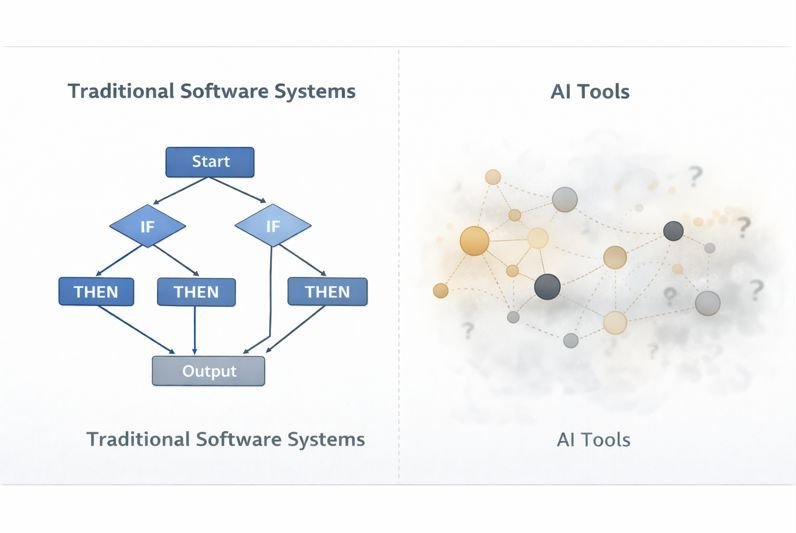
Side-by-side conceptual illustration showing rule-based logical decision paths contrasted with data-driven statistical learning structures.
Conceptual comparison of foundational design philosophies in traditional software systems and AI tools.

Among the various differences discussed in academic literature, this design distinction is often treated as foundational because it shapes how system behavior is interpreted rather than how individual features are implemented.

Traditional software systems are built on explicit instructions written by developers. Every action, decision, or output follows predefined rules coded into the system. These systems operate deterministically, meaning that the same input consistently produces the same output. Examples include spreadsheet programs, database systems, calculators, accounting platforms, and structured workflow applications. Their reliability stems from predictability: behavior is controlled, testable, and transparent.

AI tools, in contrast, are designed around data-driven learning rather than fully predefined logic. Instead of relying solely on manually written rules, they learn patterns from large datasets. Machine learning models, for example, identify correlations and probabilistic relationships rather than executing a fixed rule set. Outputs are influenced by training data, model architecture, and statistical inference rather than strict procedural commands.

This design difference leads to distinct system behaviors. Traditional software enforces strict compliance with programmed rules, making outcomes easier to anticipate. AI tools, however, produce outputs that may vary across similar inputs due to probabilistic reasoning, model uncertainty, or evolving data patterns. As a result, AI systems may exhibit flexibility but also unpredictability.

From an engineering perspective, traditional software emphasizes logic completeness, stability, and precision. AI tools are characterized by data-driven pattern recognition and statistical generalization. Neither approach is conceptually dominant; each reflects different design logics and system constraints. Rule-based systems are typically associated with structured, predictable environments, while AI tools are commonly described in relation to complex or high-variability data contexts.

Behavior and Adaptability Over Time

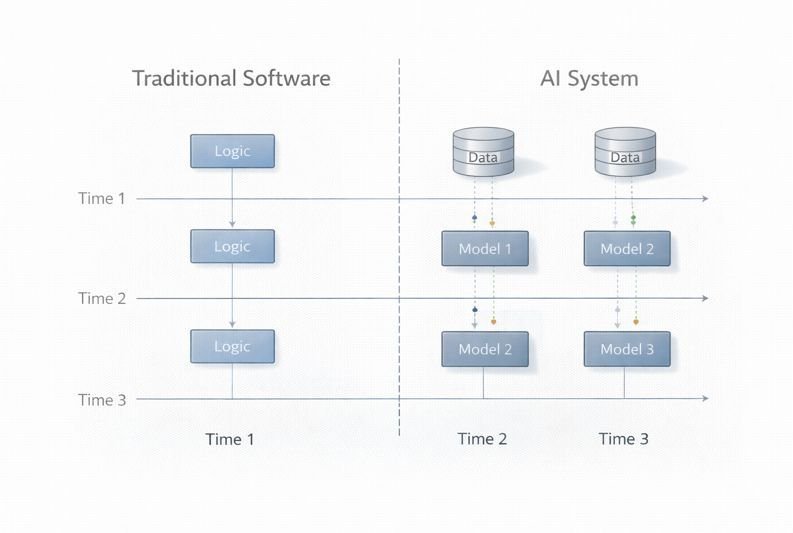
Traditional software behavior remains static unless manually updated by developers. Changes require deliberate reprogramming, version releases, or configuration adjustments. This stability supports long-term consistency and simplifies auditing, compliance checks, and performance validation. Organizations relying on traditional systems benefit from predictable lifecycle management and controlled updates.

Side-by-side conceptual illustration showing rule-based logical decision paths contrasted with data-driven statistical learning structures.
Conceptual illustration comparing fixed rule-based logic in traditional software with data-driven model evolution in AI systems over time.

AI tools, however, may change behavior over time due to model retraining, dataset updates, or evolving inference patterns. Because AI systems learn from data, new training inputs can alter how they classify, predict, or generate outputs. This adaptive nature is associated with changes in system behavior over time, which may complicate interpretation and governance.

Adaptability introduces changes in system behavior over time, which has implications for interpretation, monitoring, and governance. At the same time, it creates governance challenges. If system outputs change without clear documentation, it becomes more difficult to ensure consistency, fairness, and accountability.

For this reason, AI deployments often require structured update policies, version tracking, testing protocols, and human oversight to ensure changes do not introduce unintended risks. Traditional software updates, by comparison, typically follow predictable release cycles with well-defined functional changes.

The contrast between static and adaptive behavior represents a commonly cited distinction between AI tools and traditional software, with implications for institutional trust.

This distinction is not absolute. In practice, many deployed systems combine fixed logic with adaptive components, which is why academic discussions typically emphasize conceptual boundaries rather than implementation purity.

Decision-Making Mechanisms and Output Reliability

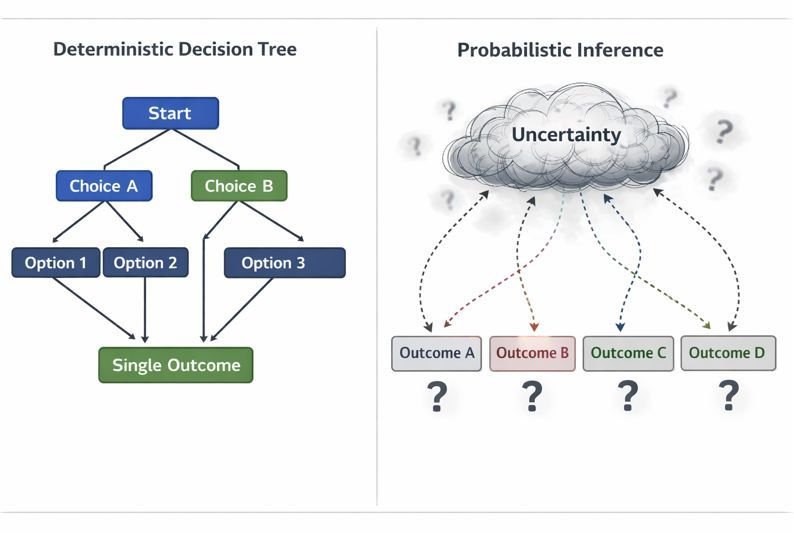
Visual comparison of fixed rule-based decision trees versus probabilistic AI inference producing variable outputs.
Conceptual illustration comparing deterministic rule-based decision pathways with probabilistic inference processes in AI systems.

Traditional software is typically designed to deliver predictable and repeatable outcomes within defined rule-based constraints. When a user performs an action, the system processes it through fixed decision trees or algorithmic procedures. Outputs are traceable through source code, making it possible to explain precisely why a given result occurred. This transparency supports debugging, regulatory compliance, and accountability.

AI tools generate outputs using probabilistic inference. Instead of following a fully traceable rule chain, they evaluate input patterns based on learned statistical relationships. In some cases, the internal reasoning process may not be fully interpretable, especially in complex neural network architectures.

This difference directly shapes how reliability is understood and evaluated in practice. Traditional software is typically expected to deliver exact and repeatable outcomes. AI tools are expected to provide approximate or probabilistic responses that may include uncertainty, bias, or error.

Because AI-generated outputs can occasionally be inaccurate or inconsistent, AI systems are commonly situated within arrangements that involve validation, human review, and constrained automation scope. These oversight mechanisms are less critical in conventional software environments where behavior is fully predetermined.

The contrast highlights a broader principle: traditional software prioritizes precision and traceability, while AI tools are commonly associated with pattern recognition and flexible inference, which may reduce interpretability in some contexts.

System Epistemology and Knowledge Boundaries

Conceptual diagram showing explicit rule-based knowledge in traditional software systems contrasted with statistical inference in AI systems.
Conceptual illustration contrasting explicit rule-based knowledge in traditional software with statistical inference-based knowledge in AI systems.

This epistemological distinction is often the most consequential, as it influences how correctness, error tolerance, and accountability are defined across system types.

Traditional software systems operate within a closed epistemic framework. Their behavior is fully specified by human-authored rules, meaning that system knowledge is explicit, enumerable, and bounded by source code. Errors arise from incorrect logic, incomplete rule coverage, or implementation faults, all of which are theoretically traceable.

AI tools, by contrast, operate within a statistical epistemic framework. Rather than encoding explicit knowledge, they approximate relationships inferred from data distributions. As a result, system “knowledge” is probabilistic, context-dependent, and partially opaque. Outputs represent likelihood-weighted inferences rather than definitive rule executions.

This epistemological distinction affects how correctness is defined. In traditional software, correctness is binary: outputs either conform to specification or they do not. In AI systems, correctness is often expressed in terms of confidence, uncertainty, error tolerance, or distributional alignment with training data. These differing conceptions of knowledge complicate direct comparisons between system types.

These epistemological differences also shape how AI tools are embedded within organizational workflows, governance structures, and oversight processes. The following discussion examines workflow roles at a conceptual level and does not describe operational procedures or design choices.

Role in Workflows: Automation vs Human-in-the-Loop Systems

For this reason, workflow comparisons tend to focus less on task execution and more on oversight expectations, a shift that is specific to systems with probabilistic output behavior.

The diagram is intended to illustrate structural differences in oversight roles rather than prescribe workflow design or operational practices.

Traditional software has long been used to automate structured tasks, such as calculations, record management, scheduling, and reporting. These systems typically replace manual steps with deterministic processes that follow established workflows. Once configured, they execute tasks consistently with minimal intervention.

AI tools, however, are more commonly integrated into human-in-the-loop workflows. Rather than replacing decision-makers, they often assist with analysis, pattern detection, summarization, classification, or content generation. Their outputs serve as inputs for human judgment rather than final authoritative decisions.

This difference influences how systems are deployed in educational, organizational, and institutional settings. Traditional software is frequently trusted to perform tasks autonomously because its logic is predictable. AI tools, by contrast, often require review layers due to potential variability, bias, or uncertainty in outputs.

In conceptual workflow models, traditional systems are typically associated with deterministic task execution, while AI tools are associated with probabilistic decision-support roles. In conceptual workflow models, conventional systems are associated with deterministic formatting processes, whereas AI tools are associated with probabilistic content generation mechanisms.

The increasing emphasis on human oversight reflects broader governance standards aimed at ensuring responsible AI use. AI tools are often positioned as decision-support systems, not replacements for accountability-bearing human actors.

Limitations, Risks, and Governance Considerations

Traditional software limitations typically stem from logical constraints, incomplete programming, or technical bugs. When errors occur, developers can often trace the cause directly to specific lines of code or configuration settings. Fixes involve correcting deterministic logic.

AI tools introduce a different category of limitations. Because their behavior depends on training data, they may reflect biases, incomplete information, or contextual misunderstandings. They may also produce plausible-sounding but incorrect outputs when operating beyond their training scope.

These characteristics require additional governance measures. Institutional governance frameworks commonly describe oversight mechanisms such as data documentation, model evaluation, and accountability structures. Documentation of training sources, model behavior boundaries, and risk mitigation strategies is often necessary to ensure responsible deployment.

Traditional software governance focuses on stability, security, and compliance with technical specifications. AI governance frameworks commonly extend oversight considerations to areas such as fairness, transparency, accountability, and explainability. This broader oversight reflects the societal and institutional implications of AI-generated outputs.

Importantly, neither system type is free from risk. Traditional software can produce critical failures if misconfigured, and AI tools may propagate or scale errors when deployed without appropriate monitoring, validation, or contextual oversight. The difference lies in how risks manifest and how they must be managed.

Governance as a Function of System Predictability

Diagram illustrating governance layers for traditional software and expanded oversight frameworks for AI systems.
Conceptual comparison of governance and oversight structures across deterministic software systems and AI tools.

Governance requirements differ between traditional software and AI tools not merely because of technical complexity, but because of differences in predictability and causal traceability. In deterministic systems, governance mechanisms can focus on specification review, code audits, and controlled release processes.

AI tools challenge these models by introducing probabilistic behavior and data-dependent variation. Governance therefore expands from managing code artifacts to managing data provenance, model behavior boundaries, and post-deployment performance drift. This shift represents a structural change in oversight philosophy rather than an incremental extension of existing software governance practices.

Importantly, governance in AI systems does not imply reduced accountability. Instead, it redistributes accountability across system designers, data curators, deployment contexts, and human overseers, reflecting the distributed nature of decision-making in learning-based systems.

From an institutional perspective, this distinction materially changes how responsibility is assigned when systems fail.
In deterministic software environments, failures are typically localized: a specific rule, configuration, or implementation error can be identified and corrected. In learning-based AI systems, failures are often diffuse, emerging from interactions between data distributions, model behavior, and deployment context rather than a single causal fault. This makes governance less about correcting individual errors and more about defining acceptable uncertainty, monitoring system behavior over time, and maintaining human accountability despite probabilistic outputs.

Conceptual Comparison of AI Tools and Traditional Software Systems

DimensionTraditional Software SystemsAI Tools
Knowledge representationExplicit, rule-basedImplicit, statistical
Output determinismFully deterministicProbabilistic
Error characterizationLogical or implementation faultsStatistical deviation or uncertainty
Update mechanismManual code modificationData-driven retraining or fine-tuning
ExplainabilityHigh (code-level traceability)Variable, often limited
Governance focusStability and complianceOversight, monitoring, accountability

Conclusion

The distinction between AI tools and traditional software systems lies in their foundational design, adaptability, decision-making processes, workflow integration, and governance requirements. Traditional software is designed to enforce predefined logic, which makes its behavior predictable, auditable, and tightly bounded by specification.
AI tools, by contrast, infer behavior from data rather than rules, which allows them to operate in less structured environments but also introduces uncertainty that must be managed rather than eliminated.

These differences shape how each system should be evaluated, deployed, and overseen. Traditional software excels in structured environments where consistency and rule enforcement are paramount. AI tools are commonly applied in environments involving complex, high-variability data—provided appropriate oversight mechanisms are in place.

Understanding AI tools and traditional software systems is not about determining superiority but about clarifying conceptual boundaries, system limitations, and accountability structures. As digital systems continue to evolve, informed comparison supports better decision-making, stronger governance, and more responsible integration into educational, organizational, and societal contexts.

From an educational perspective, comparing AI tools with traditional software systems highlights a broader transition in how digital systems are conceptualized and evaluated. The shift from rule-based logic to data-driven inference alters assumptions about reliability, transparency, and control. Understanding this transition is essential not for prescribing system use, but for interpreting system behavior, assessing limitations, and framing appropriate evaluation criteria across technical and institutional contexts.

The distinctions outlined here are intended to clarify conceptual boundaries rather than prescribe design choices, reflecting how these topics are typically treated in academic and institutional analysis.

References and Further Reading

  • OECD (2019). Artificial Intelligence in Society.
    https://www.oecd.org/going-digital/ai/
    Provides an international policy perspective on AI systems, including societal impact, governance principles, and accountability considerations.
  • NIST (2023). Artificial Intelligence Risk Management Framework (AI RMF 1.0).
    https://www.nist.gov/itl/ai-risk-management-framework
    Outlines a structured framework for identifying, assessing, and managing risks associated with AI systems across their lifecycle.
  • ISO/IEC 22989:2022 — Artificial Intelligence: Concepts and Terminology.
    https://www.iso.org/standard/74296.html
    Defines standardized concepts and terminology for artificial intelligence, supporting consistent technical and governance discussions.