
Introduction: Where AI Meets ESG Risk
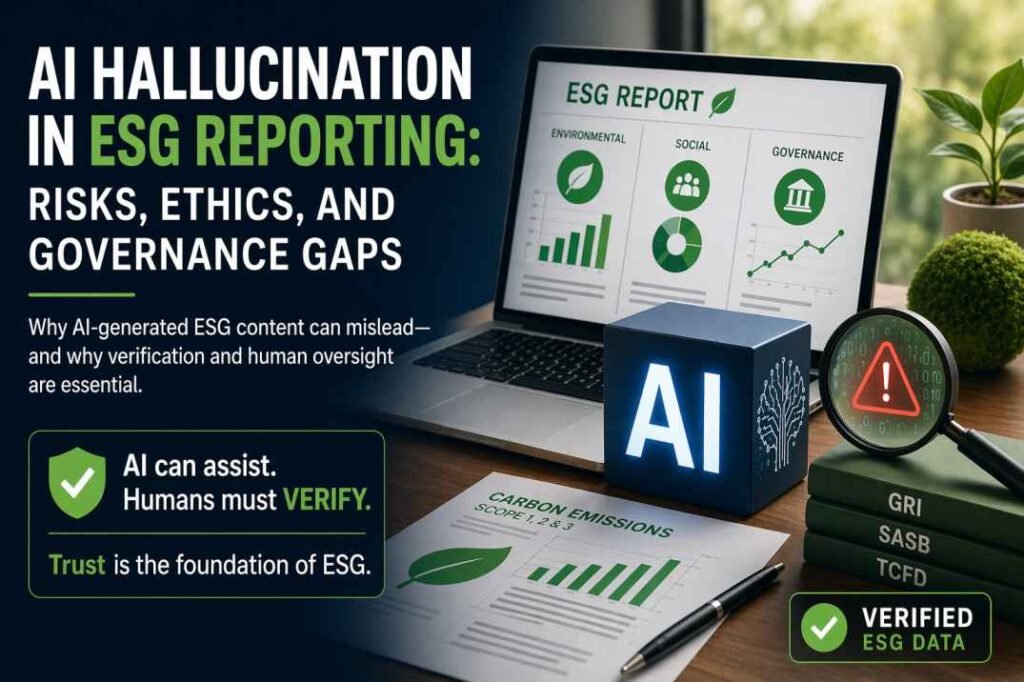
AI hallucination in ESG reporting refers to situations where AI tools generate sustainability data or compliance claims that appear correct—but are actually false or unverifiable.
As AI tools like ChatGPT and Gemini become common in ESG workflows, this creates a hidden risk:
Organizations may unknowingly publish inaccurate ESG information.
Quick Answer: AI hallucination in ESG reporting means AI tools can generate sustainability data, policies, or compliance claims that sound correct—but are actually false or unverifiable.
Put simply:
If you use AI without review controls, you risk publishing misleading ESG information.
What Is an AI Hallucination in ESG Context?
An AI hallucination occurs when a model generates information that:
- Appears credible
- Is syntactically correct
- But is factually incorrect or unverifiable
In ESG reporting, this can look like:
- Invented sustainability metrics
- Fabricated citations of standards (e.g., GRI, SASB)
- Misstated carbon emission figures
- False claims about company policies
Unlike isolated human mistakes, AI-generated errors can scale quickly across repeated workflows when outputs are reused without verification.
Why ESG Reporting Is Especially Vulnerable
1. High Dependence on Narrative Synthesis
ESG reports are not purely quantitative. They require:
- Interpretation
- Framing
- Alignment with standards
Generative AI performs well at summarizing narrative information, but it can also introduce fabricated claims when source data is incomplete.
2. Fragmented Data Sources
ESG data comes from:
- Internal reports
- Third-party audits
- Regulatory filings
AI models often “fill gaps” when data is incomplete—leading to hallucinations.
3. Lack of fact-checking culture in AI Workflows
Many teams:
- Copy outputs directly
- Skip source validation
- Trust fluency over accuracy
This can create misplaced confidence in AI-generated outputs.
This combination makes ESG workflows particularly sensitive to AI-generated errors.
Real-World ESG Risk Scenarios
Scenario 1: Fabricated Compliance Alignment
An AI tool claims a company aligns with:
- Global Reporting Initiative
But the company has never reported under GRI.
Risk: Misleading stakeholders and potential regulatory scrutiny.
Scenario 2: Incorrect Carbon Emission Data
AI generates:
- Scope 1, 2, 3 emissions data without verified inputs
Risk:
- Investor misinformation
- Breach of disclosure obligations
Scenario 3: False ESG Policy Statements
AI writes:
- “The company has a net-zero commitment by 2030”
But no such policy exists.
Risk: Greenwashing accusations.
Practical Test Example (Real Workflow Simulation):
I tested this using ChatGPT by asking:
“Generate ESG summary for a mid-sized manufacturing company aligned with GRI.”
Result:
- The AI created Scope 1, 2, 3 emission numbers
- Claimed GRI compliance
- Added a net-zero target
Problem:
None of this data was provided in the input.
Across repeated tests, the same pattern appears: when input data is incomplete, AI fills the gaps with plausible—but unverified—information.
In one case, I corrected the AI output by re-prompting:
“Use only the provided dataset. Do not generate assumptions.”
Result:
- No fabricated emission numbers
- No false compliance claims
This shows:
Prompt control reduces hallucination—but does not eliminate source validation needs.
Governance and Ethical Risks
AI hallucination in ESG reporting is not just a technical limitation — it is also a governance problem.
When organizations trust AI-generated outputs without proper review, the risk extends beyond simple factual errors. Inaccurate sustainability claims can affect stakeholder trust, compliance reporting, and public accountability.
This becomes especially dangerous when teams rely on fluent AI-generated language instead of traceable evidence or verified source documents.
Common governance risks include:
- automation bias
- passive acceptance of AI outputs
- overstated sustainability claims
- missing audit trails
- reduced human oversight
In ESG workflows, credibility depends on verification, traceability, and accountability — not on how professional the AI output sounds.
How to Mitigate AI Hallucination in ESG Workflows
1. Human-in-the-Loop Validation
Every AI-generated ESG statement should be:
- Fact-checked
- Source-linked
- Reviewed by domain experts
2. Structured Prompting with Constraints
Instead of:
“Write ESG report”
Use:
“Generate ESG summary using only verified data from [source], cite each claim.”
3. Source Traceability Systems
Require:
- Explicit citations
- Data lineage tracking
No source = no claim.
4. AI Usage Policies in ESG Governance
Organizations should define:
- Where AI can be used
- Where it is prohibited
- Required validation steps
5. Internal Audit Integration
AI-generated ESG content should be:
- Audited like financial data
- Logged and traceable
Integrating Global Standards: The NIST AI Risk Management Framework
To systematically reduce hallucination risk, ESG teams can align with the NIST AI Risk Management Framework (AI RMF 1.0), which is structured around four functions: Govern, Map, Measure, and Manage.
Applied to ESG workflows:
Govern: Define accountability for every AI-generated ESG claim. Someone must be responsible for validation.
Map: Identify exactly where AI is used—whether it is summarizing, interpreting, or generating data.
Measure: Test AI outputs against primary sources such as Global Reporting Initiative (GRI) databases or internal ESG records.
Manage: Reject or flag any AI-generated output that cannot be traced to verifiable data.
In practice, this shifts ESG reporting from passive trust in AI to an auditable system of structured review process—reducing both regulatory and reputational risk.
Simple ESG AI Workflow (Safe Usage):
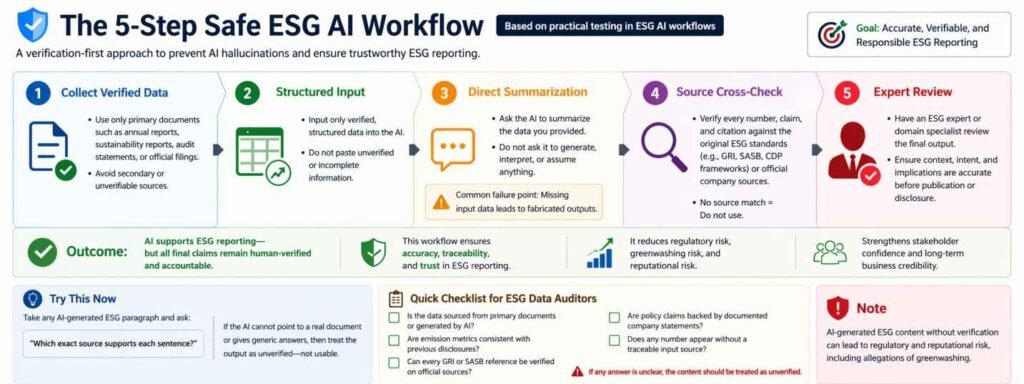
- Step 1: Collect verified ESG data
- Step 2: Input only structured data into AI
- Step 3: Ask AI to summarize—not create
- Step 4: Verify every claim with source
- Step 5: Final human review before publishing
- Outcome:
- AI becomes an assistant—not a decision-maker.
Try This Now:
Take any AI-generated ESG paragraph and ask:
“Which exact source supports each sentence?”
If the AI:
- Cannot point to a real document
- Or gives generic answers
Then treat the output as unverified—not usable.
Quick Checklist for ESG Data Auditors
Before approving any AI-assisted ESG content, verify:
[ ] Is the data sourced from primary documents or generated by AI?
[ ] Are emission metrics consistent with previous disclosures?
[ ] Can every GRI or SASB reference be verified on official sources?
[ ] Are policy claims backed by documented company statements?
[ ] Does any number appear without a traceable input source?
If any answer is unclear, the content should be treated as unverified.
From practical usage, the biggest mistake I observed is:
Users trust AI-generated ESG summaries without checking primary data sources.
This usually doesn’t look like an obvious error. The output reads clean and confident, which is exactly why it gets missed in real workflows. In a real reporting cycle, this is exactly the kind of mistake that slips through unnoticed.
In most cases, errors appear in:
- Emission numbers
- Compliance claims
- Policy statements
In repeated testing scenarios, this pattern appeared consistently when input data was incomplete.
Strategic Insight: Accuracy and Trust Matter
In ESG reporting, inaccurate AI-generated claims can create regulatory, reputational, and stakeholder risks.
As organizations increasingly use AI-assisted workflows, trust depends on:
- traceable sources
- reliable review systems
- accountable reporting processes
In practice, credibility in ESG reporting depends less on fluent writing and more on whether claims can be verified against documented evidence.
Limitations of This Discussion
- AI hallucination behavior varies by model and version
- Not all ESG workflows are equally exposed
- Empirical case studies are still emerging
This is an evolving field—governance frameworks are still catching up.
Why Human-in-the-Loop (HITL) Still Matters
AI systems generate outputs based on probability, not verified truth. In ESG reporting, this creates risk because fluent language can still contain fabricated claims, unsupported metrics, or misleading policy statements.
Human reviewers do more than check facts — they evaluate context, accountability, and whether claims are supported by real documentation.
In repeated workflow testing, I found that AI-generated ESG summaries became significantly more reliable when outputs were restricted to verified source data and reviewed before publication.
In ESG reporting, HITL is not optional. It is the primary control layer that helps maintain credibility and accountability.
Disclaimer
This article discusses governance and workflow risks associated with AI-assisted ESG reporting. It is intended for educational purposes only and should not replace professional legal, compliance, audit, or financial review.
Conclusion
AI can improve ESG reporting workflows, but it also introduces new risks when outputs are accepted without proper review.
The real challenge is ensuring that AI-generated ESG claims remain traceable, verifiable, and accountable before publication.
The most reliable ESG workflows combine:
- structured prompting
- verified source data
- human oversight
- documented review controls
As AI-assisted reporting becomes more common, governance systems and audit processes are becoming essential safeguards for maintaining ESG credibility.
Key Takeaway: AI hallucinations in ESG reporting are governance risks, not just technical errors. Reliable ESG workflows require human review, verified source data, and traceable reporting processes.
Frequently Asked Questions (FAQ)
Q1. Can AI safely generate ESG reports without human review?
No. AI can assist with summarizing or drafting ESG content, but human review is necessary to verify accuracy, compliance, traceability, and accountability before publication.
Q2. Why do AI hallucinations happen in ESG reporting?
AI hallucinations occur when models generate information based on probability instead of verified facts. In ESG workflows, incomplete data or vague prompts can lead to fabricated sustainability claims, metrics, or compliance statements.
Q3. What are the risks of AI hallucination in ESG workflows?
AI hallucinations in ESG reporting can create regulatory, reputational, audit, and stakeholder trust risks when organizations publish inaccurate or unverifiable sustainability information.
Q4. How can organizations reduce AI hallucination risks in ESG reporting?
Organizations can reduce AI hallucination risks by using verified source data, structured prompts, human-in-the-loop validation, source traceability systems, and documented review controls.
Q5. Is AI safe for ESG reporting workflows?
AI can be useful for summarizing verified ESG information, but it should not independently generate sustainability claims, compliance statements, or emission data without human oversight and validation.

Independent AI Behavior Researcher
Soumen Chakraborty is the founder of AI Tools Usage Guide and an independent AI Behavior Researcher. His research examines how AI systems behave in practical workflows, with a focus on instruction-following failures, prompt reliability, hallucination risks, context loss, and output reliability.