
Quick Summary: This page lists trusted AI verification resources, research organizations, and governance frameworks that help readers evaluate AI-generated information more critically and responsibly.
This page lists trusted research organizations, verification resources, and AI governance frameworks referenced across AI Tools Usage Guide.
The goal is not to overwhelm beginners with technical documentation.
Instead, this page helps readers:
- verify AI-generated information,
- understand how AI systems behave,
- evaluate reliability risks,
- and learn where trustworthy AI research comes from.
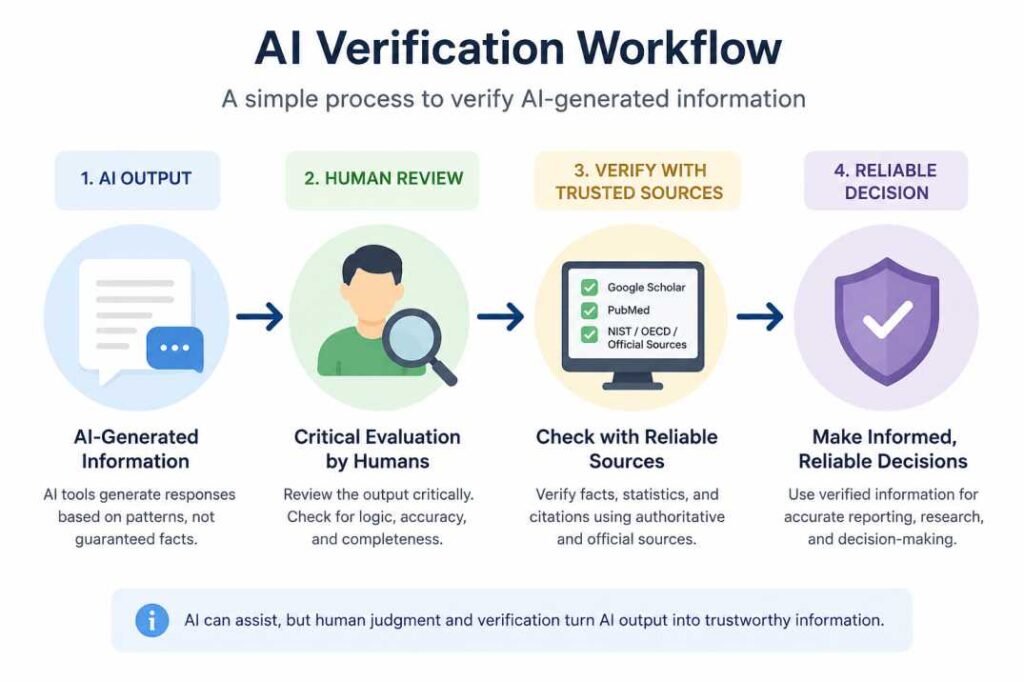
Many AI tools can produce convincing but inaccurate outputs. These references support the workflow principles discussed throughout this site, including verification, prompt reliability, hallucination risks, and responsible AI usage.
Many articles on this site discuss hallucinations, prompt failures, and AI reliability risks. The resources below help readers independently verify important claims instead of relying entirely on AI-generated outputs.
On This Page
- AI verification and fact-checking resources
- AI research organizations
- AI governance and risk frameworks
- AI Workflow Reliability and Prompting Resources
- Related beginner guides
AI Verification and Fact-Checking Resources
AI-generated outputs should not automatically be treated as verified facts.
The following resources are useful for checking:
- studies,
- statistics,
- claims,
- citations,
- and technical information.
Google Scholar
Official resource:
https://scholar.google.com/
Useful for:
- verifying academic studies,
- checking whether cited research exists,
- finding original research papers.
Practical relevance:
AI systems sometimes generate references or statistics that sound legitimate but cannot be verified in academic databases.
PubMed
Official resource:
https://pubmed.ncbi.nlm.nih.gov/
Useful for:
- medical research,
- healthcare information,
- scientific verification.
Why it matters:
Medical or health-related AI outputs should always be verified using trusted scientific sources.
Official Government Sources
Examples include:
- NIST
- NIH
- FDA
- government statistical databases
Useful for:
- policy information,
- regulatory guidance,
- public datasets,
- and official standards.
Why it matters:
Government sources are often more reliable than AI-generated summaries for high-risk topics.
AI Research Organizations
These organizations regularly publish research related to:
- AI systems,
- model behavior,
- reliability,
- alignment,
- and safety.
OpenAI Research
Official resource:
https://openai.com/research
Useful for:
- language model research,
- AI safety discussions,
- system behavior analysis.
Anthropic Research
Official resource:
https://www.anthropic.com/research
Useful for:
- AI alignment,
- constitutional AI,
- prompt behavior,
- and reliability research.
Google DeepMind
Official resource:
https://deepmind.google/research/
Google DeepMind publishes advanced AI research related to reasoning systems, scientific discovery, and large-scale AI development.
Stanford HAI (Human-Centered AI)
Official resource:
https://hai.stanford.edu/
Stanford HAI focuses on human-centered AI research, governance discussions, and the societal impact of AI systems. Its research is useful for understanding how AI affects decision-making, policy, education, and real-world workflows.
AI Governance and Risk Frameworks
These frameworks help explain how organizations evaluate:
- AI risks,
- reliability,
- accountability,
- and operational governance.
They are referenced throughout this website when discussing AI workflow risks and responsible usage.
NIST AI Risk Management Framework (AI RMF 1.0)
Official resource:
https://www.nist.gov/itl/ai-risk-management-framework
Used for:
- AI risk evaluation,
- governance structure,
- monitoring AI systems,
- reliability assessment.
Why it matters:
Helps organizations identify and reduce operational AI risks.
Related articles:
- AI Tools vs Traditional Software
- Why AI Tools Require Monitoring After Deployment
- AI Hallucination in ESG Reporting
OECD AI Principles
Official resource:
https://www.oecd.org/going-digital/ai/
Used for:
- transparency,
- accountability,
- ethical AI governance,
- responsible AI usage.
Why it matters:
Widely recognized international AI governance principles.
Related articles:
- AI Tools vs Traditional Software
- AI Prompt Engineering for Teams
ISO/IEC 22989
Official resource:
https://www.iso.org/standard/74296.html
Used for:
- AI terminology,
- system definitions,
- conceptual consistency.
Why it matters:
Provides standardized language for discussing AI systems and workflows.
Related articles:
- How AI Tools Generate Responses
- AI Tools vs AI Models
AI Workflow Reliability and Prompting Resources
AI outputs depend heavily on:
- prompts,
- workflow structure,
- verification steps,
- and instruction clarity.
Several workflow factors strongly affect AI output quality and reliability.
Prompt Clarity
Clear prompts usually improve:
- output relevance,
- consistency,
- and structure.
Weak prompts often increase:
- hallucinations,
- instruction failures,
- or unstable responses.
Clear instructions can also reduce blended, incomplete, or conflicting AI outputs.
Human Verification
AI systems generate predictions, not guaranteed truth.
Human review remains important for:
- statistics,
- legal information,
- medical advice,
- academic citations,
- and important business decisions.
Workflow Reliability
Long or conflicting prompts can reduce output reliability.
This is especially important in:
- multi-step workflows,
- AI-assisted publishing,
- and collaborative team environments.
This is one reason many teams separate AI drafting from independent human verification during publishing workflows.
Related Beginner Guides
The following beginner guides explore many of the workflow and reliability concepts referenced throughout this page:
- Why AI Gives Wrong Answers
- Why Humans Overtrust AI Outputs
- Why ChatGPT Ignores Instructions
- Instruction Conflict in AI Workflows
- What Is an AI Workflow?
- AI Prompt Engineering for Teams
Final Note
The resources listed on this page are intended to support practical learning, responsible AI usage, and better verification habits.
AI systems can generate useful outputs quickly, but accuracy should never be assumed automatically.
Understanding how AI behaves — and knowing how to verify important information — is an important part of using AI tools responsibly.