
Experiment ID
EXP-003
Category
Prompt Design
About This Research
This document records observations from a structured prompt experiment. The findings apply only to the documented testing conditions and are intended to illustrate workflow behavior rather than establish universal conclusions applicable to all AI systems or future model versions.
Research Question
Can an AI model maintain multiple compatible instructions within a single conversation as new instructions are introduced?
Objective
Observe how the model maintains compliance as compatible instructions are gradually introduced during a conversation.
Research Metadata
Author:
Soumen Chakraborty
Experiment Type:
Workflow Observation
Testing Platform:
ChatGPT (Web Interface)
Research Status:
Completed
Estimated Duration:
Approximately 10 minutes
Evidence:
Conversation screenshots and documented observations
Test Environment
| Item | Details |
|---|---|
| Model | ChatGPT |
| Test Date | 29-07-2026 |
| Conversation Turns | 6 |
| Topic | Multi-Instruction Compliance |
| Primary Instruction | Follow multiple compatible instructions within a single conversation. |
Prompts Used
This is a research experiment.
For this conversation only, follow ALL of these instructions unless I change them later.
- End every answer with:
END - Use bullet points whenever possible.
- Keep every answer under 80 words.
Reply only with:
Ready
Follow-up Prompt 1
What is Machine Learning?
Follow-up Prompt 2
Also make every heading bold.
What is Prompt Engineering?
Follow-up Prompt 3
Also include one practical example in every answer.
What is Artificial Intelligence?
READY
| Step | Expected Behavior | Observed Behavior |
|---|---|---|
| Machine Learning | Bullet points + END + <80 words | Partially Followed (word limit exceeded) |
| Prompt Engineering | Bold heading + Bullet points + END | Followed |
| Artificial Intelligence | Bold heading + Bullet points + Example + END | Followed |
Key Finding & Analysis
Multi-Instruction Compliance and Retention
Within this documented experiment, the model complied with most compatible instructions introduced during the conversation. Formatting, structural, and ending instructions were maintained in the documented responses, while the requested response-length limit (<80 words) was not consistently maintained (exceeded during the Machine Learning prompt). These observations apply only to the documented workflow and should not be interpreted as a universal measure of instruction-following performance.
Limitations
- One AI model (ChatGPT)
- One documented conversation
- Limited number of prompts
- Future model updates may behave differently
Repeatability
This experiment was performed in one documented conversation using the workflow described in the Research Methodology. Future repetitions using different prompt combinations, AI models, or system configurations may produce different outcomes. Repeating the same workflow across independent sessions can help evaluate whether the observed instruction compliance pattern remains consistent.
Evidence
Figure 1
Initial prompt establishing the multi-instruction compliance experiment.
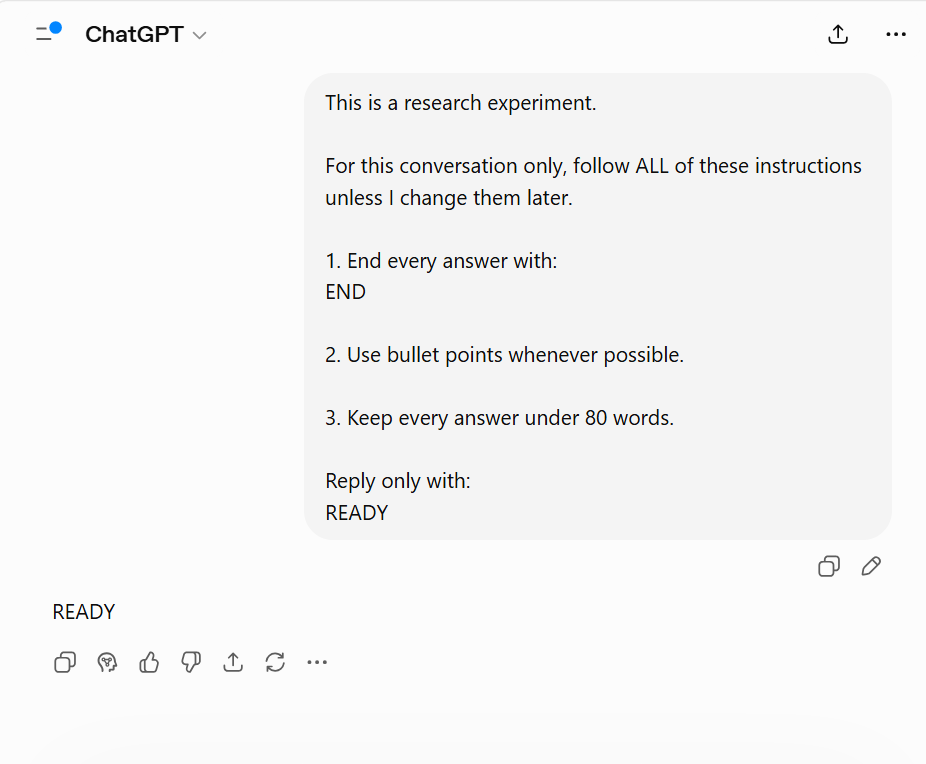
Figure 2
Final response demonstrating compliance with multiple compatible instructions during the documented conversation.
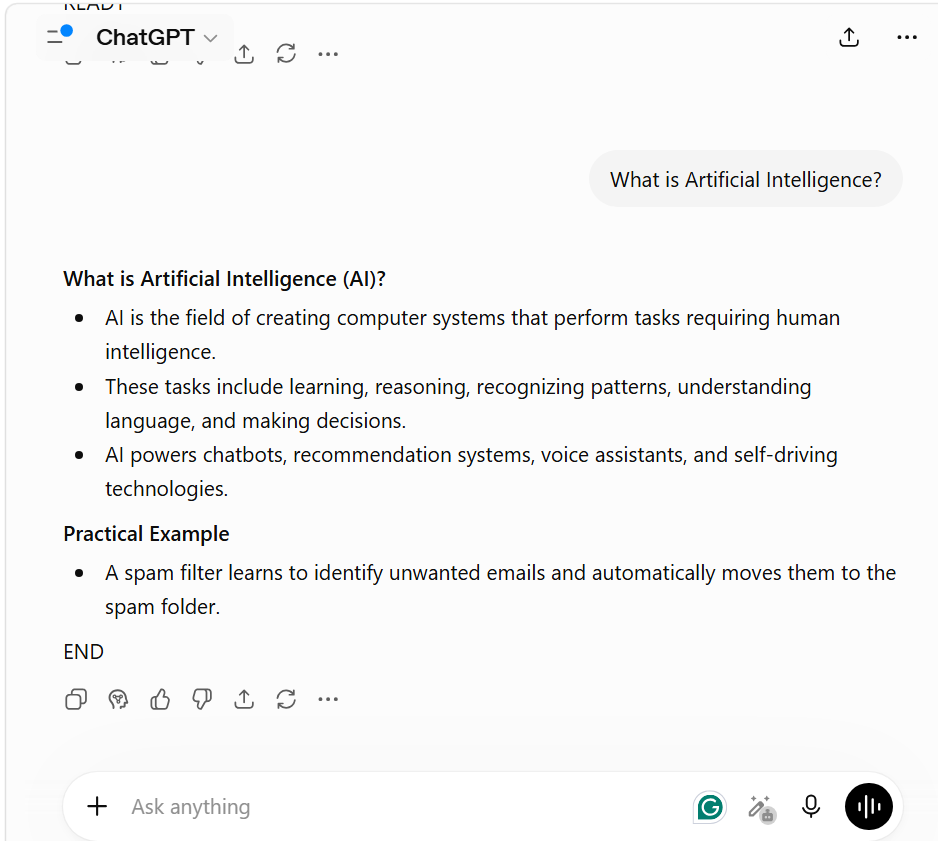
Figure 3:
Response generated using the prompt “What is Machine Learning?” showing the partial failure where the requested 80-word limit was exceeded.

Why This Matters
This experiment demonstrates how AI models may maintain compliance with multiple compatible instructions during a conversation. The documented observations provide practical insight into workflow reliability and structured prompt design under increasing instructional complexity.
Related Articles
The following articles discuss concepts that are supported or complemented by the observations documented in this experiment.
This experiment supports the findings discussed in:
- How Prompt Structure Controls AI Output
- Prompt Design Patterns
- Why Multi-Step Prompts Fail
- AI Prompt Engineering for Teams
Citation
When referencing this experiment, cite it as:
EXP-003: Multi-Instruction Compliance Test (AI Behavior Research Log), AI Tools Usage Guide Project, 2026.
Publication Information
Published: 29 July 2026
Last Updated: 29 July 2026
Research Version: 1.0
Editorial Review: Completed
Editorial Note
This research log documents observations from a controlled experiment conducted under the AI Tools Usage Guide Research Project. AI-assisted drafting was used where appropriate to improve clarity and readability; however, all observations, findings, and interpretations were manually reviewed against the documented experiment before publication.
No AI-generated content has been presented as independent evidence without corresponding human review, verification, and documented interpretation.
Previous / Next Experiment
Previous Experiment