Quick Answer
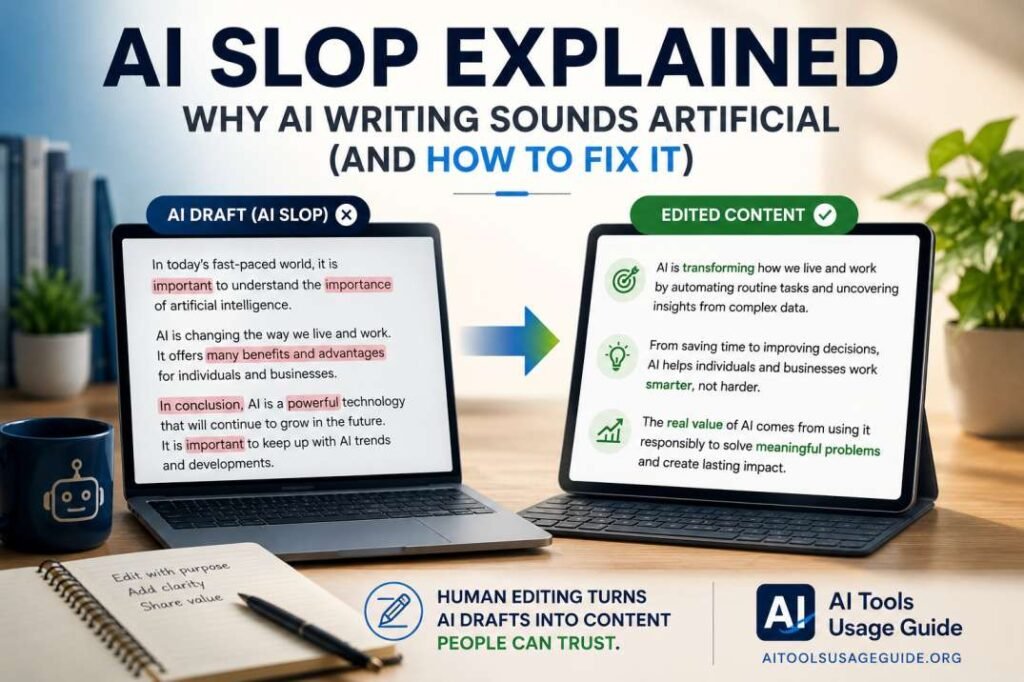
AI slop is writing that feels generic, repetitive, vague, or low in useful information. It is not defined by whether AI was used: human-written content can have the same weaknesses, while carefully researched and edited AI-assisted writing can be useful.
To improve a draft, focus on the quality of the finished content. Remove repeated ideas, verify factual claims, add relevant context and specific examples, and preserve the author’s own judgment. The SCOPE framework in this guide offers a practical five-step editorial process; it is an editing aid, not a scientifically validated test or a method for detecting AI authorship.
Introduction
AI-generated writing can be fluent and grammatically polished yet still feel generic, repetitive, or short on useful detail. The issue is not simply whether AI helped produce the text, but whether the finished article gives readers accurate, specific, and relevant information.
This guide explains how to recognize common writing-quality problems, distinguish them from evidence of AI use, and revise a draft using the SCOPE editing framework. It also describes documented prompt and editing tests, including their methods and limitations, so readers can distinguish observed results from general editorial advice.
Table of Contents
What Is AI Slop?
AI slop is a broad term used to describe low-quality, generic content. However, it is crucial to understand that AI-generated content is not automatically AI slop.
In writing, AI slop usually becomes noticeable when the text communicates familiar ideas without enough specificity, evidence, context, or original judgment. The presence of AI is not the defining characteristic. The more useful question is whether the finished writing gives the reader meaningful information that they could not get from a generic explanation.
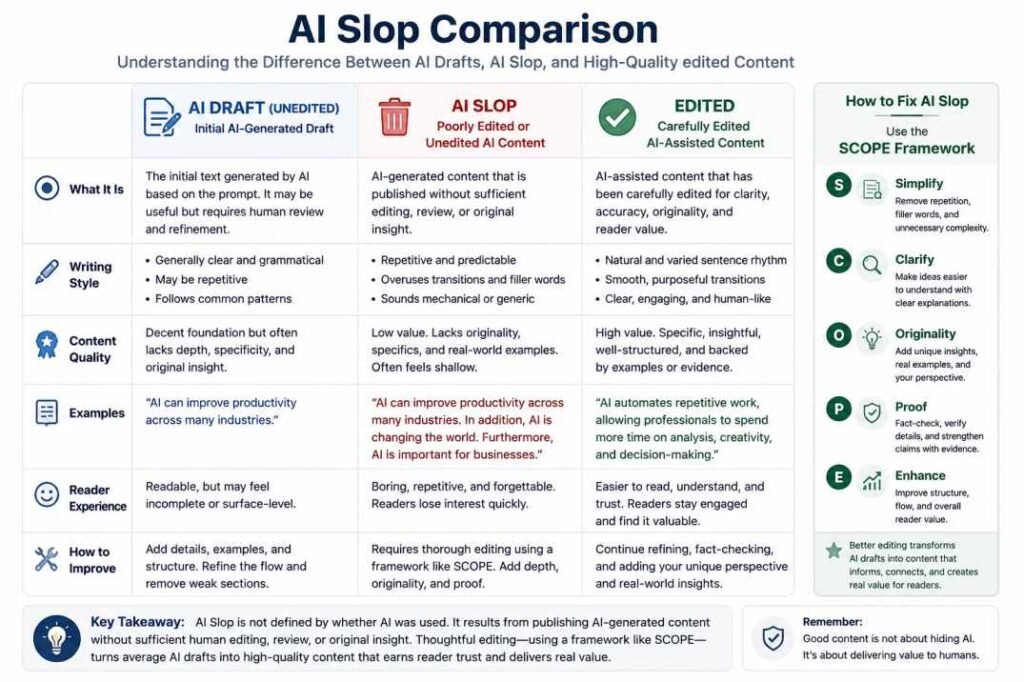
Human-written content can be repetitive and poorly structured, just as AI-assisted content can be accurate, well-researched, and highly valuable if carefully edited. The key distinction for editors is separating how content is produced from the quality of the finished piece:
| AI-Generated Content | AI Slop |
|---|---|
| Created with assistance from an AI model | Describes low-quality characteristics of the finished content |
| Can be accurate, useful, and well edited | Often repetitive, generic, or lacking originality |
| May require only light editing | May require substantial editorial improvement |
| Refers to how the content was produced | Refers to the quality of the final content |
Why Does AI Writing Often Sound Artificial?
Many people assume AI-generated writing sounds artificial because “AI doesn’t think like humans.” A more useful explanation is that large language models generate probable language based on patterns learned from vast amounts of text. This can produce fluent, grammatically consistent, and broadly understandable writing, but it can also create predictable stylistic patterns.
That design has clear advantages: AI can produce fluent drafts quickly and adapt them to many topics. However, these same characteristics can sometimes make the writing feel overly familiar, regular, or generic.
Probability and Consistency Can Make Writing Predictable
Language models generate text by predicting plausible continuations from the context available to them. When several ways of expressing an idea are possible, the model may produce familiar language patterns that are broadly applicable across many situations.
This can sometimes make AI-generated writing feel predictable. The prose may be fluent and polished, but repeated sentence structures, familiar phrasing, or a regular rhythm can make the writing feel generic when the content does not provide enough specific information.
Limited Context Can Lead to Generalized Writing
When important context is missing from the prompt, the resulting answer may therefore remain broad or generalized rather than addressing the reader’s specific situation.
When a prompt provides limited context or few constraints, AI may generate explanations that are broadly applicable rather than tailored to a specific situation. For example:
“Clear communication improves collaboration.”
This statement is accurate—but it teaches very little. A more specific explanation is:
“Clear communication reduces unnecessary clarification cycles, shortens feedback loops, and helps teams make decisions with fewer misunderstandings.”
Both statements can be correct, but the second provides more information that the reader can understand and apply. It identifies specific effects rather than simply making a broad positive statement. For a deeper explanation of this problem, read our guide to why AI gives generic answers.
This illustrates an important distinction: fluent writing is not necessarily information-rich writing. AI can produce coherent and grammatically correct text without adding much specificity, context, or distinctive insight.
Editorial Spot-Check: EXP-001 (Prompt Context Test)
To examine how prompt context affected an AI response, we conducted a documented three-prompt test using ChatGPT.
The prompts were:
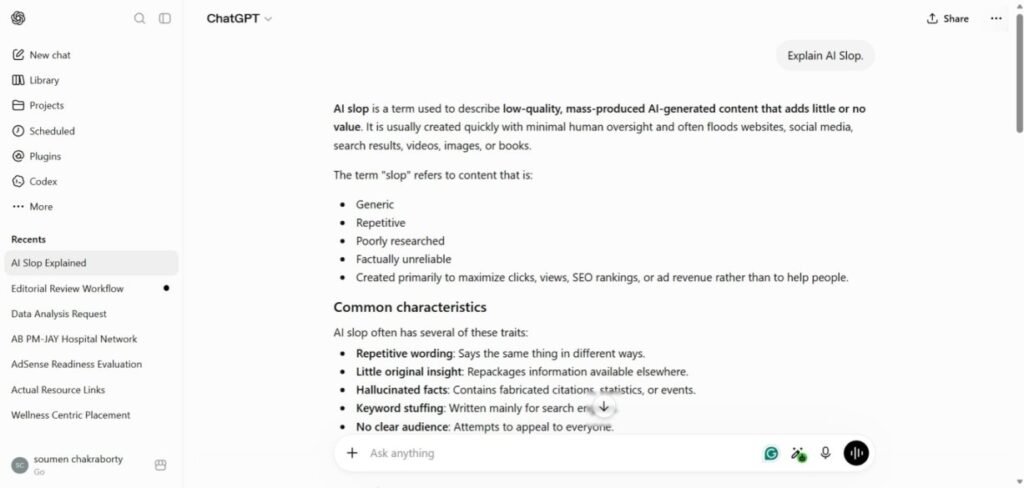
- “Explain AI Slop.”
- “Explain AI Slop with real examples.”
- “Explain AI Slop for SEO writers who publish AI-assisted content.”
We reviewed the responses for three editorial dimensions: specificity, practical value, and audience relevance. In this session, the first prompt produced a broad explanation, the second requested more concrete examples, and the third specified an audience and publishing context. The responses became more focused as the prompts included more task and audience detail.
What this observation shows: In this documented session, adding context was associated with responses that were more tailored to the requested audience and task.
Limitation: This was an illustrative test involving one model, three prompts, and one session. It does not establish a universal or measurable effect, and results may differ across models, versions, prompts, and evaluation methods.
Practical takeaway: Include relevant audience, task, context, and output requirements in prompts—but independently verify the resulting content. A more detailed prompt does not guarantee accuracy or quality.
Artificial Writing Usually Comes From Patterns, Not Individual Words
These patterns should therefore be treated as editing signals, not AI-detection rules. The goal is not to remove every phrase that “sounds like AI,” but to improve the information, specificity, accuracy, and usefulness of the finished writing.
No single word or phrase establishes that text was generated by AI. Familiar expressions, em dashes, three-part lists, or predictable transitions can appear in human-written content as well.
The more useful editorial approach is to look at the combined effect of multiple quality problems: vague explanations, repeated ideas, predictable structure, weak specificity, missing context, or little information gain.
How to Identify AI Slop Writing: Common Patterns That Matter
AI slop is usually easier to recognize as a pattern than as a single word or phrase. Look for combinations of generic language, repeated ideas, predictable structure, vague explanations, and a lack of concrete information.
These patterns do not prove that AI was used. Human-written content can show the same weaknesses. They are better treated as practical editing signals: clues that a piece of writing may be generic, repetitive, or less useful than it could be.
Common Patterns of AI Slop Writing
1. Generic introductions
- What to look for: Broad statements before addressing the actual topic.
- Why it matters: Delays useful information.
- How to improve: Start with the reader’s actual problem or question.
2. Predictable transitions
- What to look for: Repeated connectors or formulaic transitions.
- Why it matters: Can make writing feel mechanical.
- How to improve: Remove unnecessary transitions and vary the flow naturally.
3. Repetitive sentence structure
- What to look for: Similar sentence openings, lengths, or rhythms.
- Why it matters: Creates a predictable reading pattern.
- How to improve: Vary sentence structure where it improves readability.
4. Vague or generalized explanations
- What to look for: Claims that could apply to almost any situation.
- Why it matters: Provides little information gain.
- How to improve: Add specific examples, comparisons, evidence, or observations.
5. Repeated ideas and filler
- What to look for: The same point expressed several times.
- Why it matters: Adds length without useful information.
- How to improve: Keep the strongest version and remove repetition.
6. Few concrete examples
- What to look for: Concepts explained without practical illustrations.
- Why it matters: Makes advice harder to apply.
- How to improve: Add realistic examples, before-and-after comparisons, or documented observations.
7. Formulaic conclusions
- What to look for: Endings that simply repeat earlier points.
- Why it matters: Adds little new value.
- How to improve: End with a practical takeaway or decision.
What About the “Rule of Three”?
The rule of three is a long-established communication technique that appears naturally in both human and AI writing. A single three-part list is therefore not evidence of AI-generated content.
However, if nearly every paragraph uses the same three-part rhythm—for example, “Faster. Smarter. Better.”—the repetition can make the writing feel overly polished or predictable. Treat this as a stylistic editing signal: vary the rhythm when repeated patterns reduce readability.
AI Slop Is Usually a Pattern, Not a Checklist
One of the biggest mistakes writers make is treating AI editing like a checklist:
- Remove “Furthermore”
- Delete em dashes
- Replace “In today’s world”
- Change every list of three
Removing familiar phrases or changing punctuation does not automatically improve writing quality. Instead, assess whether the article answers the reader’s question, adds specific information, supports important claims, and avoids unnecessary repetition. Treat stylistic patterns as prompts for editorial review—not as evidence that a text was generated by AI.
When Missing Context Becomes a Writing Problem
A generic AI answer is not always caused by the model’s default writing style. Sometimes, the input itself leaves important information unspecified.
When prompts lack sufficient detail, language models must guess the intended meaning. This often results in writing that is overly broad, vague, or filled with generalizations. In situations where crucial context is missing, the model might either generate completely surface-level content or attempt to invent information to fill the gap. AI slop can therefore be an input problem as well as an editing problem.
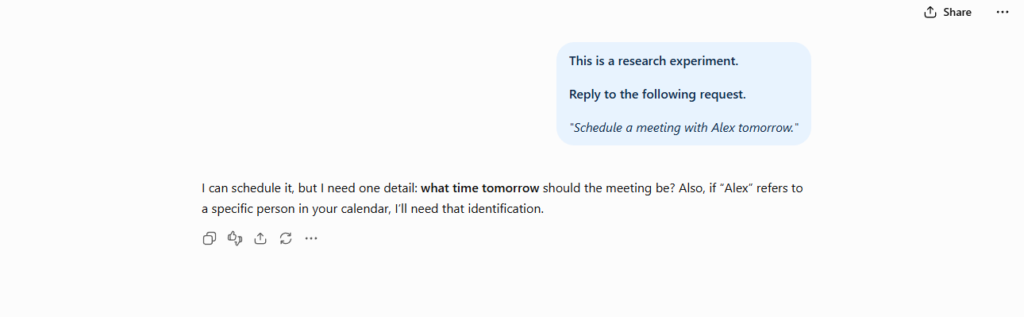
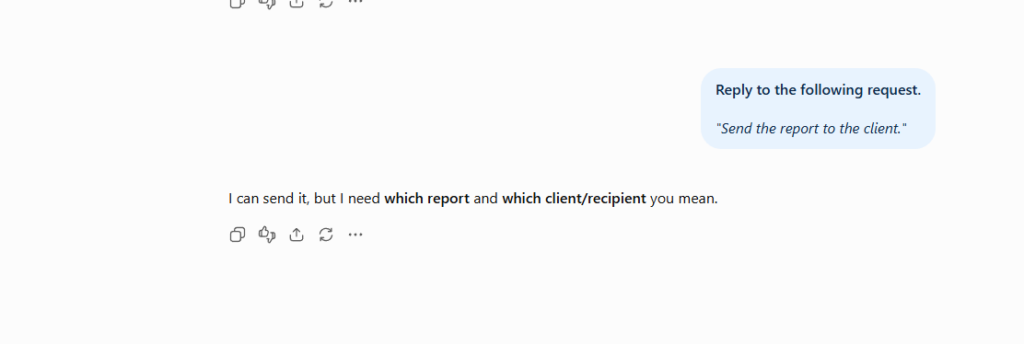
Editorial Spot-Check: EXP-007 (Ambiguity Resolution Test)
In a small editorial spot-check (EXP-007), we used three ambiguous prompts to observe whether ChatGPT would identify missing information or proceed by making an unsupported assumption.
The three prompts covered different types of ambiguity: missing meeting details, an unspecified report and recipient, and an undefined reference (“it”). In all three documented cases, the model identified the missing information or requested clarification rather than assuming the missing details.
What this suggests: ambiguous input can require clarification before an AI task can proceed. This makes missing-input handling an important consideration when designing AI-assisted workflows. Read our ambiguity resolution test to see how ChatGPT handled prompts with missing or unspecified details.
Limitation: This was a single-model test using three prompts in one conversation. The observation is bounded to these documented conditions and does not establish how AI systems generally handle ambiguous input.
How to Reduce AI Slop
Reducing AI slop is not about making AI-generated writing sound less like AI. The goal is to improve the information value of the writing by removing repetition, adding useful specificity, checking claims, and preserving human judgment and context.
AI slop usually does not require rewriting an entire article. In many cases, careful editing can improve an existing draft without starting over.
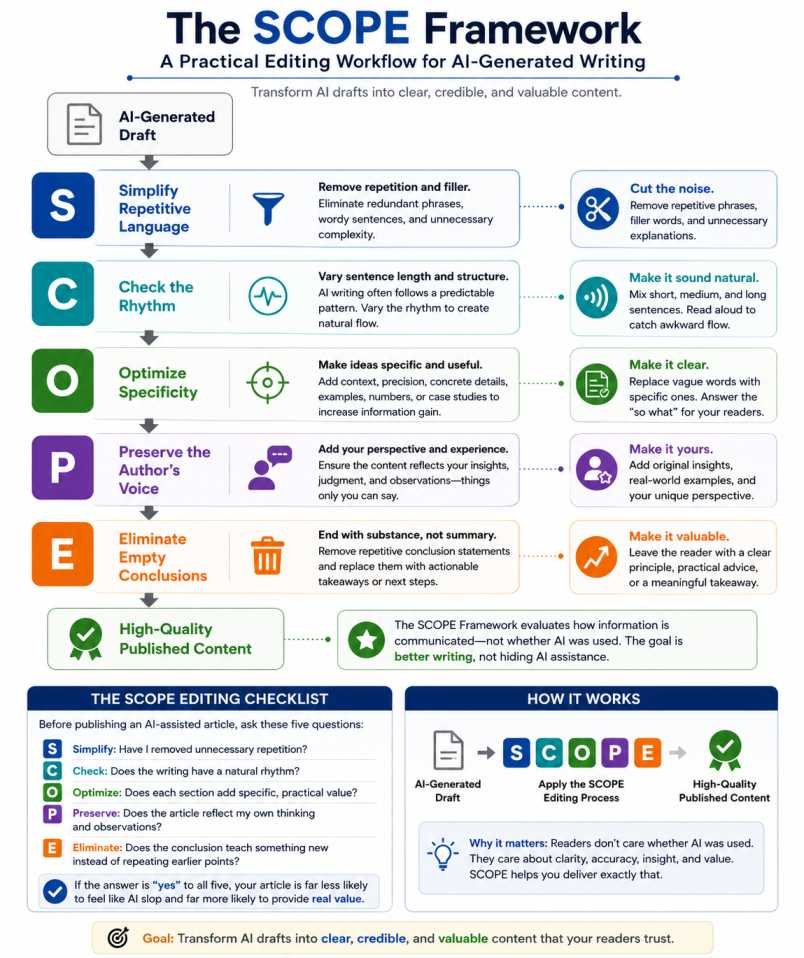
How to Edit AI-Generated Writing: The SCOPE Framework
Most editing advice focuses on removing a few “AI words” or asking the model to “sound more human.” However, a more useful approach is to evaluate how the article communicates information.
The SCOPE Framework organizes the main editing decisions into a practical five-step process: Simplify, Check, Optimize, Preserve, and Eliminate. It is designed to help improve clarity, specificity, rhythm, and reader value—not simply to hide AI assistance.
What SCOPE Is Designed to Fix
| SCOPE step | Problem it targets |
|---|---|
| Simplify | Repetition and redundant explanations |
| Check | Unsupported or inaccurate claims |
| Optimize | Generic, low-specificity writing |
| Preserve | Loss of author context and judgment |
| Eliminate | Empty conclusions and filler |
SCOPE is an editorial framework developed for this guide. It is not presented as a scientifically validated scoring system.
SCOPE in Practice: EXP-010
The full experiment examined this question under repeated test conditions. The average score changed from 12.2/14 before editing to 12.4/14 after editing. The experiment also revealed that unsupported first-person claims could survive the editing process.
Read the full EXP-010 experiment →
Flow Diagram
S — Simplify Repetitive Language
A useful test is simple: if removing a sentence does not remove a distinct idea, example, qualification, or useful detail, the sentence may be unnecessary.
AI-generated drafts can sometimes explain the same idea multiple times using slightly different wording. For example:
“AI helps improve productivity by increasing efficiency and making work more effective.”
This sentence communicates essentially one idea three different ways. A clearer version would be:
“AI can reduce repetitive work and help people complete tasks more efficiently.”
During editing, ask yourself:
Does this sentence introduce a new idea?
Am I repeating something the reader already knows?
Can I say the same thing more clearly?
Removing unnecessary repetition can improve readability more effectively than simply adding more words.
C – Check: Verify Before You Trust
The goal is not to make every sentence more cautious; it is to make sure each important claim is accurate, appropriately supported, and clear about its limitations.
While AI can generate fluent and grammatically correct text, AI output is not independent evidence. Factual claims, citations, and assumptions still require manual human verification. Instead of just reading for grammar, you must actively evaluate the output for accuracy:
- Factual claims: Ensure names, dates, statistics, and definitions are entirely accurate.
- Citations: Verify that referenced studies, books, or articles actually exist and genuinely support the claim.
- Missing assumptions: Identify where the AI might have filled in missing context with highly probable but incorrect guesses.
- False premises: Ensure the model didn’t blindly accept a flawed instruction provided in the prompt.
For a practical verification process, see our guide to AI answer reliability.
Editorial Spot-Check: EXP-004 & EXP-008 (Citation and False-Premise Tests)
In EXP-004, ChatGPT identified an intentionally fictional research paper as unverifiable rather than presenting it as a confirmed citation. However, the experiment did not independently establish the accuracy of every citation generated during the conversation. This highlights why AI-generated references should be checked against external sources.
In EXP-008, ChatGPT corrected three false premises when explicitly instructed to address incorrect assumptions before answering. The test demonstrates instruction-following under these specific conditions; it does not establish whether the model would have corrected the same premises without that instruction.
*Boundary/Limitation: These experiments document specific model responses under limited testing conditions. They do not establish universal behavior across AI systems, prompts, or model versions. Important factual claims and citations should be independently verified.
O — Optimize Specificity
A practical question to ask is: what specific detail would help the reader understand, verify, or apply this point?
Broad, interchangeable statements can make AI-generated writing less useful because they offer little guidance the reader can act on. Compare these examples:
- Generic: “Good prompts improve AI responses.”
- More specific: “For a beginner-focused guide, specify the reader’s experience level, the task they need to complete, and the required output format.”
The second example gives the writer concrete details to include in a prompt. Whether those details improve the final response still depends on the task and the quality of the instructions.
When editing, replace vague advice with relevant details, concrete examples, or verifiable evidence where appropriate. Do not add specificity merely to make a sentence longer.
P — Preserve the Author’s Voice
This is especially important when the content includes first-hand observations, original examples, or conclusions drawn from your own testing.
AI can imitate many writing styles, but it does not automatically have access to your experience, judgment, or personal perspective. After the first draft, ask yourself:
- What do I genuinely believe?
- What have I personally observed?
- Which part of this explanation reflects my own research?
Adding original observations can make an AI-assisted draft more distinctive and give readers information that is less likely to be available in exactly the same form elsewhere. For example:
Instead of writing (Passive/AI-tone): “In documented prompt testing, adding relevant context and examples made responses more specific and useful under the tested conditions.”
Preserve the author’s genuine perspective, documented observations, and editorial judgment. Do not add first-person claims merely to make AI-assisted writing sound personal.
Before publishing a statement such as “I tested,” “I observed,” or “In my experience,” confirm that the author actually performed the activity and that the relevant notes, records, or evidence exist.
For example, if EXP-001 was conducted and documented, the article may describe the specific prompts used and the responses observed. It should not imply broader personal experience or results that the test did not establish.
Editorial safeguard: Treat every first-person experience claim as a factual claim requiring verification. If it cannot be substantiated, remove it or rewrite it as a clearly labeled general observation.
E — Eliminate Empty Conclusions
A strong conclusion should leave the reader with a specific insight, implication, or next step rather than simply restating that the topic is important or useful.
Many AI-generated articles finish by summarizing what has already been said. Readers gain little from repeating the introduction. Instead, end with a practical decision or actionable takeaway.
Instead of: “In conclusion, AI can be useful when used correctly.”
Try: “The goal is not to hide that AI assisted your writing. The goal is to ensure every paragraph gives readers clear, specific, and trustworthy information. If careful editing improves understanding, AI becomes a productivity tool rather than a shortcut.”
That ending leaves the reader with a principle they can immediately apply.
The SCOPE Editing Checklist
Before publishing an AI-assisted article, do a quick audit:
- Simplify: Have I removed unnecessary repetition?
- Check: Have I verified factual claims, citations, and premises?
- Optimize: Does each section add specific, practical value?
- Preserve: Does the article reflect my own firsthand observations?
- Eliminate: Does the conclusion teach something new?
EXP-010: Does SCOPE Improve AI-Generated Writing?
We tested whether the SCOPE editorial framework could improve AI-generated writing by applying it to five AI-generated drafts written for SEO writers.
The test used the same base prompt for each run and then applied the SCOPE framework to each output. We evaluated the drafts before and after editing across seven dimensions: specificity, concrete examples, repetition control, information gain, audience relevance, unsupported-claim control, and formulaic-structure control.
What We Tested
Each draft was scored on a 14-point scale, with each of the seven dimensions receiving 0–2 points.
The five raw AI-generated drafts produced an average score of 12.2/14.
After applying SCOPE, the average score increased to 12.4/14.
| Measure | Before SCOPE | After SCOPE |
|---|---|---|
| Average score | 12.2/14 | 12.4/14 |
| Runs tested | 5 | 5 |
The improvement was therefore modest rather than dramatic.
The clearest change appeared in formulaic-structure control, while most other dimensions changed little because the original outputs already scored relatively highly on specificity, examples, repetition control, information gain, and audience relevance.
An Important Limitation We Found
The test also exposed a more important problem.
One generated article included a first-person statement claiming:
“I tracked my own output for six weeks after switching to remote work…”
No such remote-work experiment was performed as part of our study.
This matters because the statement presents an apparently firsthand observation as evidence, even though there was no corresponding experiment behind it.
The SCOPE editing pass did not remove this unsupported first-person claim.
That result does not show that SCOPE can never detect fabricated experience. It shows that, in this small test, the current SCOPE process did not reliably identify this type of unsupported claim.
What This Experiment Shows
In this five-run test, the average editorial score increased from 12.2/14 before SCOPE to 12.4/14 after editing. The change was modest. The clearest reported improvement was in formulaic-structure control, while most other dimensions changed little because the original drafts already received relatively high scores.
These results provide a limited example of how the SCOPE editing process performed on the drafts tested. They do not establish that SCOPE will improve every article, produce a meaningful improvement in reader outcomes, or work equally well across topics and AI models.
The test also identified an important limitation: the editing pass did not remove an unsupported first-person claim. This illustrates why stylistic editing and evidence verification should be treated as separate tasks.
Limitations: The test involved one AI model, five runs, one topic, and a qualitative 0–2 scoring system across seven dimensions. The available results should be interpreted as preliminary observations under these conditions, not as validation of SCOPE as a universally reliable framework.
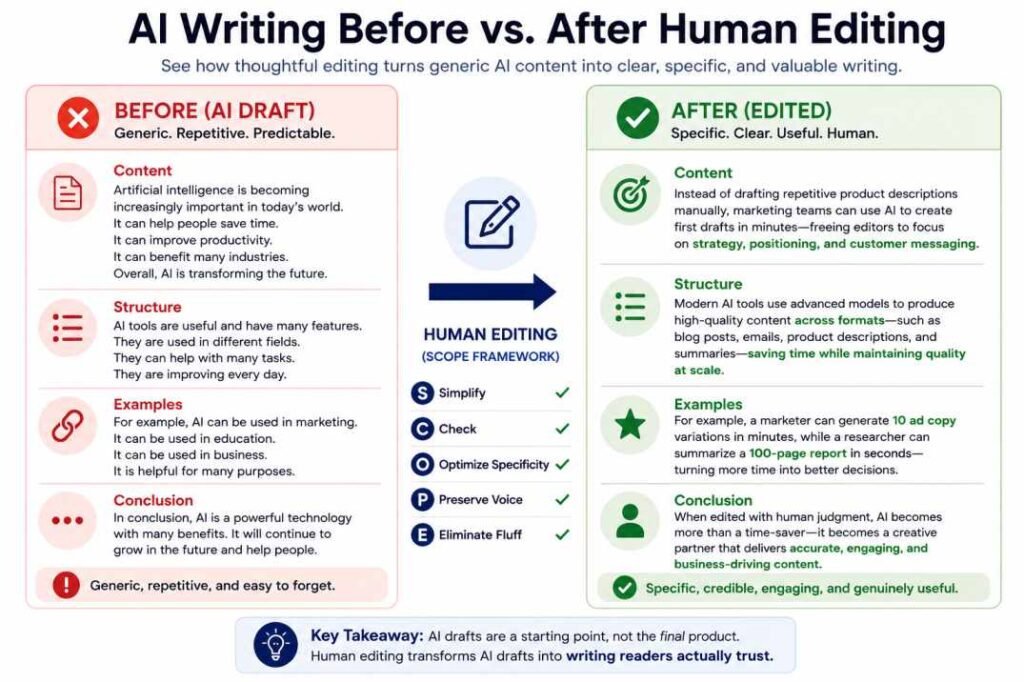
AI Slop Writing Examples: Before and After
The examples below illustrate common AI-slop patterns in writing. They are editorial examples, not evidence that any particular text was generated by AI.
Understanding the definition of AI slop is helpful, but seeing real examples makes the concept much easier to recognize.
The examples below compare common AI writing patterns with carefully edited versions. They illustrate how specificity, sentence variety, and thoughtful editing can improve AI-generated content without requiring you to rewrite an entire article from scratch.
Example 1 — Replace Generic Claims with Specific Information
Before: AI improves productivity by helping people work faster and more efficiently.
Why this can feel like AI slop: The sentence makes a broad positive claim without telling the reader which tasks become faster, for whom, or under what conditions. The problem is not that the sentence is false; it is that the information density is low.
After: AI can reduce repetitive administrative work, such as summarizing documents or drafting routine responses, when the output is reviewed before use.
Why this works: The revision names specific tasks and includes a review condition, making the claim more concrete without implying that AI improves every task in every situation.
Example 2 — Remove Repetitive Ideas
Before: Good prompts help AI produce better results. Better prompts also improve output quality. High-quality prompts usually generate better responses.
Why this can feel like AI slop: The three sentences repeat essentially the same idea—better prompts lead to better results—without adding new information. The repetition increases length but does not increase meaning.
After: Well-structured prompts provide clearer instructions, making AI responses more consistent and easier to evaluate.
Why this works: The edit removes repeated claims and retains the central point in one concise sentence.
Example 3 — Improve Sentence Rhythm
Before: AI can save time. AI can improve efficiency. AI can increase productivity. AI can support creativity.
Why this can feel like AI slop: The sentence structure is repetitive, with the same subject and pattern repeated four times. Each statement is also broad, so the paragraph sounds formulaic rather than informative.
After: AI can save time on repetitive work, improve drafting efficiency, and support creative exploration—but only when the output is reviewed critically before publication.
Why this works: The revised sentence combines related ideas and adds a qualification about reviewing the output before publication.
Example 4 — Add Real Context
Before: AI sometimes produces generic answers.
Why this can feel like AI slop: The sentence states a common problem but gives the reader no explanation of when or why it happens. Without context, the statement remains generic and provides little actionable information.
After: Generic answers often appear when prompts lack clear constraints, sufficient context, or a well-defined objective.
Why this works: The revision adds possible causes of generic answers, giving the reader a more actionable explanation.
Example 5 — Improve the Conclusion
Before: AI is a useful tool when used correctly.
Why this can feel like AI slop: The sentence ends with a broad conclusion but does not explain what “used correctly” means. It gives the reader a general statement without a specific takeaway or useful insight.
After: AI-assisted drafting is rarely the core issue; the problem is often publishing raw, unedited text that lacks human judgment and specific context. Careful editing can make a fast first draft clearer, more specific, and easier for readers to evaluate.
Why this works: The revised conclusion gives a practical editorial takeaway instead of making a broad claim about AI being useful.
The Goal Is Better Writing, Not Better AI Detection
For editorial purposes, a more useful question than ‘Was AI used?’ is whether the finished content is specific, accurate, useful, and supported by meaningful information.
They are much more likely to ask:
- Was this useful?
- Did I learn something new?
- Can I trust the information?
- Would I recommend this article to someone else?
These questions are much better indicators of whether your content will actually help the reader. Therefore, your editing process should focus on improving reader value, not simply on trying to fool AI detection tools.
Optional Learning Resource: AI-Assisted Writing Editing
Affiliate Disclosure: We may earn a commission if you purchase through our referral link. This does not affect our independent editorial analysis.
Portions of the editing concepts discussed in this article were informed by an educational editing demonstration from Joshua Lisec. The SCOPE Framework, experimental analysis, and examples presented in this guide were independently developed by AI Tools Usage Guide.
The resource is optional and is not part of the experiments reported in this article. It is included for readers who want to see another practical approach to editing AI-generated drafts.
This educational demonstration shows an example of editing an AI-generated draft for clarity, specificity, and reader value.
[View the optional editing resource →]
Final Thoughts & Your Next Step
AI assistance does not, by itself, determine whether an article is useful or low quality. The finished content matters: its accuracy, specificity, evidence, relevance, and value to the reader.
Before publishing your next AI-assisted article, choose one section and review it with the SCOPE framework:
- Simplify repeated ideas and unnecessary wording.
- Check factual claims, citations, and assumptions.
- Optimize broad statements with relevant details and examples.
- Preserve genuine author experience and editorial judgment.
- Eliminate filler and conclusions that add no new value.
Do not invent firsthand experience or treat an editing pass as proof of factual accuracy. Verify important claims and make sure each section gives readers a clear reason to keep reading.
The goal is not to disguise AI assistance. It is to publish content that is accurate, useful, and worth the reader’s time.
Research Summary
Methodology and Scope
This guide combines documented AI behavior spot-checks with practical editorial examples. The experiments described in the article examine specific tasks, including prompt specificity, citation reliability, ambiguity handling, false-premise responses, and the SCOPE editing process.
The observations are limited to the models, prompts, sessions, and evaluation methods described in each experiment. The SCOPE framework and the before-and-after examples are editorial tools developed for this guide; they should not be interpreted as independently validated measures of writing quality.
Limitations
The experiments are small and exploratory. They do not establish universal behavior across AI systems, prove that a particular editing method will improve reader outcomes, or provide a formal benchmark of AI-generated writing. Some writing-quality judgments are subjective and may vary by evaluator, audience, topic, and editorial objective.
Readers should treat the experiment results as bounded observations, verify factual claims against appropriate sources, and use the editing framework as a practical review aid rather than a guarantee of accuracy or quality.
Continue Learning
If you’d like to understand the underlying AI behaviors that contribute to repetitive or low-value writing, these related guides explore common prompt and model failure patterns.
Appendix: EXP Methodology and Limitations
This section contains the documented test environments and limitations for the AI behavior observations referenced throughout this guide.
EXP-001: Prompt Specificity Test
- Model: ChatGPT | Test Date: 27 July 2026 | Prompts: 3
- Evaluation Criteria: Specificity, Practical Value, Audience Relevance
- Limitation: This observation is limited to the documented prompts and test conditions; it does not establish a universal effect size.
EXP-004: Citation Reliability Test
- Methodology: Examined how the model handled verifiable research citations versus unsupported citation requests.
- Limitation: This is evidence about the tested citation behavior under specific conditions, not proof that AI citations are universally unreliable.
EXP-007: Ambiguity Resolution Test
- Model: ChatGPT | Prompts: 3 sequential prompts
- Evaluation: Observational comparison of clarification behavior and avoidance of unsupported assumptions.
- Limitation: This test involved three documented ambiguous prompts; it does not establish a universal rule for how all AI systems behave with ambiguous input.
EXP-008: False Premise Detection Test
- Methodology: False-premise prompts were used to examine whether the model corrected the premise rather than simply accepting it.
- Limitation: The model’s correction itself is not independent verification of the underlying fact. Facts must still be verified externally.
Last Update: July 2026
- The 4 Prompting Moves That Fix Generic AI Output - September 12, 2026
- How to Evaluate AI Answer Reliability: A 7-Step Verification Framework - August 9, 2026
- AI Memory vs. Context Window: Why Most People Confuse Them (And Why It Matters) - July 23, 2026