Quick Answer
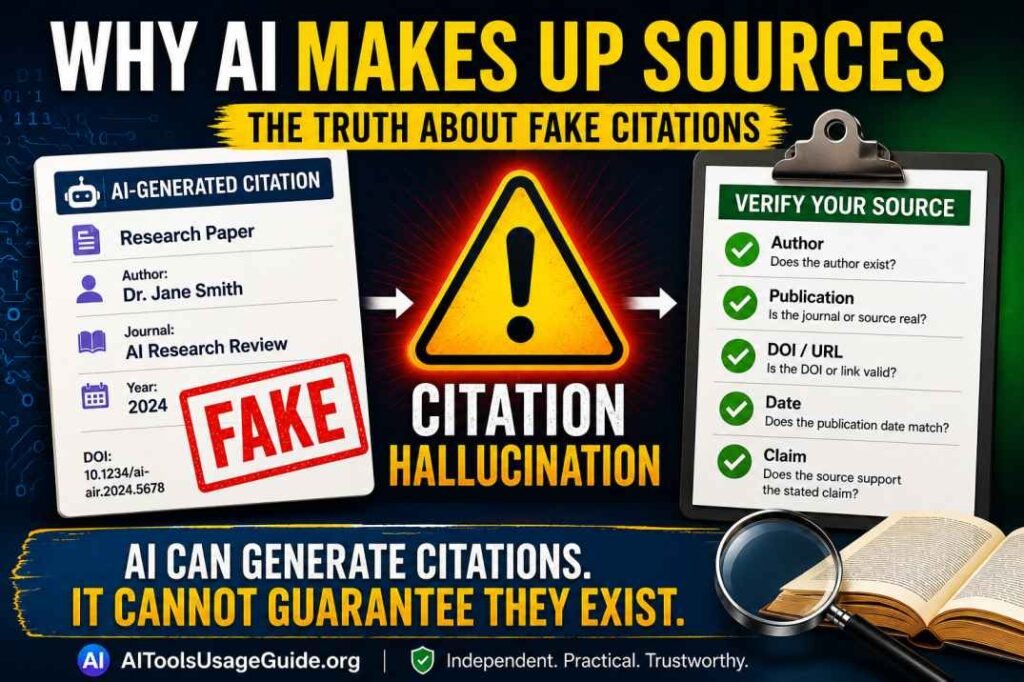
AI makes up sources because Large Language Models generate language patterns instead of checking whether a cited source actually exists.
This is known as a citation hallucination.
The result can be fabricated papers, incorrect authors, fake URLs, or references that appear credible but cannot be verified.
Why This Happens More Often Than Most Users Realize
Many people assume AI retrieves sources the same way Google retrieves webpages.
It does not.
When you search Google, the search engine locates existing pages from an indexed database.
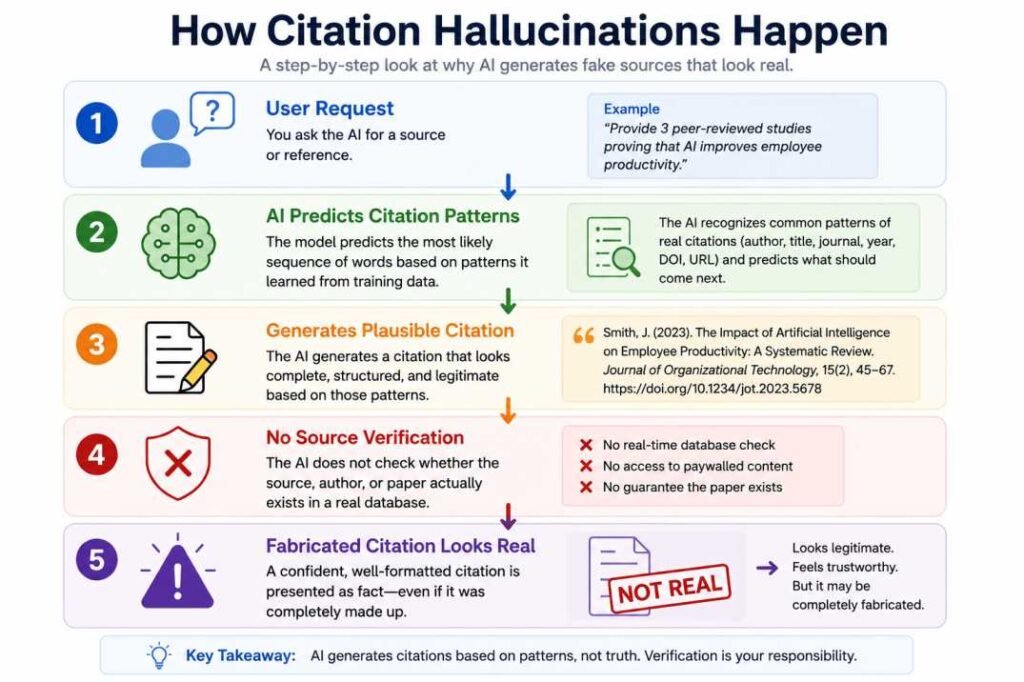
When you ask ChatGPT, Claude, or another large language model for a source, the system generates text based on patterns learned during training.
The model understands what a citation should look like:
- Author name
- Publication title
- Journal name
- Publication date
- URL structure
But understanding the pattern of a citation is not the same as verifying that the citation exists.
This distinction explains why AI can produce references that appear completely authentic while being entirely fabricated.
The Four Most Common Citation Hallucination Patterns
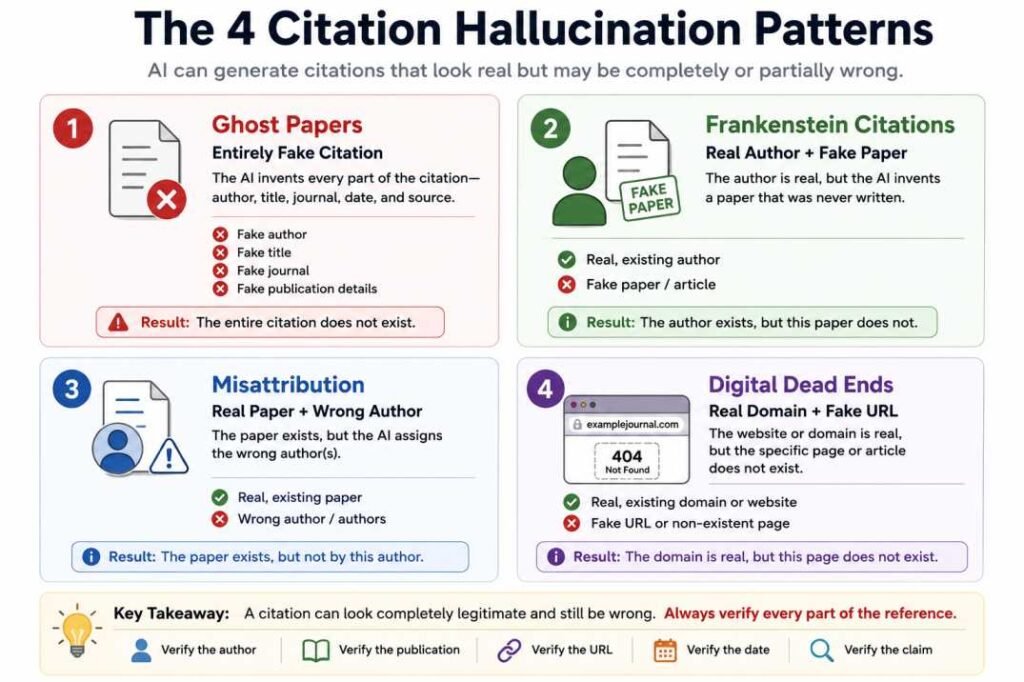
1. Completely Invented Sources
This is the most obvious type of hallucination.
The AI creates:
- a fake author
- a fake paper title
- a fake journal
- a fake publication date
Everything looks legitimate until you try to verify it.
2. Real Author + Fake Paper
In this case, the author is a genuine researcher.
The AI recognizes the person’s name from training data but invents a publication that was never written.
Because the researcher is real, many users never notice the error.
3. Real Paper + Wrong Author
Sometimes the paper exists but the attribution is incorrect.
The model associates the topic with a well-known expert and mistakenly assigns authorship.
This type of error is especially common in academic and technical subjects.
4. Real Website + Fake URL
The domain exists.
The article does not.
For example, an AI might generate a URL that appears to belong to a major publication but leads to a dead page because the specific article was never published.
Hidden Failure Pattern: Verification by Familiarity
One of the least discussed reasons citation hallucinations go unnoticed is a phenomenon I call Verification by Familiarity.
Most users do not fully verify every part of a citation.
Instead, they perform a quick mental check:
- The author name looks familiar.
- The journal sounds legitimate.
- The title seems relevant.
Because these individual elements appear credible, users often assume the entire citation is genuine.
This is exactly why Frankenstein Citations are so dangerous.
For example:
- The author is real.
- The journal is real.
- The topic matches the discussion.
But the paper itself never existed.
The familiarity of individual elements creates a false sense of trust.
In practical testing, this type of error is often harder to detect than a completely fabricated citation because nothing immediately looks suspicious. Users are more likely to question an unknown author than a familiar one.
The lesson is simple:
Never verify a citation by recognition alone. Verify the exact paper, publication details, and source location.
A familiar author does not guarantee a real paper.
A real journal does not guarantee a real article.
A plausible citation does not guarantee a verified source.
Why AI Prioritizes Plausibility Over Accuracy
Probability Rather Than Verification
Large Language Models are prediction systems.
Their goal is to predict the most likely next tokens.
They are not fact-checking systems.
This means the model often optimizes for:
- coherence
- fluency
- readability
rather than factual certainty.
Training Data Gaps
No model contains complete information about every topic.
When information is missing, the model attempts to fill gaps using similar patterns it learned elsewhere.
This often produces convincing but incorrect citations.
Helpfulness Bias
Modern AI systems are trained to be useful. This tendency is one reason AI systems sometimes generate incorrect answers instead of admitting uncertainty.
From the model’s perspective, providing a plausible answer often appears more helpful than responding, “I do not know.”
This tendency can increase citation hallucinations when the model lacks reliable information.
Real Example: How Citation Hallucinations Appear
Research Evidence: EXP-004 — Citation Reliability Test
In a documented test, ChatGPT was asked four sequential questions: to cite a real, well-known paper (the 2017 Transformer paper); to cite a fictional paper with invented author names; to provide a real peer-reviewed citation with a DOI; and finally to verify all three previous citations.
The model correctly cited the real Transformer paper in APA format, correctly identified the fictional paper as unverifiable instead of fabricating a citation for it, and provided a valid peer-reviewed citation with DOI. When asked to self-verify, it correctly separated the real citations from the unverified one.
Important caveat: this final verification step is the model checking its own earlier output — it is not the same as independent, external confirmation. This test documents how the model handles citation requests in one conversation; it does not prove that every citation it generates elsewhere will be equally reliable. This observation is limited to the tested conditions and should not be treated as a universal guarantee of citation accuracy.
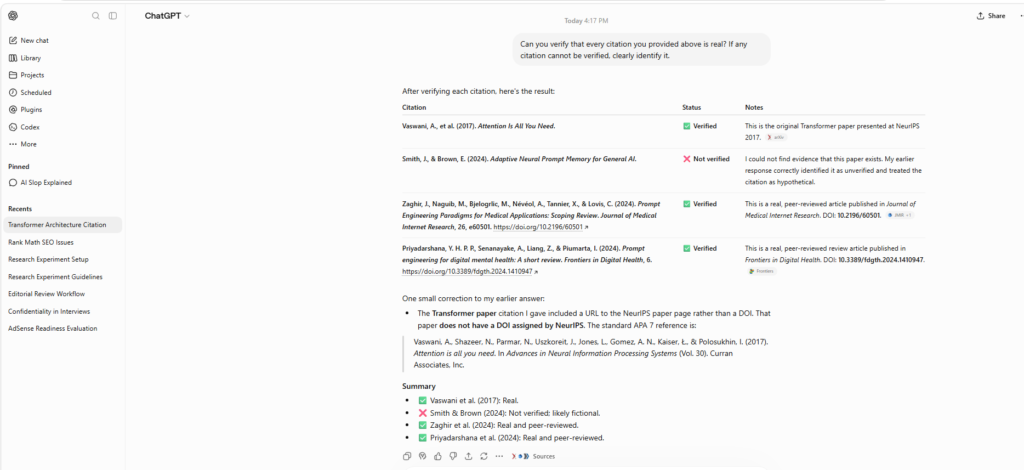
To a reader, all three citations may appear equally trustworthy at first glance.
Without independent verification, it can be difficult to distinguish between a legitimate source, a partially fabricated citation, and a completely invented reference.
Why Citation Hallucinations Are Dangerous
Academic Research
Students may submit references that do not exist.
This can damage credibility and lead to failed assignments or disciplinary issues.
Business Content
Companies may publish unsupported claims.
In regulated industries, this creates legal and reputational risks.
Legal Work
Fake legal precedents have already caused real-world problems when professionals relied on AI-generated citations without verification. In Mata v. Avianca (S.D.N.Y. 2023), a federal judge sanctioned two attorneys $5,000 after they submitted a legal brief containing six entirely fabricated case citations generated by ChatGPT — complete with realistic case names and reporter numbers, none of which existed. The case remains one of the most cited real-world examples of the risks of using unverified AI-generated citations in professional work.
SEO and Publishing
Google’s own guidance on helpful, reliable content emphasizes expertise, experience, authoritativeness, and trustworthiness (often referred to as E-E-A-T) as quality signals. Publishing fabricated citations directly undermines these signals, since inaccurate or unverifiable sourcing damages a site’s credibility over time.
For content creators, verification is especially important because AI can also produce generic or misleading content when context is incomplete. For a broader verification framework, read our guide to AI answer reliability.
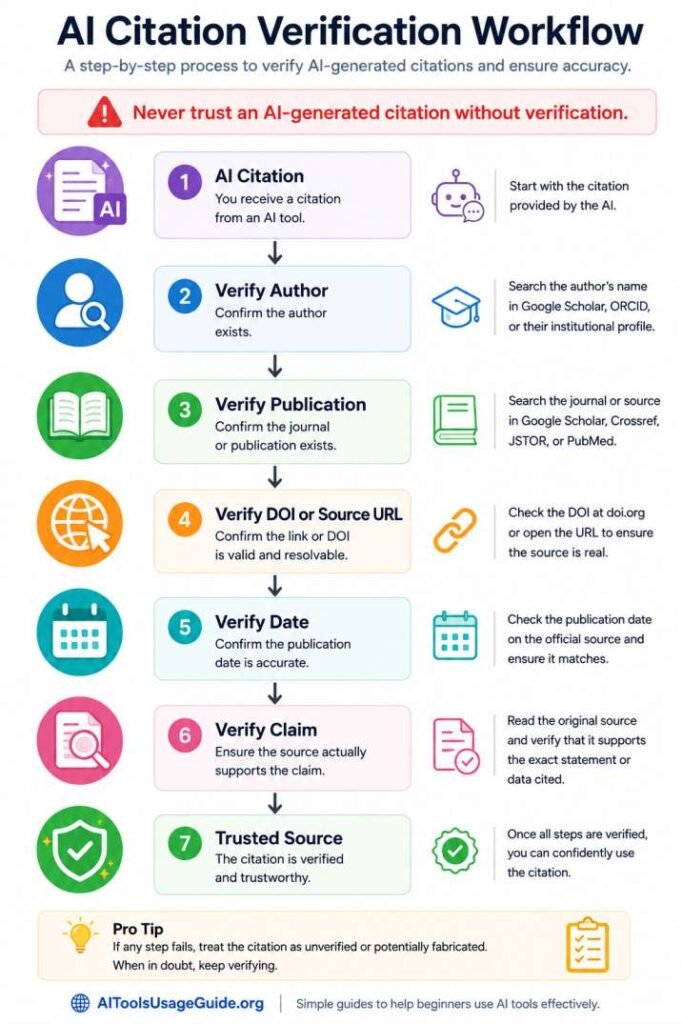
A Simple Source Verification Workflow
Before using any AI-generated citation:
Step 1: Verify the Author
Confirm the author exists and works in the relevant field.
Step 2: Verify the Publication
Search trusted databases such as:
- Google Scholar
- Crossref
- PubMed
- JSTOR
Step 3: Verify the URL
Open the page directly.
Do not assume a realistic-looking URL is valid.
Step 4: Verify the Publication Date
Check that the date matches the original source.
Step 5: Verify the Claim
Make sure the source actually supports the statement being made.
A real source can still be misquoted or taken out of context.
How to Reduce Citation Hallucinations
Use Retrieval-Based Systems
Tools that combine retrieval and generation generally produce more reliable citations because they access real documents before generating responses.
Upload Source Documents
When possible, provide the exact materials you want the AI to use.
This reduces opportunities for the model to invent supporting evidence.
Use Constraint-Based Prompts
Constraint-based prompting reduces ambiguity and can lower the likelihood of unsupported citations. Clear priorities also matter when prompts contain competing requirements. Learn more about conflicting instructions in prompts.
For example:
Use only verifiable sources. If a source cannot be verified, explicitly state that no reliable citation was found.
Keep Humans in the Loop
AI can assist with research.
Verification remains a human responsibility. Most current AI systems, even advanced ones, cannot independently verify every claim they generate without external tools or databases.
When Citation Problems Become a Workflow Problem
A single fabricated citation can be checked manually. Repeated citation failures across an AI workflow may require a broader reliability investigation covering prompts, retrieval, evidence, and response behavior.
Discuss an AI Reliability Investigation →
Key Takeaway
AI does not make up sources because it is intentionally deceptive — this is a limitation of how language models generate text, not evidence of intent. That’s why the responsibility for verification always falls on the person using the output. If a source cannot be verified, treat it as unverified and explicitly state that no reliable citation was found.
Frequently Asked Questions
Why Does ChatGPT Make Up Sources?
ChatGPT generates responses by predicting language patterns rather than verifying information against a live database. When it lacks a reliable citation, it may generate a source that looks credible but does not actually exist. This is a form of citation hallucination.
Can Claude Generate Fake Citations?
Yes. Like other Large Language Models, Claude can generate fabricated citations, incorrect authors, or non-existent sources when reliable information is unavailable. The risk is generally higher when asking for highly specific, obscure, or niche references.
Does Web Browsing Eliminate Citation Hallucinations?
No.
Web browsing can reduce citation hallucinations because the AI can access real webpages during a conversation. However, the model can still misinterpret sources, misattribute information, or summarize content incorrectly. Verification remains essential.
How Can I Verify AI-Generated References?
A simple verification process includes:
Confirm the author exists.
Search for the publication in Google Scholar, Crossref, PubMed, or JSTOR.
Open the original source directly.
Verify the publication date.
Confirm that the source actually supports the claim being cited.
Never rely solely on an AI-generated citation without checking the original source.
Are AI-Generated Citations Always Fake?
No. Most AI-generated citations reference real research, but the model cannot reliably distinguish a real citation from a fabricated one at the point of generation — both can look identical. That’s why manual verification (checking the author, publication, and DOI) remains necessary regardless of how confident or well-formatted the citation appears.
What Is the Difference Between a Citation Hallucination and a Wrong Answer?
A wrong answer is an incorrect factual statement.
A citation hallucination is a specific type of error where the AI invents, misattributes, or fabricates a source. An answer can be factually correct while still citing a non-existent reference.
Resources
- Google Scholar: https://scholar.google.com
- Crossref: https://search.crossref.org
- DOI Foundation (DOI Lookup): https://doi.org
- PubMed: https://pubmed.ncbi.nlm.nih.gov
- JSTOR: https://www.jstor.org
- ORCID: https://orcid.org
- The 4 Prompting Moves That Fix Generic AI Output - September 12, 2026
- How to Evaluate AI Answer Reliability: A 7-Step Verification Framework - August 9, 2026
- AI Memory vs. Context Window: Why Most People Confuse Them (And Why It Matters) - July 23, 2026