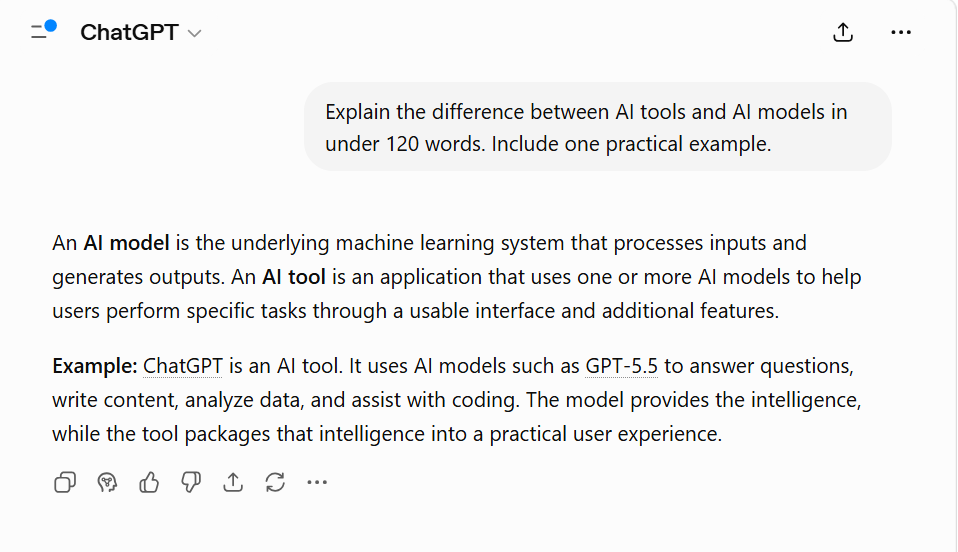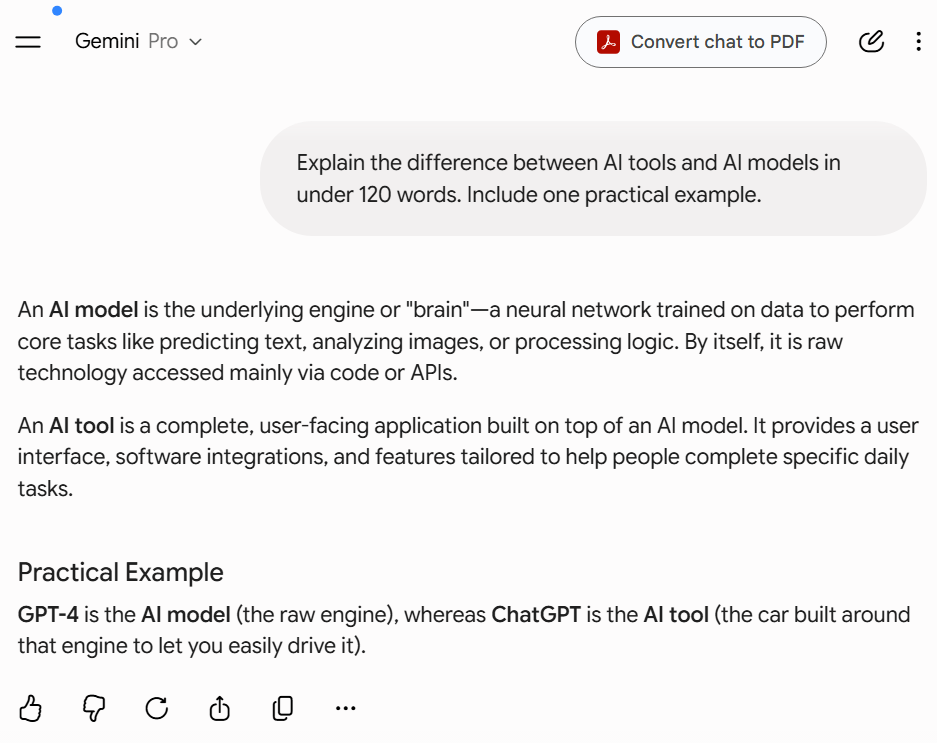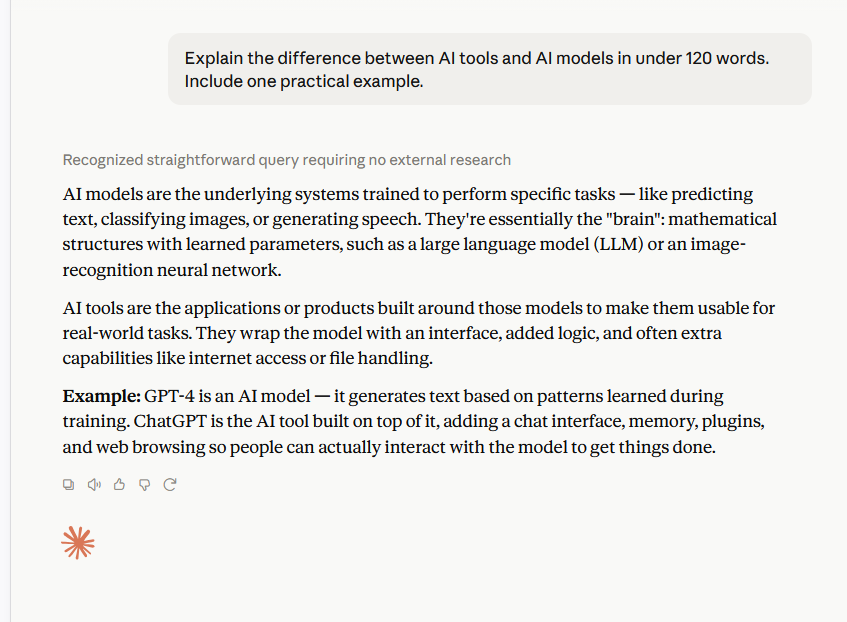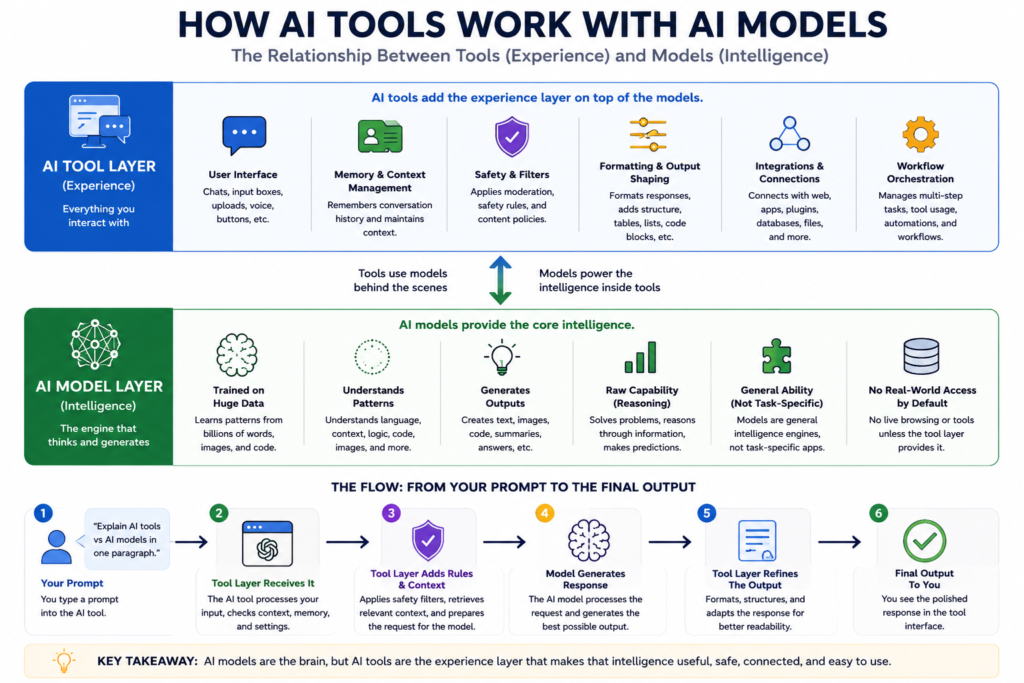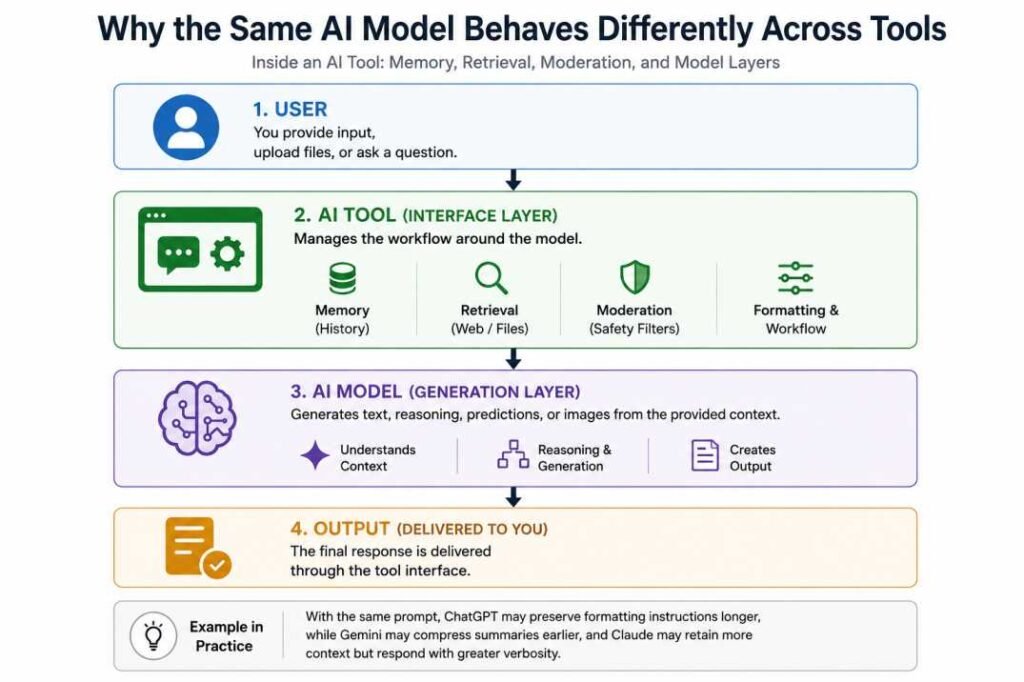
Within contemporary AI system architecture, the terms “AI tools” and “machine learning models” refer to structurally distinct layers.
Introduction
Artificial intelligence discourse frequently compresses multiple architectural layers into simplified terminology. References to “AI tools” and “machine learning models” are often treated as equivalent descriptors, despite representing different structural positions within a system. For analytical clarity, these terms must be situated within their respective layers of composition rather than interpreted through surface-level functionality. The distinction between AI Tools vs Machine Learning Models concerns architectural scope rather than computational capability.
Within a layered system architecture, a machine learning model occupies the computational core. It operates as an encapsulated inference mechanism whose boundaries are defined by input parameters, learned weights, and output mappings. It does not inherently contain interface logic, workflow sequencing, persistence layers, or access controls. These elements exist externally to the model artifact.
In practical terms, this distinction means that when individuals interact with an AI tool, they are engaging with a coordinated system of layers rather than directly with the underlying model artifact.
An AI tool, by contrast, is positioned at a higher architectural layer. It functions as an integration container that embeds one or more models within an orchestrated operational structure. This structure may include task framing mechanisms, request routing, data preprocessing modules, output formatting components, and environmental constraints. The distinction emerges from containment boundaries and coordination scope rather than from differences in computational sophistication.
A clarifying distinction emerges at the boundary of execution context: a model performs inference when invoked, whereas a tool defines the conditions under which invocation occurs. The boundary between invocation and execution context establishes distinct accountability domains and governance surfaces. Analytical precision requires maintaining this architectural boundary throughout system evaluation.
Conceptual Framing
AI Systems as Layered Architectures
Artificial intelligence systems are structured as multi-layered constructs rather than singular computational entities. Each layer performs a distinct role within the broader system, and analytical clarity depends on recognizing these separations.
At the outermost level, the interface layer governs human-system interaction. This layer manages input capture, output presentation, and interaction constraints. It does not perform statistical inference; instead, it structures communication between users and underlying components.
Beneath the interface, the orchestration layer coordinates system behavior. This layer defines task sequencing, request routing, conditional logic, and integration between services. It determines how and when computational components are invoked, and may also manage state, logging, or validation mechanisms.
The model layer resides below orchestration. It contains the trained computational artifacts responsible for inference. This layer processes structured inputs and produces outputs according to learned parameters. It does not inherently regulate workflow progression or user interaction patterns.
These layers operate interdependently, but they remain structurally distinct. Confusion arises when the entire layered construct is labeled using terminology that properly refers only to one internal component. This mislabeling often occurs in public discussions where the visible interface is assumed to represent the entirety of the system.

Position of Machine Learning Models Within AI Systems
Within this layered structure, machine learning models operate as computational inference engines. Their scope is confined to parameterized inference based on previously established training configurations. They transform inputs into outputs through internal statistical representations.
A critical structural distinction lies in the separation between inference logic and user-facing execution. Inference logic is encapsulated within the model artifact itself. User-facing execution, however, is governed by external layers that manage how inputs are prepared, how outputs are formatted, and under what conditions the model is called.
Operational context is established by higher architectural layers rather than by the model itself. It is invoked by higher-level system components that regulate access, enforce constraints, and determine workflow positioning. This placement establishes the model as a contained computational unit within a broader architectural system rather than as a complete operational entity.
Definition and Structural Role of Machine Learning Models
Computational Core
Within an AI system, the machine learning model functions as the computational core. It is structured as a parameterized artifact derived from statistical learning procedures. During training, the model internalizes patterns from data through optimization processes that adjust weights or coefficients according to defined objective functions. The resulting artifact encodes these learned parameters in a fixed configuration suitable for inference.
Statistical learning mechanisms may include supervised, unsupervised, or reinforcement-based paradigms. Regardless of method, the outcome is a bounded computational object capable of transforming structured inputs into probabilistic or deterministic outputs. The model itself does not retain the procedural steps of training; rather, it contains the finalized parameter state produced by that process.
Training artifacts—such as weight matrices, token embeddings, feature mappings, or gradient-derived adjustments—constitute the internal structure of the model. These artifacts define its inference behavior but do not extend beyond computational transformation.
Model Scope and Boundaries
The scope of a machine learning model is limited to input–output mapping. It accepts defined input formats and produces outputs according to its learned parameterization. This mapping is executed within a controlled inference environment and does not inherently include task framing, session management, or user interaction handling.
The model’s behavior is dependent on training data characteristics. Its representational capacity reflects the statistical properties of the data used during training, including distributional patterns and encoded relationships. However, verification of data provenance, access policy enforcement, and deployment regulation occur beyond the boundaries of the model artifact.
A defining structural boundary lies in the absence of workflow logic. Invocation timing, post-processing procedures, and presentation formatting are defined within orchestration and interface layers. Those responsibilities reside in higher architectural layers. Consequently, the model remains a bounded computational unit embedded within a broader operational structure.
Definition and Structural Role of AI Tools
System Composition
An AI tool is structured as an integrated system that incorporates one or more machine learning models within a broader operational framework. Unlike a standalone model artifact, the tool encompasses multiple coordinated components, including user interface elements, orchestration logic, service layers, and data storage mechanisms. These components function collectively to enable controlled interaction with embedded computational models.
Integration occurs through defined interfaces that connect model inference endpoints to higher-level services. The orchestration layer governs request routing, input preprocessing, output transformation, and conditional execution. Storage components may retain configuration data, session state, logs, or intermediate artifacts, depending on system design. The model remains a core component, but it operates within this coordinated structure rather than independently. For a breakdown of the layered composition discussed here, see core structural components of AI tools.
Workflow coordination is a defining characteristic of the tool layer. The system determines how tasks are sequenced, how dependencies are resolved, and how multiple components interact during execution. This coordination establishes procedural context around the model’s inference capabilities. In multi-model configurations, orchestration layers may coordinate several specialized models within a single operational container. In such cases, structural responsibility remains at the tool layer, while each embedded model retains its bounded computational scope.
Operational Context
AI tools operate within a defined human interaction layer. This layer structures how inputs are captured, constrained, and transmitted to underlying services. It may include validation mechanisms, formatting standards, and access controls that regulate how the system is used.
Task framing is handled at the tool level rather than within the model itself. The tool defines how user intent is interpreted, how requests are categorized, and how outputs are formatted for presentation. Constraint handling—such as rate limiting, policy enforcement, or domain-specific boundaries—is likewise managed externally to the model.
This separation establishes a structural distinction: the model performs computation, while the tool governs execution context. The AI tool therefore represents an operational container that situates machine learning models within a controlled and interpretable system architecture.
Structural Comparison
| Dimension | AI Tool | Machine Learning Model |
|---|---|---|
| Architectural Scope | System-level construct integrating multiple layers | Bounded computational artifact within a system |
| Human Interface | Includes user interaction layer and presentation components | Does not contain interface mechanisms |
| Workflow Logic | Defines sequencing, routing, and execution conditions | Lacks inherent task sequencing or orchestration |
| Dependency on Training Data | May depend on model training data indirectly | Directly parameterized by training data characteristics |
| Governance Surface | Encompasses access control, logging, deployment policy, and data handling | Limited to model evaluation, versioning, and training data governance |
| Deployment Context | Operates as an application or service environment | Deployed as an inference endpoint or embedded component |
The structural comparison highlights differences in architectural breadth rather than functional capability. The AI tool operates at the system level, encapsulating interaction layers, orchestration logic, and integration mechanisms. The machine learning model remains confined to computational transformation within that system. This distinction also informs discussions on how AI tools differ from traditional software systems.
A key distinction emerges in governance surface area. Operational oversight mechanisms extend beyond the model artifact at the tool layer, whereas model-level governance concentrates on training provenance, parameter integrity, and evaluation benchmarks.
Deployment context further reinforces the separation. A tool is instantiated as an operational environment that coordinates components, while a model is deployed as a contained computational endpoint invoked by higher-level processes. The API or service layer further illustrates this boundary, functioning as the integration interface through which models are accessed while remaining structurally distinct from user-facing orchestration logic.
Taken together, these distinctions reflect differences in containment scope, coordination responsibility, and accountability surfaces rather than differences in computational capability. Unlike the model artifact, which remains parameter-bound once trained, the tool layer may evolve through configuration changes, interface adjustments, and deployment modifications.
Workflow Architecture Distinctions
Model as Component
Within workflow architectures, a machine learning model is positioned as an embedded component inside a larger processing pipeline. It is invoked at defined stages where computational inference is required. Upstream components prepare structured inputs, while downstream components interpret or transform outputs for subsequent processing.
The model itself does not define pipeline sequencing. It executes inference when called and returns results according to its parameterized structure. Its placement is therefore dependent on external orchestration mechanisms that regulate execution timing and data flow. The positioning of models within pipelines is further examined in how AI tools are positioned within workflows.
In many implementations, models operate in stateless contexts during inference. Each request is processed independently without intrinsic memory of prior interactions. Where state is required—such as session continuity or contextual accumulation—state management is handled externally by surrounding system layers rather than embedded within the model artifact itself. This separation reinforces the model’s role as a computational unit rather than a workflow controller.
Tool as Workflow Container
An AI tool functions as the workflow container that governs how computational components are coordinated. It defines orchestration logic, including request routing, conditional branching, task segmentation, and integration with auxiliary services.
Input validation and formatting layers operate before inference is triggered. These layers ensure that user-provided data conforms to expected schemas and constraints. Input structuring, sanitization, and transformation processes are executed within preprocessing components of the tool environment.
Output rendering is likewise managed at the tool level. After inference, results may be reformatted, filtered, contextualized, or presented through a user interface. The model provides computational output, but the tool defines how that output is incorporated into a broader interaction flow.
Architectural responsibility is distributed across layers: bounded inference occurs at the model level, while pipeline governance resides within the tool architecture.
In distributed architectures, models may be deployed as containerized services accessed through internal APIs. In such configurations, the separation between model artifact and tool orchestration becomes observable at network boundaries, where inference endpoints operate independently of user-facing systems. A broader definitional overview appears in what is an AI workflow.

Governance and Accountability Boundaries
Governance structures differ depending on whether the analytical focus is placed on the machine learning model or on the AI tool as an operational system. The divergence corresponds to variations in system scope and accountability domains, not to differences in inference mechanics. These governance distinctions align with standards-based system risk frameworks that differentiate between model lifecycle controls and operational system oversight responsibilities. The workflow distinctions discussed earlier provide the structural foundation for these governance separations.
Understanding these distinctions is necessary when assigning responsibility for system behavior, as oversight mechanisms apply differently to computational artifacts and operational environments. Governance boundaries at the system level are also contextualized in AI tools explained — conceptual foundations, system logic, and institutional context.
Model-Level Governance
Governance at the model layer concentrates on the integrity and traceability of the computational artifact. Primary considerations include training data provenance, which refers to the origin, composition, and representational characteristics of datasets used during model development. Documentation of data sources and preprocessing procedures establishes traceability within the training lifecycle.
Evaluation and benchmarking frameworks constitute another governance layer. These mechanisms assess performance characteristics under defined testing conditions and establish comparative baselines across model iterations. Benchmarking does not regulate deployment behavior directly but supports internal validation of parameterized inference behavior.
Model version control addresses the management of successive parameter configurations. Each trained instance represents a distinct artifact with specific weights and evaluation outcomes. Version tracking enables reproducibility, rollback procedures, and controlled updates within system environments.
Collectively, these elements govern the integrity and traceability of the computational core without extending to broader operational controls.
Tool-Level Governance
At the system layer, governance mechanisms address the operational environment in which models are deployed. Access control mechanisms regulate who may invoke the system, under what permissions, and within which operational constraints. These controls apply to interfaces, APIs, and administrative configurations.
Logging and monitoring mechanisms document system activity, including invocation frequency, request characteristics, and execution outcomes. These records support operational oversight and accountability within deployed environments.
User data handling policies govern how input data is stored, processed, retained, or discarded. These policies exist outside the model artifact and are enforced through infrastructure and orchestration layers.
Deployment policies further define where and how the system operates, including environmental constraints, update procedures, and compliance boundaries. Unlike model-level governance, which focuses on parameter integrity and evaluation traceability, tool-level governance encompasses runtime behavior and systemic accountability.
Governance obligations expand in proportion to architectural scope: computational artifacts require lifecycle oversight, whereas operational systems require runtime and deployment controls.
Boundary Misinterpretations in Public Discourse
Public discussions frequently compress layered system structures into simplified terminology. As a result, references to “AI tools” and “machine learning models” are often treated as interchangeable descriptors. This linguistic overlap obscures architectural boundaries that are structurally significant.
Conflation of Tools and Models
A common structural misunderstanding arises when the computational model is described as the complete system. In such cases, the inference engine is implicitly equated with the interface, orchestration logic, storage mechanisms, and deployment infrastructure that surround it. This conflation collapses multiple architectural layers into a single conceptual unit.
Another form of confusion occurs when system-level behaviors—such as access restrictions, logging policies, or task sequencing—are attributed directly to the model. These behaviors originate in orchestration and infrastructure layers rather than within the model artifact itself. When the model is treated as the agent responsible for system-wide operations, the layered architecture becomes analytically indistinct.
Such conflation reduces clarity regarding containment relationships: the model is embedded within a tool, but the tool is not reducible to the model.
Implications for System Design Clarity
Architectural mislabeling has direct implications for system interpretation. When models and tools are not distinguished, design discussions may overlook the role of integration layers.
As a result, representations of system composition can become incomplete. This affects documentation accuracy and reduces precision in communication among technical and governance stakeholders.
Governance ambiguity also emerges when accountability boundaries are blurred. Model-level concerns—such as parameter evaluation and training data provenance—may be incorrectly merged with operational responsibilities such as user data management or deployment oversight. Without explicit separation, responsibility surfaces become diffuse.
Maintaining terminological precision preserves structural transparency. Clear differentiation between models and tools supports accurate architectural mapping and coherent governance delineation across system layers.
Structural Summary
The preceding analysis distinguishes between two structurally different entities within AI systems.
A machine learning model is a computational learning artifact. It consists of parameterized representations derived from statistical training procedures and is confined to executing input–output inference within defined boundaries. Its scope is limited to computational transformation and does not inherently include workflow coordination, user interaction management, or deployment governance.
An AI tool is an operational system that integrates one or more models within a broader architectural framework. It encompasses interface layers, orchestration logic, validation mechanisms, storage components, and infrastructure controls. The tool defines execution context, regulates access, and coordinates system behavior around embedded models.
The separation between these entities is grounded in system architecture rather than in functional performance characteristics. Both may contribute to intelligent behavior within a system, but they occupy different structural layers. The model constitutes a contained computational component, whereas the tool operates as the system-level container that organizes and governs that component.
References
National Institute of Standards and Technology (NIST).
Artificial Intelligence Risk Management Framework (AI RMF 1.0).
Gaithersburg, MD: NIST, 2023.
https://www.nist.gov/itl/ai-risk-management-framework
OECD.
OECD AI Principles.
Organisation for Economic Co-operation and Development, 2019 (updated 2022).
https://oecd.ai/en/ai-principles
IEEE.
IEEE 7000™-2021 — Model Process for Addressing Ethical Concerns During System Design.
Institute of Electrical and Electronics Engineers, 2021.
https://standards.ieee.org/standard/7000-2021.html
ISO/IEC JTC 1/SC 42.
ISO/IEC 23894:2023 — Artificial Intelligence — Risk Management.
International Organization for Standardization, 2023.
https://www.iso.org/standard/77304.html
European Commission.
Ethics Guidelines for Trustworthy AI.
High-Level Expert Group on Artificial Intelligence, 2019.
https://digital-strategy.ec.europa.eu/en/library/ethics-guidelines-trustworthy-ai
National Institute of Standards and Technology (NIST).
Secure Software Development Framework (SSDF) SP 800-218.
NIST Special Publication 800-218, 2022.
https://csrc.nist.gov/publications/detail/sp/800-218/final