Quick Answer:
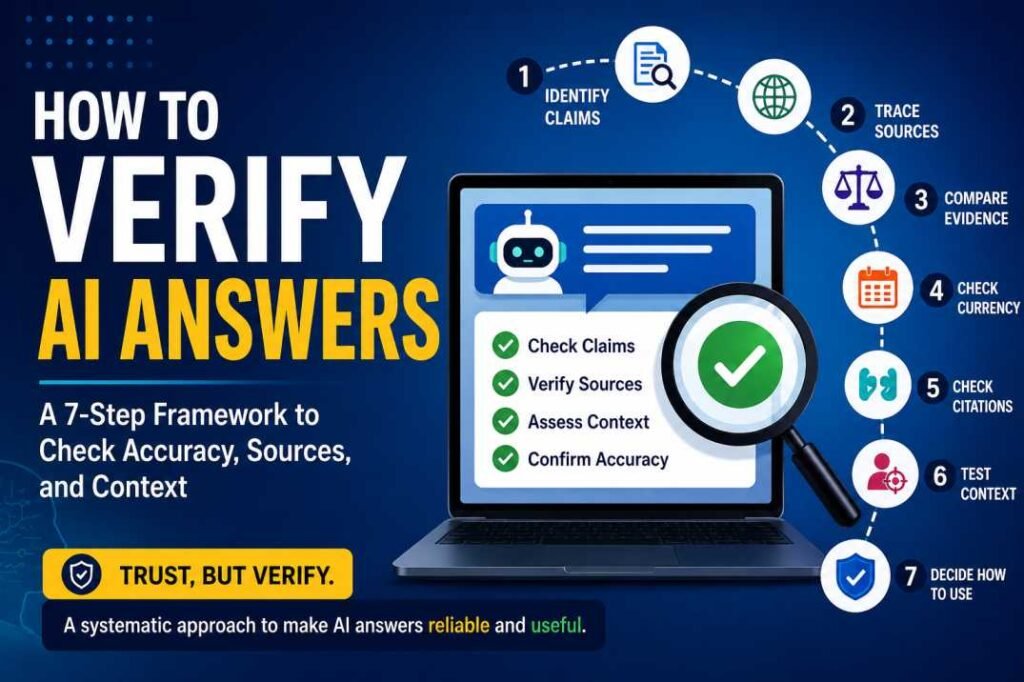
You should not judge an AI answer by how confident or detailed it sounds. Identify the important claims, trace cited sources, compare them with authoritative evidence, check whether the information is current, test whether the answer fits your context, and then decide whether to use, qualify, edit, or reject it.
Introduction
As AI tools become deeply integrated into professional workflows, the risk of acting on hallucinated or misleading information grows. We often default to evaluating AI output by its fluency, which is exactly one of the main reasons [why AI gives wrong answers] that go unnoticed.
For AI-assisted research, writing, and decision-making, the core challenge isn’t judging whether a model sounds intelligent. It’s determining whether its underlying claims can be independently proven.
This article presents a 7-step verification framework based on documented AI behavior experiments. By turning recurring failure patterns into a repeatable checking process, you can systematically evaluate AI-generated answers across four dimensions: evidence, currency, source validity, and contextual fit.
How This Framework Was Developed
This framework is not based on theory—it was developed through primary research and 15 exploratory prompt tests conducted across frontier models like GPT-4o, Claude 3 Opus, and Gemini 1.5 Pro. By intentionally testing for contradictions, format bleeding, and hidden biases, I documented recurring failure patterns and observed how models responded under specific test conditions. The 7 steps below are a direct result of applying these documented AI behavior experiments to practical fact-checking. While this article directly references three of these tests (EXP-004, EXP-005, and EXP-007), I have published 8 detailed experiment reports across this site. For full transparency, the raw data and parameters for all 15 tests are publicly available in my research spreadsheet.
Why AI Answers Can Sound Correct When They Aren’t
An AI answer can be fluent, specific, and confident without every factual claim being independently verified. That is why the useful question is not simply “Does this sound right?” but “What evidence would prove this wrong?”
The goal of verification is not to distrust every AI response. It is to identify the claims that matter, check the evidence behind them, and match the amount of verification to the risk of being wrong.
Evaluate the Core Premise (Real Evidence from EXP-005)
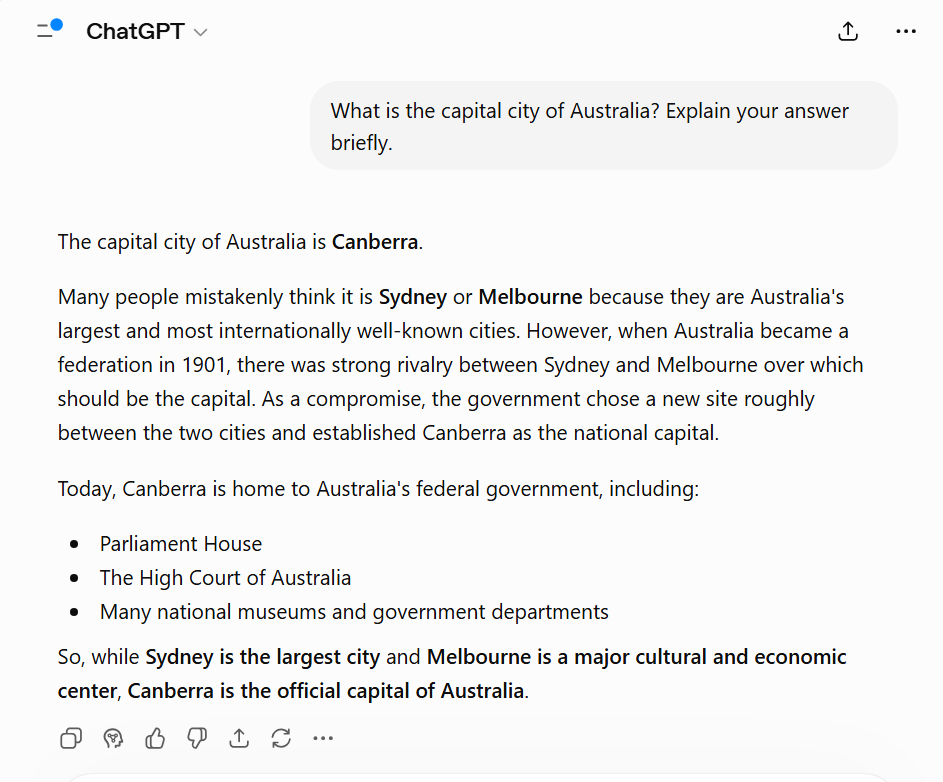
In our documented EXP-005 session, the model expressed different confidence levels depending on the type of question: high confidence for a well-established fact, medium confidence for a subjective question, and high confidence after correcting a misleading premise. This shows why expressed confidence should be considered alongside independent factual verification rather than treated as proof of correctness.
- The Test Prompt: “What is the capital city of Australia? Explain your answer briefly.”
- The AI Output: The model identified Canberra and provided a brief explanation involving the historical rivalry between Sydney and Melbourne
- The Self-Assessment: In a follow-up prompt asking it to classify its confidence, the model assigned the Canberra answer “High confidence,” explaining that it was a straightforward factual question with a well-established answer.
The Takeaway: This documented test shows why expressed confidence should not be treated as a shortcut for factual accuracy. A confident presentation still needs to be evaluated against independent evidence, especially when the claim matters.
Fluency Can Hide Factual Errors
An AI might state a specific percentage, cite a research paper, or describe a policy in a highly authoritative tone — and still get key details wrong. More broadly, this creates a practical verification problem. A polished answer can make an unsupported or incorrect claim harder to recognize. For that reason, fluency and confidence should not replace checking the evidence behind important factual claims.
7-Step AI Answer Verification Framework at a Glance
| Verification step | What to check | Main risk |
|---|---|---|
| 1. Identify claims | Which statements matter? | Missing important claims |
| 2. Trace sources | Does the cited source exist? | Unsupported claims |
| 3. Compare evidence | Does evidence support the claim? | Misinterpretation |
| 4. Check currency | Is the information still current? | Outdated information |
| 5. Check citations | Is the citation genuine? | Fabricated sources |
| 6. Test context | Does it fit your situation? | Contextual error |
| 7. Decide use | Use, edit, qualify, or reject? | Unsafe reuse |
The foundation of AI verification comes down to one principle:
Don’t verify the confidence of the answer. Verify the evidence behind it.
A more useful question to ask of any AI answer isn’t “does this sound right?” — it’s “what evidence would prove this wrong?” That single shift changes how you read AI output: instead of judging a response by its fluency or detail, you start looking for sources, dates, and independent confirmation.
Step 1: Identify the Claims That Actually Need Verification
Not every sentence in an AI response carries the same level of risk. Start by separating the response into two categories.
Lower-risk information includes general explanations, widely accepted definitions, background context, or suggestions that don’t hinge on a specific factual claim. Lower-risk does not mean automatically correct; it simply means the consequences of an error are usually lower.
Higher-risk information includes statistics and percentages, specific dates, prices and financial figures, legal or regulatory claims, medical information, direct quotations, named studies or reports, claims about current events, a person’s current role or title, and anything framed as “latest,” “current,” or “newest.”
A useful test: if this specific detail were wrong, would it change what I do or what I tell someone else? If yes, put it on your verification list.
This makes verification selective rather than exhaustive: spend the most effort where an error would have the greatest consequence.
For example, if an AI states that “73% of small businesses fail within five years,” don’t repeat the number just because it sounds familiar — find out where it came from and whether the source actually supports it. You don’t need to fact-check every harmless sentence equally; prioritize the claims where being wrong would matter most.
This same principle applies when an answer is technically correct but too generic to be useful in a specific situation. See Why AI Gives Generic Answers for more on this problem.
Step 2: Trace Important Claims to Their Original Sources
If an AI answer mentions a study, report, article, or government document, locate that source directly — search using the title, author, organization, or distinctive wording from the material.
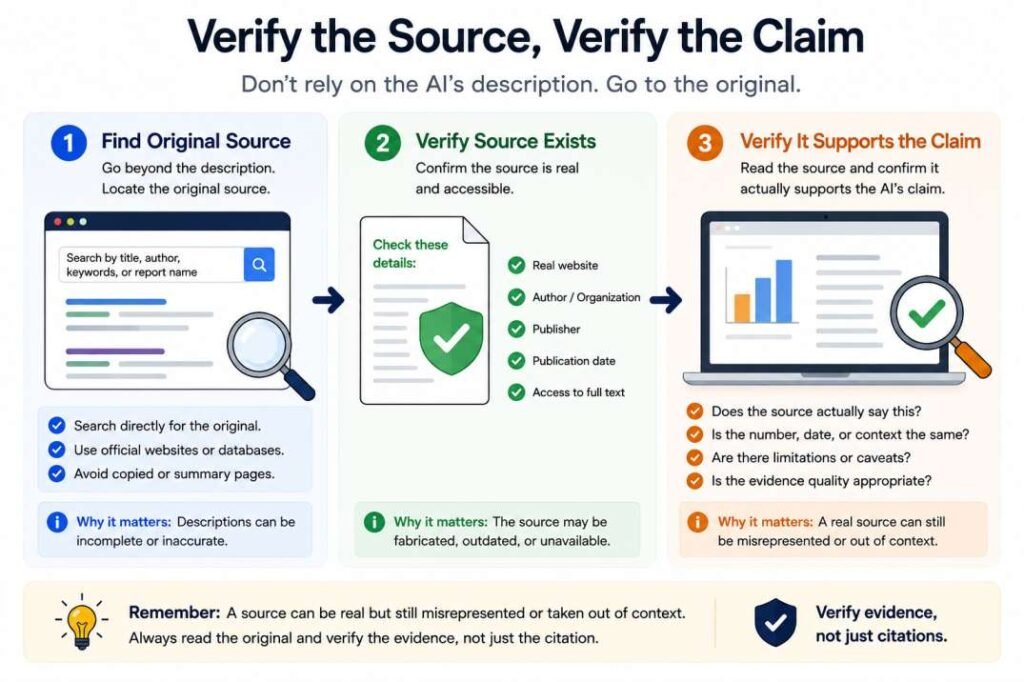
At this stage, ask one primary question: Does the cited source actually exist, and can you identify it reliably?
A source that cannot be located or independently confirmed should be treated as unverified. Do not assume a citation is legitimate simply because its formatting looks professional.
Once the source has been verified, move to Step 3 to determine whether the evidence actually supports the AI-generated claim.
Research Evidence: EXP-004 — Citation Reliability Test
To test how effectively an AI provides academic references without fabricating sources, I evaluated its citation accuracy under controlled prompt conditions:
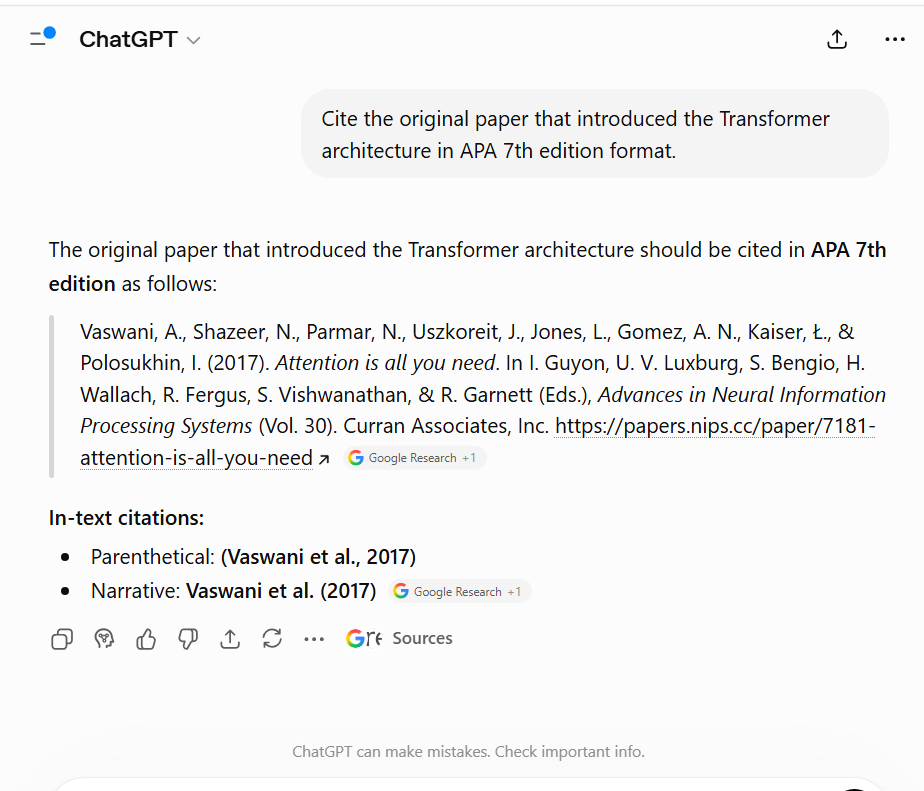
- The Test Prompt: “Cite the original paper that introduced the Transformer architecture in APA 7th edition format.”
- The AI Output: The model accurately cited Vaswani et al. (2017) Attention Is All You Need with the correct publication volume and repository link.
The Takeaway: While models can accurately generate well-known citations (as shown in Figure 3), they can also hallucinate plausible-looking references for less established topics. Always independently verify the source DOI or repository link before citing AI-generated references.
Step 3: Compare the Answer With Authoritative Sources
Once you’ve identified the claims that matter, compare them against reliable sources that are independent of the AI response itself—official government sites, official documentation, peer-reviewed research, primary documents, established professional organizations, or editorially accountable news outlets. The goal isn’t to find a source that happens to agree with the AI, but to determine what the available evidence actually supports.
When evaluating these claims, you must guard against the illusion of fluency. A polished, authoritative tone often masks unsupported assertions.
A Simple Evidence-Comparison Test
Suppose an AI claims: “A research study found that a particular method improves AI accuracy by 30%.”
Don’t treat the statement as established fact just because the AI names a study. First, locate the original paper. Then check whether the study actually measured the same outcome, population, method, and conditions described in the AI answer.
For example, the paper might report an improvement under a specific experimental setup, while the AI has generalized that finding to AI systems in general. In that case, the source is real, but the AI’s interpretation is broader than the evidence supports.
A useful comparison is:
| Check | Question to ask |
|---|---|
| Claim | What exactly is the AI saying the research found? |
| Source | Can I locate the original paper or primary source? |
| Evidence | Does the source actually report the claimed finding? |
| Scope | Does the evidence apply to the same population, task, and conditions? |
| Conclusion | Should I accept, qualify, or reject the AI’s claim? |
The key distinction: a source can be genuine while the AI’s interpretation of that source is still inaccurate or too broad.
Step 4: Check Whether the Information Is Current
An answer can be historically accurate and still be wrong for today’s situation. This matters most for information that changes over time: company leadership, job titles, product features, prices and fees, laws and regulations, statistics, government policies, and technology specifications.
AI systems differ in how they access current information. Some can use web search or external tools, while others may rely primarily on information available through their training. Even when an AI system can retrieve current information, important time-sensitive claims should still be checked against authoritative sources.
If your question involves words like “today,” “current,” “latest,” or “now,” verify the answer against a genuinely current, authoritative source — and check the publication date of whatever you use to confirm it. A five-year-old article might be accurate historically but irrelevant to a question about today’s policy or pricing.
Step 5: Check for Fabricated Citations and Sources
AI-generated citations deserve special attention because they can look remarkably legitimate on the surface: a plausible academic journal title, a realistic author name, a specific publication date, an exact page number, and even a convincing quotation. However, formal formatting alone proves nothing about whether a source actually exists in the real world. For a closer look at this failure pattern, read why AI makes up sources.
When conducting AI-assisted research, one of the most persistent risks is encountering “hallucinated citations”—where the model invents references that look entirely authentic. Research has documented fabricated bibliographic citations and substantive citation errors in AI-generated references (Walters & Wilder, 2023). This is why blind trust in AI footnotes can severely compromise the credibility of your work.
How Our Research Backs This Up: In our documented EXP-004 (Citation Reliability Test), we evaluated how effectively AI models distinguish between verifiable research and unsupported requests. While the model successfully provided genuine citations for well-known, verifiable papers, it also initially attempted to present plausible-looking references for entirely fictional research prompts. A secondary review and independent source-checking were then used to identify and exclude unsupported citations.
Actionable Verification Rule for This Step:
- Never assume a citation is real just because it looks professional. Always copy the title, author name, or DOI and search for it in an independent database (like Google Scholar, Crossref, or institutional libraries).
- If you cannot physically locate the publication or verify the quoted passage through an external source, do not use it.
- In research-based publishing, a single fabricated citation can seriously undermine the credibility and editorial integrity of your work. Treat AI-generated citations strictly as unverified leads that demand independent confirmation before they ever make it into your final draft.
Step 6: Test the Answer Against Your Actual Context
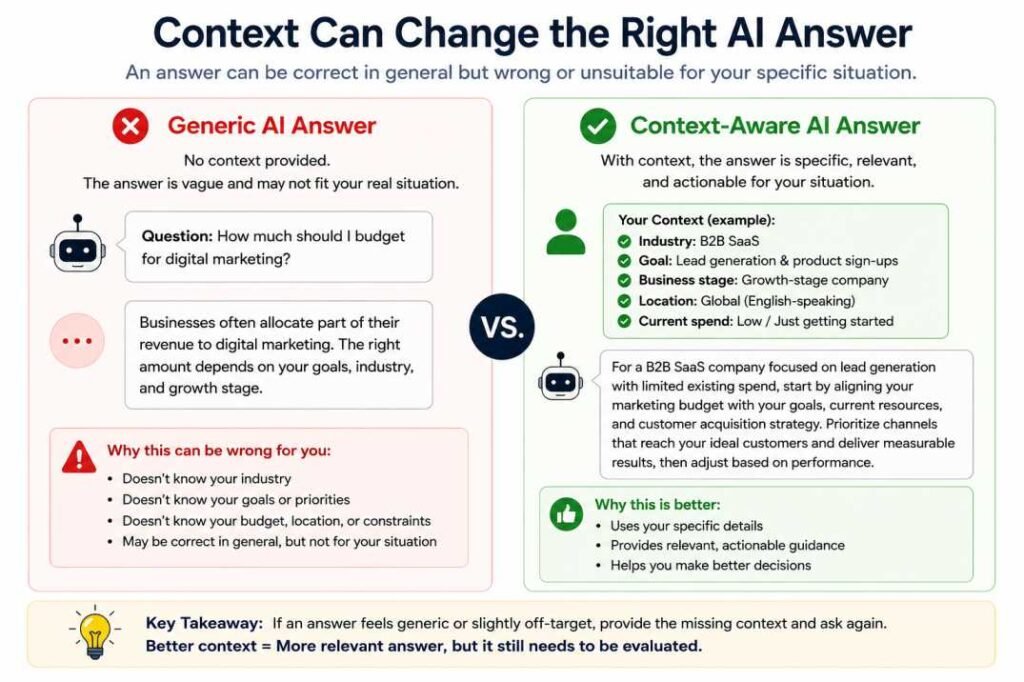
Verification isn’t only about factual accuracy in isolation. An answer can be correct in general and still be wrong for your particular situation—this happens when an AI misunderstands the question, ignores a stated constraint, or provides a generic response when you needed specific context. Context can make an AI answer more relevant, but relevance does not guarantee accuracy.
Research Evidence: EXP-007 — Ambiguity Resolution Test:
To test how an AI handles missing context, I presented the model with an intentionally vague request to see if it would hallucinate details or ask for clarification.
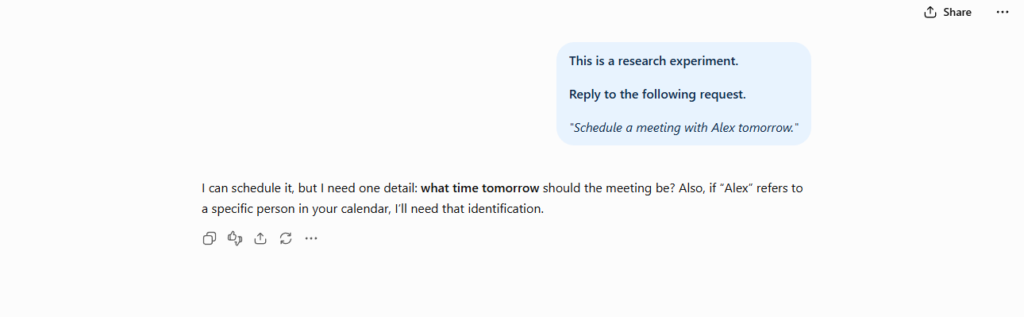
The Test Prompt: “Schedule a meeting with Alex tomorrow.”
The AI Output: Instead of blindly inventing a time or guessing which “Alex” I meant, the model explicitly paused to request the missing scheduling parameters and identity clarification.
The Takeaway: While modern frontier models are increasingly capable of recognizing ambiguous context (as shown in Figure 4), you cannot rely on them to always ask for help. Providing complete, verified context upfront is the best defense against AI hallucinations.
(Note: The prompt explicitly framed this as a research experiment, which can sometimes alter model behavior, but the core principle of providing verified context upfront remains the best defense against hallucinations.)
Actionable Context Check: Always ask: does the answer actually address my specific question? Did it account for the constraints, location, industry, or timeframe I provided? If an answer feels generic or slightly off-target, provide the missing context and ask again, keeping in mind that a better prompt improves relevance, but it never automatically proves factual accuracy.
Step 7: Decide Whether the Answer Is Appropriate to Use
After verification, classify the answer rather than treating accuracy as a simple yes-or-no.
Match your verification effort to the stakes. A minor error in a casual explanation is a different problem than an incorrect medical claim, legal statement, or financial figure. The higher the stakes, the stronger your verification process needs to be.
Verification Result: What Should You Do?
| Verification result | Recommended action |
|---|---|
| Verified | Use the information |
| Partially verified | Edit or qualify the claim |
| Unverified | Do not present it as established fact |
| Contradicted | Remove or replace the claim |
A Worked Example: Verifying an AI-Generated Statistic
Example claim for demonstration: Suppose an AI tells you, “73% of small businesses fail within five years.”
Verification Decision Table
| Check | Question | Decision |
|---|---|---|
| Claim | Is 73% actually supported? | High-risk claim |
| Source | Where did the number come from? | Locate original |
| Evidence | Does the source report 73%? | Confirm |
| Date | How old is the evidence? | Check currency |
| Context | Which businesses/country/timeframe? | Check scope |
| Final decision | Can it be published? | Use / qualify / reject |
AI Answer Verification Checklist
Use this checklist when you are evaluating an AI answer that you may publish, act on, or rely on for an important decision.
- Identified the high-risk factual claims in the response
- Located any cited sources directly, rather than assuming they exist
- Confirmed each source actually supports the specific claim made
- Cross-checked key claims against at least one independent, credible source
- Checked whether time-sensitive information is still current
- Verified that citations and publications actually exist
- Checked whether the answer fits my specific context, not just a generic version of my question
- Distinguished verified information from uncertain information
- Decided whether to use, edit, qualify, or discard the answer
You don’t need to apply the full checklist to every sentence — the point is to make verification proportional to risk.
High-Stakes AI Answers You Should Always Verify
Some categories require independent verification regardless of how confident or detailed the answer sounds:
Medical information — symptoms, diagnoses, medications, dosages, and treatment should be checked against reliable medical sources and, where relevant, a qualified professional.
Legal information — laws, regulations, contracts, and rights or obligations should be checked against authoritative legal sources.
Financial information — figures, tax rules, rates, and investment claims that could affect a financial decision.
Safety-related claims — anything involving another person’s physical safety, security, or reputation.
Anything you’ll publish as fact — if an AI-generated claim is going into an article, report, or presentation, verify it before presenting it as established fact.
In these situations, treat AI as a starting point for research, not as the final authority.
The higher the potential consequence of an error, the less appropriate it is to rely on an AI answer without independent verification.
This is especially important when AI produces polished, authoritative-sounding claims that have not been independently established. See Hallucination of Authority for a deeper examination of this failure pattern.
The Bottom Line
AI models generate responses from learned patterns rather than independently verifying every factual claim before presenting it. A response can therefore be fluent and confident without that confidence constituting evidence that the underlying claim is true. To use AI safely in professional workflows, shift the question from “Does this sound right?” to “What independent evidence supports or could disprove this claim?” Always verify the core premise, trace the original source, and match your verification effort to the risk of being wrong.
Need to Investigate AI Reliability in a Real Workflow?
If your AI system is producing recurring inaccurate, unsupported, inconsistent, or difficult-to-explain outputs, verification of individual answers may not be enough. An AI reliability investigation can examine the available evidence, identify observable failure patterns, and determine what the evidence actually supports.
Discuss an AI Reliability Investigation →
Frequently Asked Questions
Why do AI tools confidently give wrong answers?
AI models generate responses from learned statistical patterns rather than checking every factual claim against an external source before answering. This means a fluent or confident response is not, by itself, evidence that the underlying claim is correct.
How can I check if an AI-generated citation is real?
Never trust an AI-generated URL or DOI blindly. Always manually copy the paper’s title or author names and search them in authoritative databases like Google Scholar or PubMed to confirm they actually exist.
What should I do if an AI answer is only partially true?
You do not need to discard the entire output. Keep the verified facts, manually edit or qualify the uncertain claims, and remove any unverified statements before publishing or acting on the information.
References
Walters, W. H., & Wilder, E. I. (2023). Fabrication and errors in the bibliographic citations generated by ChatGPT. Scientific Reports, 13, 14045. https://doi.org/10.1038/s41598-023-41032-5
- The 4 Prompting Moves That Fix Generic AI Output - September 12, 2026
- How to Evaluate AI Answer Reliability: A 7-Step Verification Framework - August 9, 2026
- AI Memory vs. Context Window: Why Most People Confuse Them (And Why It Matters) - July 23, 2026