
AI Failures Matrix: Understanding How AI Systems Fail
AI systems often fail in predictable ways. The AI Failures Matrix organizes these recurring behavior patterns into eight categories, helping users identify the type of failure, understand its likely cause, and apply an appropriate mitigation strategy.
Instead of evaluating prompts based on subjective interpretations, this tracking model isolates variations observed when explicit formatting rules clash with raw descriptive inputs within an active conversational stream.
AI Failures Matrix at a Glance
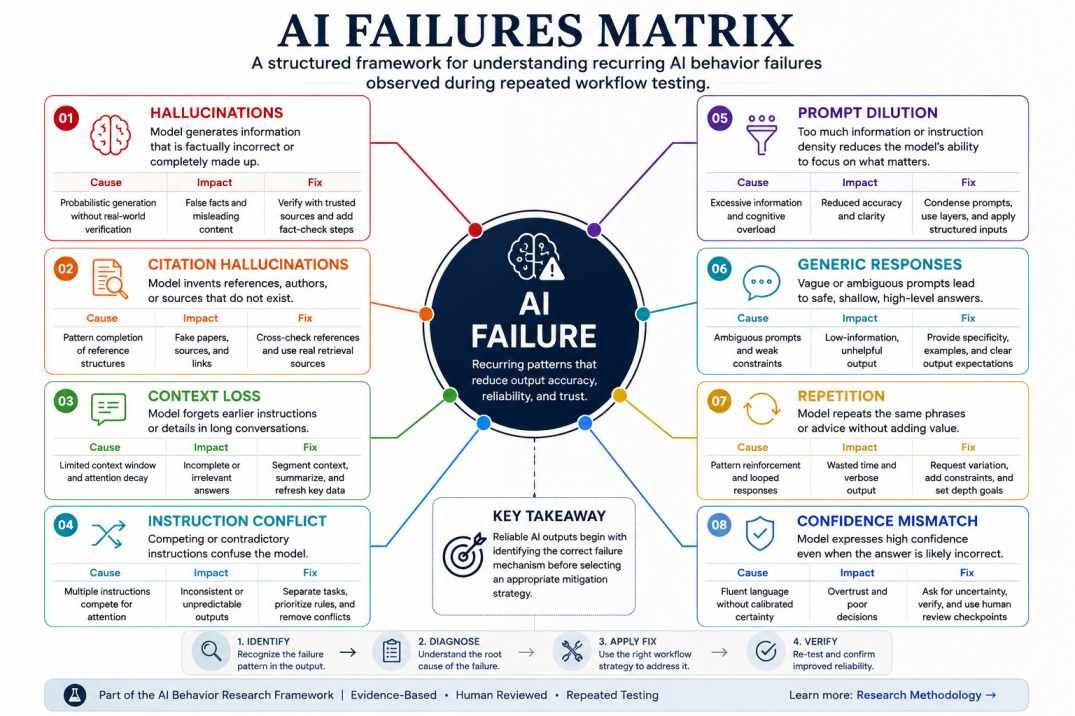
This framework summarizes the eight recurring AI behavior failures discussed throughout this guide. Each category links to a dedicated research article with detailed analysis and practical mitigation strategies.
Explore Each Failure
- Hallucinations → Why AI Gives Wrong Answers
- Citation Hallucinations → Why AI Makes Up Sources
- Context Loss → Why AI Loses Context in Long Conversations
- Instruction Conflict → Conflicting Instructions in Prompts
- Prompt Dilution → Prompt Dilution Explained
- Generic Responses → Why AI Gives Generic Answers
- Repetition → Why AI Repeats Itself
- Confidence Mismatch → Why AI Sounds Certain When Guessing
Why We Built This Matrix
Standard evaluation sets often obscure operational errors by relying on simple, single-turn benchmark checks. In real operational settings, workflows suffer when long instructions compete with massive target files within a single prompt iteration.
We developed this classification model to map these patterns through systematic, repeated workflow testing. By recording recurring behavior patterns across structured prompt evaluations, our studies map where instructions break down, providing a blueprint to improve consistency.
Primary Failure Classifications
Our tracking library groups text deviations into eight core categories based on recurring workflow observations:
| Failure Type | Primary Cause | User Impact | Research |
|---|---|---|---|
| Hallucinations | Probabilistic generation without verification | False facts and fabricated information | Why AI Gives Wrong Answers |
| Citation Hallucinations | Pattern completion of references | Fake papers and invented sources | Why AI Makes Up Sources |
| Context Loss | Limited context retention | Forgotten instructions | Why AI Loses Context in Long Conversations |
| Instruction Conflict | Competing prompt objectives | Inconsistent responses | Conflicting Instructions in Prompts |
| Prompt Dilution | Excessive instruction density | Reduced accuracy | Prompt Dilution Explained |
| Generic Responses | Ambiguous prompts or weak constraints | Low-information answers | Why AI Gives Generic Answers |
| Repetition | Pattern reinforcement | Recycled advice | Why AI Repeats Itself |
| Confidence Mismatch | Fluent language without calibrated certainty | Overtrust in incorrect answers | Why AI Sounds Certain When Guessing |
Instruction Degradation Trajectory
Observed behavior suggests that complex instruction structures can reduce consistency across repeated interactions, leading to constraint drops during generation tasks:
Methodology
Every classification marker mapped within this repository is vetted through a multi-step observational process. Rather than evaluating isolated runs, our framework evaluates behavioral patterns using the following guidelines:
- Classification Criteria: Failure items are categorized according to clear, repeatable symptoms such as forgotten constraints or synthetic reference generation.
- Repeated Observations: Test templates are executed across multiple distinct chat sessions to ensure noted anomalies are recurring rather than singular variations.
- Human Review: Every output log undergoes manual evaluation to document deviations between the initial request constraints and the generated result text.
- Cross-Session Consistency: Patterns must be verified across distinct model versions, including GPT-4o, Claude 3.5 Sonnet, and Gemini 1.5 Pro, to qualify for classification.
Research Integrity
This framework classifies observable AI behavior patterns mapped across multiple repeated system interactions. The proposed explanations reflect systematic data tracking loops and evidence-informed analysis rather than verified descriptions of proprietary internal model weights or commercial attention mechanisms. The framework is intended for educational analysis and does not describe the proprietary internal implementation of any specific AI model.
Related Research
Explore the supporting studies behind the AI Failures Matrix. Each document examines a specific operational failure through high-frequency testing and verified trace analysis.
Why AI Gives Wrong Answers
Understand why models generate incorrect information, how hallucinations develop, and which verification strategies improve output reliability.
Why AI Makes Up Sources
Learn why systems invent citations and references, how citation hallucinations occur, and practical methods for verifying generated links.
Why AI Loses Context in Long Conversations
Explore how context windows affect processing memory, why instructions disappear, and how structured design minimizes context drift.
Conflicting Instructions in Prompts
Discover how competing rules reduce response quality and how structured prompt isolation balances performance across complex workflows.
Prompt Dilution Explained
Understand why overloaded instructions reduce generation accuracy and how layered boundaries keep systems focused on critical rules.
Why AI Gives Generic Answers
Learn why probability arrays produce vague responses and discover configuration frameworks that force specific, evidence-backed outputs.
Why AI Repeats Itself
Examine sequence loops where networks reinforce common patterns, and learn how prompt structures reduce word loops.
Why AI Sounds Certain When Guessing
Explore the calibration mismatch phenomenon and learn why fluent linguistic arrays appear highly confident even when incorrect.